Blog
Domestic Helper Medical Expenses in Singapore: Who Pays and What Is Covered?

Executive Summary
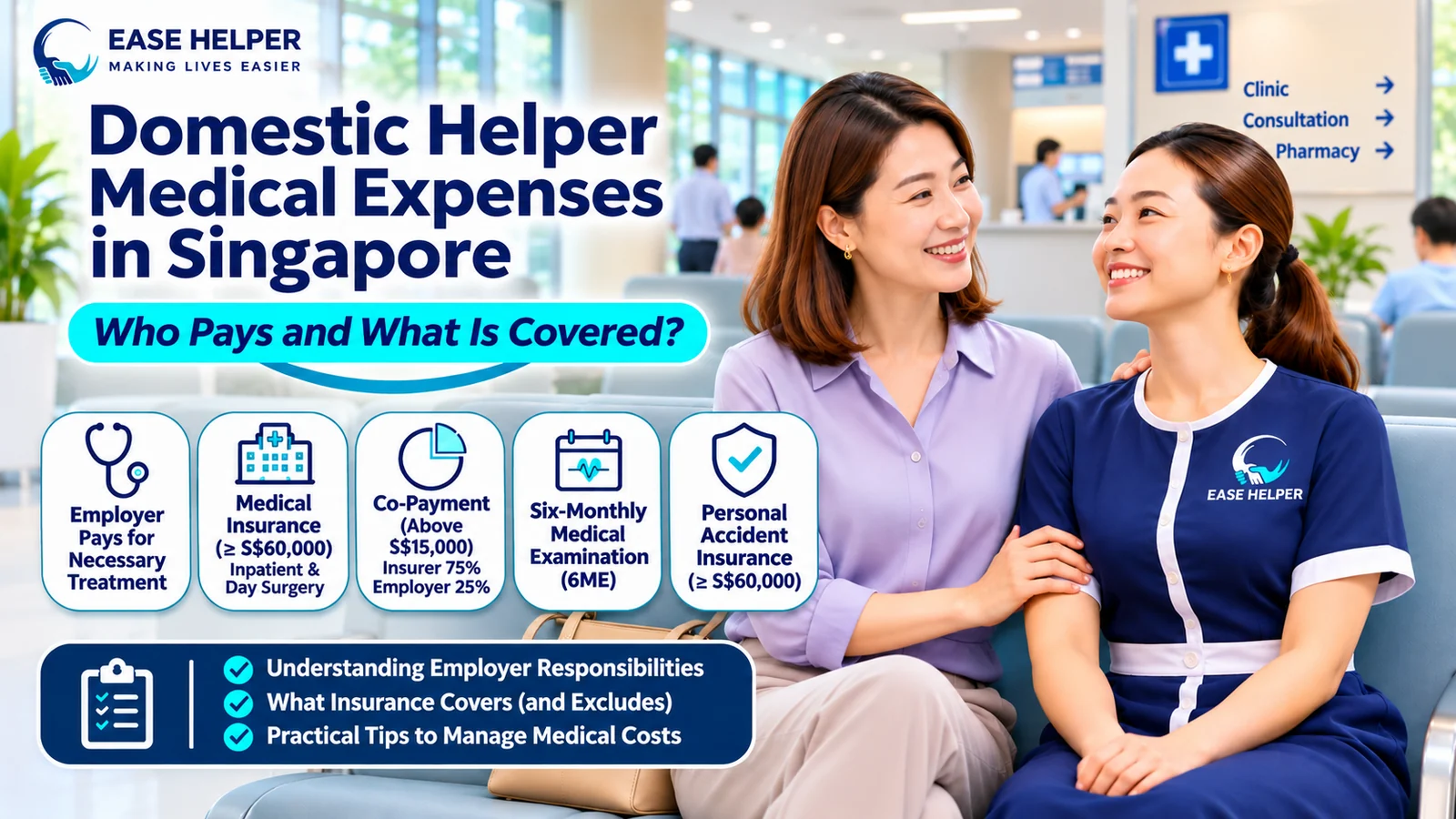
Who pays for a domestic helper’s medical expenses in Singapore? Under Ministry of Manpower (MOM) requirements, employers must pay for necessary medical treatment during the helper’s employment in Singapore. This includes doctor consultations, hospitalisation and mandatory medical examinations. Employers must also purchase medical insurance with at least S$60,000 in annual inpatient and day surgery coverage, alongside personal accident insurance. However, insurance does not necessarily cover every expense. This guide explains medical costs, policy limits, co-payments, exclusions and practical ways to manage healthcare responsibilities.
Who Is Responsible for Domestic Helper Medical Expenses in Singapore?
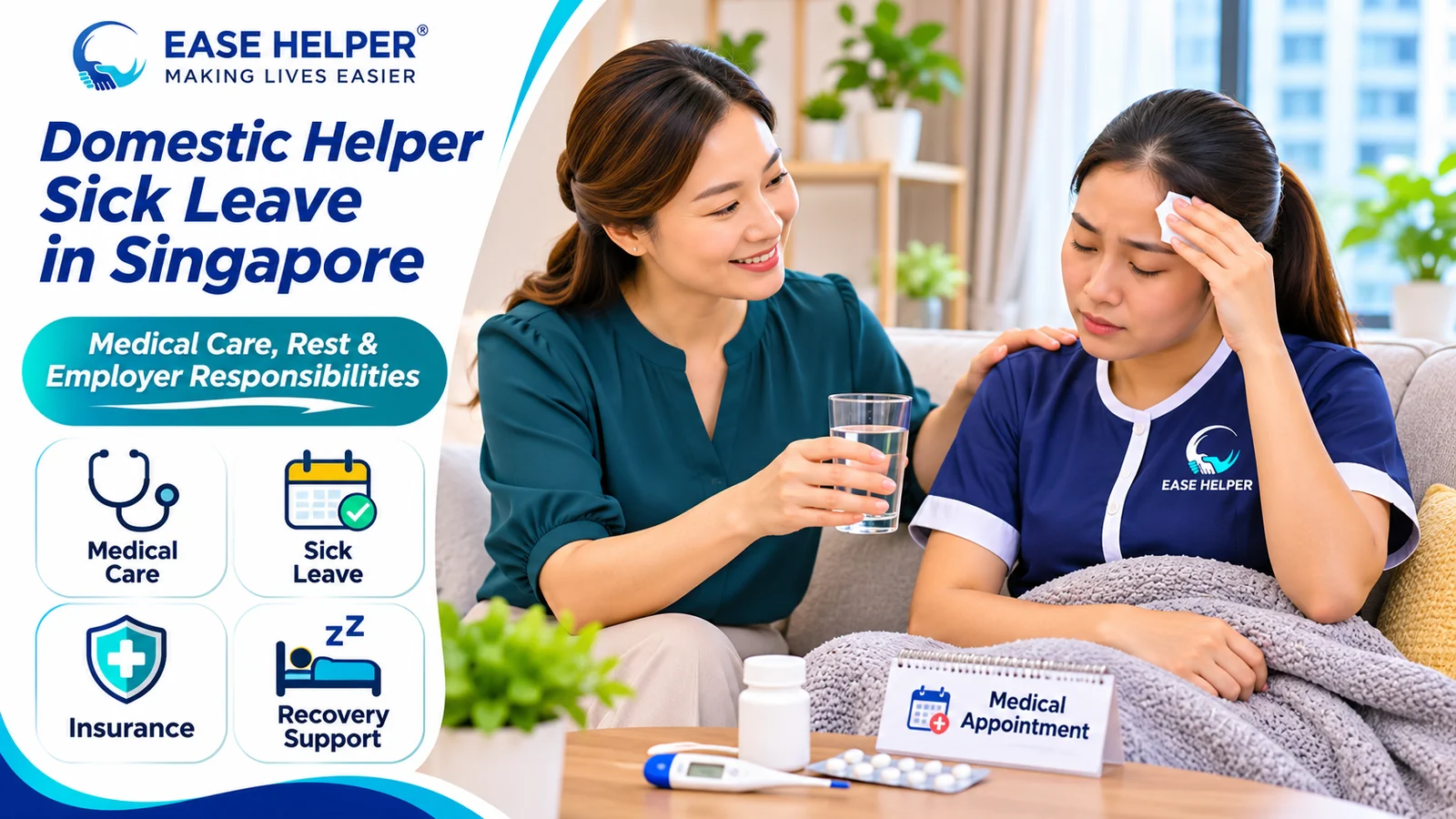
Employers are responsible for the necessary medical expenses of their migrant domestic workers during employment in Singapore.
This responsibility applies whether the helper becomes ill or suffers an injury. Furthermore, it is not limited to medical conditions caused by household work.
For example, an employer may need to pay for treatment when a helper develops a fever, experiences a recurring health problem or requires hospital care.
MOM also requires employers to purchase and maintain the relevant insurance policies.
Importantly, employers cannot transfer necessary medical expenses to the helper simply because an insurance policy does not cover the full bill.
Read the official MOM guidance on domestic helper health and well-being for further information.
What Medical Expenses Must Employers Pay?
Employers should prepare for both routine healthcare costs and unexpected medical treatment.
| Medical Expense | Employer Responsibility | Insurance Consideration |
|---|---|---|
| GP consultations | Pay for necessary medical consultations and treatment | Outpatient coverage depends on the policy |
| Prescription medication | Pay for medically necessary prescribed treatment | Check outpatient benefits and exclusions |
| Hospitalisation | Responsible for medical costs, including amounts not paid by insurance | Mandatory medical insurance covers eligible inpatient expenses |
| Day surgery | Responsible for necessary treatment | Covered subject to policy terms and limits |
| Six-monthly medical examination | Pay for the examination and related medical expenses | Routine screening may not fall under standard hospitalisation benefits |
| Emergency treatment | Arrange timely medical attention and meet applicable costs | Coverage depends on the treatment and policy conditions |
| Specialist consultations | Pay for necessary specialist care | Check referral, outpatient and inpatient benefits |
Therefore, employers should not assume that mandatory insurance eliminates every out-of-pocket expense.
What Is the Minimum Medical Insurance Coverage for Domestic Helpers?
MOM requires employers to purchase medical insurance for their domestic helpers before employment begins.
The minimum annual claim limit is S$60,000 for inpatient care and day surgery.
This requirement applies to policies, renewals and extensions subject to MOM’s enhanced medical insurance rules.
In addition, the insurance must satisfy the applicable requirements for coverage limits, co-payments and permitted exclusions.
Key Insurance Requirements
- At least S$60,000 in annual inpatient and day surgery coverage.
- Coverage for eligible hospital treatment, including conditions unrelated to work.
- Applicable enhanced medical insurance co-payment arrangements.
- Compliance with MOM’s rules on permitted policy exclusions.
- Direct payment arrangements between insurers and hospitals for admissible claims under the enhanced requirements.
Employers should review MOM’s official domestic helper insurance requirements before purchasing or renewing a policy.
How Does the Medical Insurance Co-Payment Work?
Under MOM’s enhanced medical insurance framework, the insurer pays 75% and the employer pays 25% of admissible claim amounts above the first S$15,000, subject to the policy’s annual claim limit and applicable terms.
Consequently, an employer may still need to contribute to a large hospital bill even when the treatment qualifies for insurance coverage.
Illustrative Example: S$30,000 Eligible Hospital Bill
Assume the full S$30,000 bill is admissible under a compliant policy and no other deductions or exclusions apply.
| Bill Component | Illustrative Amount |
|---|---|
| First S$15,000 covered by insurer | S$15,000 |
| Remaining eligible bill | S$15,000 |
| Insurer’s 75% share of remaining amount | S$11,250 |
| Employer’s 25% share of remaining amount | S$3,750 |
| Total insurer payment | S$26,250 |
| Total employer co-payment | S$3,750 |
Important: This is a simplified example of the minimum co-payment structure. Actual payments depend on the policy, admissible expenses, claim limits and exclusions. Employers may face additional costs that the insurer does not cover.
What Happens If Medical Bills Exceed S$60,000?
The S$60,000 figure is the minimum annual insurance claim limit, not a cap on the employer’s medical responsibilities.
If the helper’s necessary treatment costs exceed the available insurance coverage, the employer may remain responsible for the outstanding amount.
For this reason, some employers choose policies with higher annual limits or additional benefits.
However, higher coverage does not automatically mean every treatment will qualify for reimbursement.
Before purchasing a policy, compare its annual limits, exclusions, co-payment arrangements and hospital billing procedures.
Are Outpatient Consultations and Medication Covered?
Mandatory medical insurance focuses on inpatient care and day surgery.
Therefore, standard outpatient consultations, prescribed medication and certain specialist visits may not be included in the minimum insurance benefits.
Some insurers offer additional outpatient protection. However, coverage varies between products.
Employers should check whether their policy covers:
- General practitioner consultations.
- Prescription medication.
- Specialist outpatient treatment.
- Diagnostic tests and investigations.
- Emergency department visits without hospital admission.
Even when a policy excludes necessary treatment, the employer’s underlying medical responsibility may still apply.
Who Pays for the Six-Monthly Medical Examination?
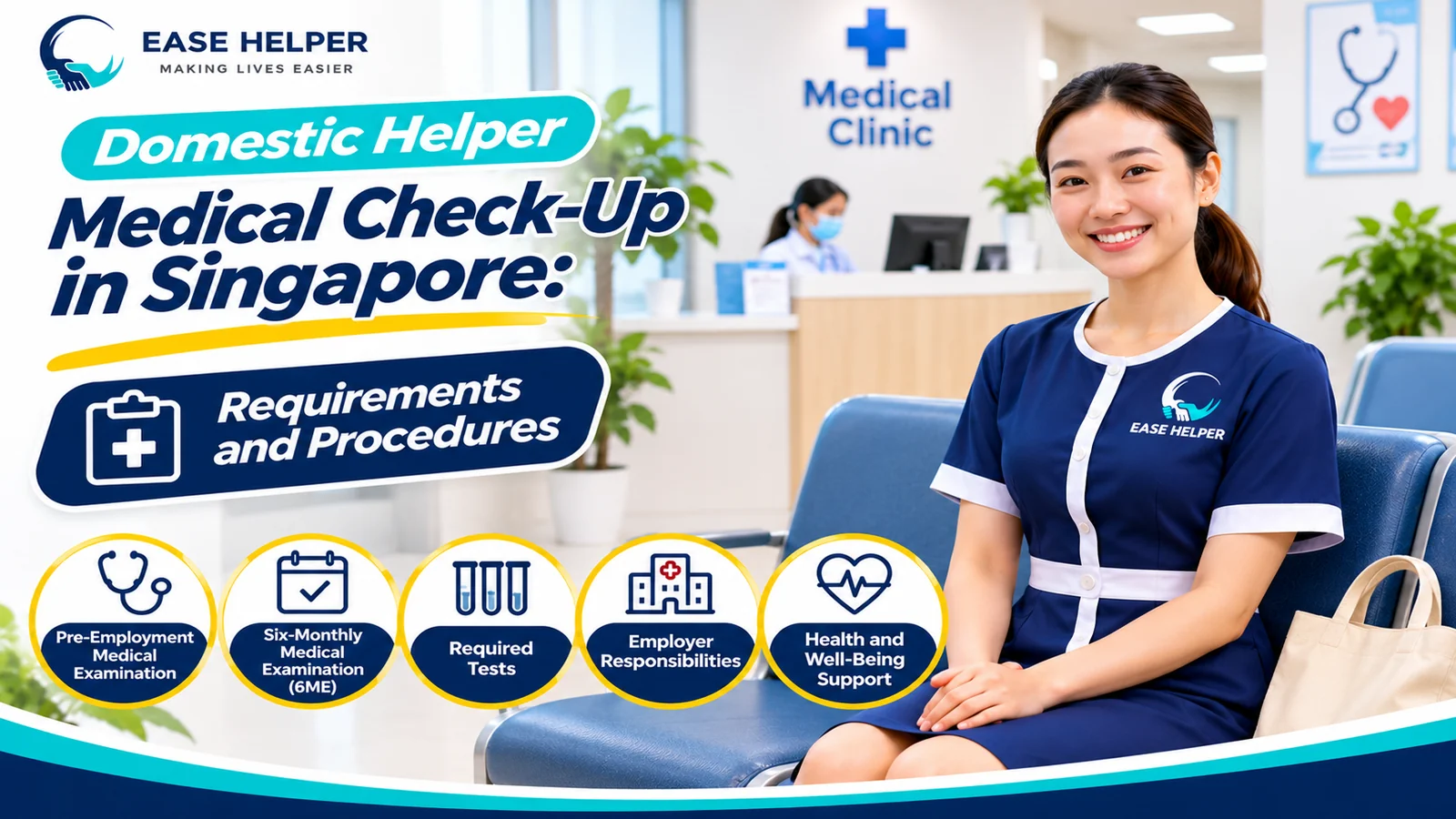
MOM requires domestic helpers to undergo the relevant six-monthly medical examination, commonly called the 6ME.
The employer must pay for the examination and any medical expenses arising from it.
The required screening depends on MOM’s instructions. It may include pregnancy testing and screening for infectious diseases.
Furthermore, employers must ensure that the helper attends the examination within the required timeframe.
For details, consult MOM’s six-monthly medical examination guidance.
Can Employers Deduct Medical Expenses From a Helper’s Salary?
No. Employers cannot require their domestic helpers to pay for necessary medical treatment during employment in Singapore.
Likewise, employers cannot make helpers pay the portion of necessary medical expenses that exceeds an insurance benefit limit.
Therefore, employers should not deduct such medical expenses from the helper’s salary.
Instead, employers should budget for medical costs and select appropriate insurance protection.
What Is the Difference Between Medical Insurance and Personal Accident Insurance?
These two mandatory insurance products serve different purposes.
| Insurance Type | Main Purpose | Minimum Requirement |
|---|---|---|
| Medical insurance | Eligible inpatient care and day surgery expenses | S$60,000 annual claim limit |
| Personal accident insurance | Compensation for accidental death or permanent disability | S$60,000 sum assured |
Personal accident insurance is not a substitute for medical insurance. Its purpose is to provide compensation to the helper or her beneficiaries when a qualifying accident causes death or permanent disability.
As a result, employers must maintain both forms of insurance as required by MOM.
What About Pre-Existing Medical Conditions?
Medical insurance policies may contain exclusions or limitations relating to pre-existing conditions and certain treatments.
However, employers should not assume that an excluded condition automatically removes their responsibility for necessary medical care.
Before purchasing insurance, ask the insurer about relevant policy exclusions, waiting periods and coverage for ongoing treatment.
If a helper has an existing medical condition, obtain appropriate professional advice about treatment and insurance arrangements while respecting her medical privacy.
What If a Helper Needs Emergency Medical Treatment?
If a domestic helper experiences a medical emergency, arrange appropriate medical attention immediately.
For a life-threatening emergency in Singapore, call 995 for an ambulance.
Once the immediate situation is under control, contact the insurer or hospital’s billing team to understand the claims process.
Keep the relevant medical documents and invoices. These records can help with insurance claims and follow-up treatment.
How Can Employers Manage Domestic Helper Medical Costs?
1. Compare Insurance Beyond the Minimum Coverage
Look beyond the premium. Instead, compare annual claim limits, exclusions, co-payments and available additional benefits.
2. Budget for Routine Medical Expenses
Allow for GP consultations, medication and mandatory medical examinations.
3. Keep Insurance Documents Accessible
Store the policy details, emergency contact numbers and claims instructions somewhere you can find quickly.
4. Encourage Early Medical Attention
Ask your helper to inform you when she feels unwell. Prompt treatment may prevent a manageable condition from becoming more serious.
5. Review Coverage Before Renewal
Check whether the existing policy remains suitable and complies with current MOM requirements.
Frequently Asked Questions
1. Who pays for a domestic helper’s hospital bill in Singapore?
The employer is responsible for necessary medical expenses during employment in Singapore. Insurance may cover eligible costs, but the employer remains responsible for applicable co-payments and uncovered necessary expenses.
2. Does domestic helper insurance cover GP visits?
Not necessarily. MOM’s minimum medical insurance requirement focuses on inpatient care and day surgery. GP and other outpatient benefits depend on the selected policy.
3. Can a domestic helper pay part of her medical bill?
Employers cannot require a helper to pay for necessary medical expenses, including amounts exceeding the insurance benefit limit.
4. Is S$60,000 medical insurance enough?
S$60,000 meets MOM’s minimum annual claim limit. However, employers may consider higher coverage because serious medical conditions can produce substantial bills.
5. Who pays for the helper’s six-monthly medical examination?
The employer must pay for the required 6ME and related medical expenses.
How EaseHelper Can Assist Employers
Understanding medical responsibilities is an important part of hiring and employing a domestic helper in Singapore.
EaseHelper helps employers navigate the recruitment process and understand key employment obligations, including mandatory insurance and medical examination requirements.
Although insurance coverage depends on the chosen provider and policy, our team can help employers identify the administrative matters they should clarify before employment begins.
Planning to Hire a Domestic Helper in Singapore?
EaseHelper can help you understand the recruitment process and prepare for the responsibilities involved in employing a domestic helper.
Explore EaseHelper ServicesDisclaimer: This article provides general information, not legal, medical or insurance advice. Insurance benefits depend on policy terms, admissible claims, exclusions and current regulatory requirements. Employers should verify the latest MOM rules and consult their insurer or qualified professionals when necessary. The example calculations are illustrative and do not represent a quotation or guarantee of claim payment.