Blog
Domestic Helper Annual Leave and Home Leave in Singapore: What Employers Should Know

Executive Summary
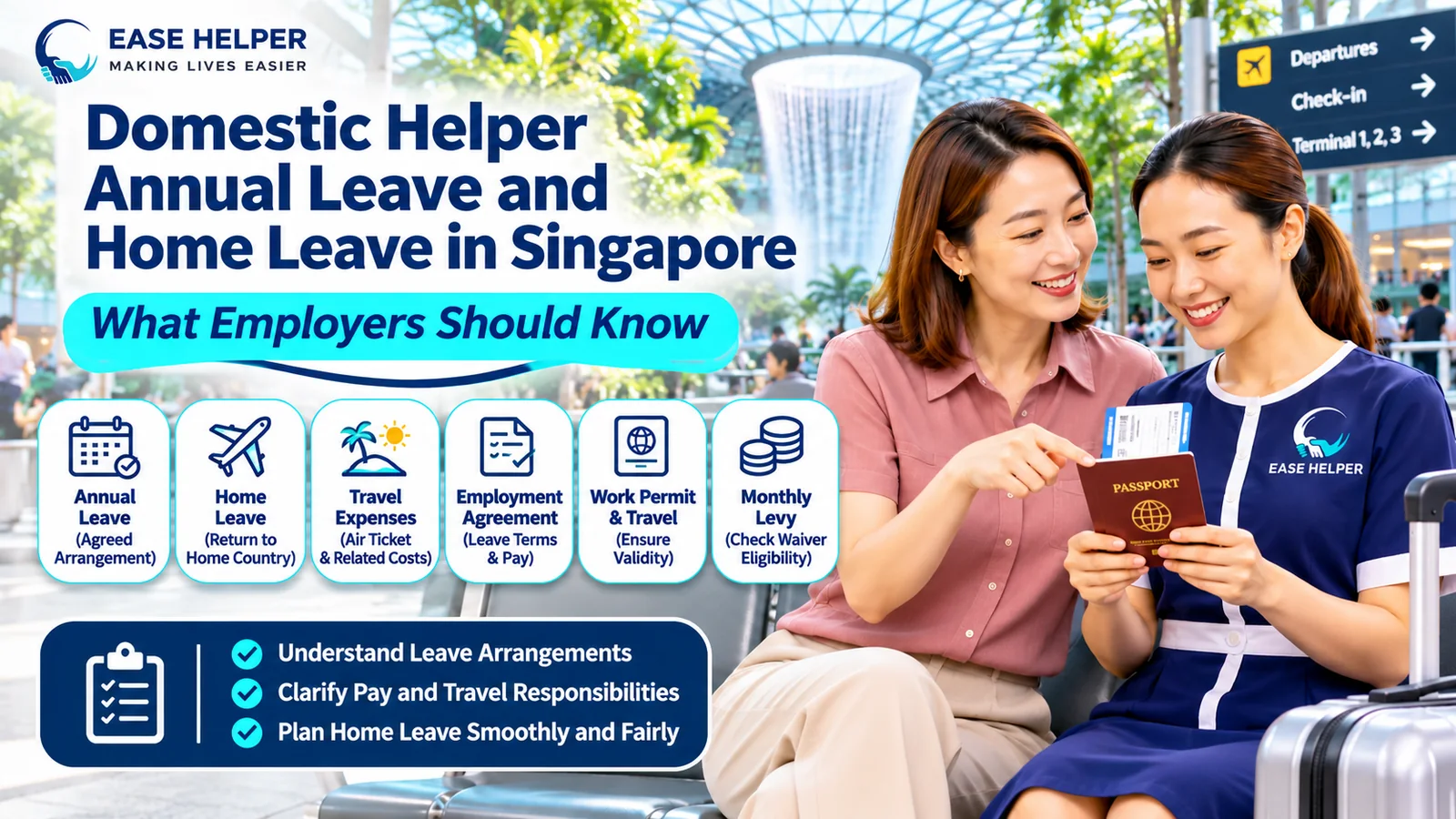
Domestic helper annual leave and home leave arrangements in Singapore are important for both employers and helpers. Unlike employees covered by the Employment Act, migrant domestic workers do not have a standard statutory annual leave entitlement under that Act. Instead, employers and helpers should agree on leave dates, payment and travel arrangements. However, MOM’s mandatory weekly rest-day rules still apply. This guide explains how to plan home leave, manage airfare and salary, check Work Permit validity and understand levy waiver requirements.
Domestic Helper Annual Leave and Home Leave: Understanding the Difference
Annual leave and home leave serve different purposes. Although both allow a helper to take time away from work, the arrangements may differ.
Annual leave generally refers to agreed time off. Meanwhile, home leave usually involves travelling overseas to visit family or attend to personal commitments.
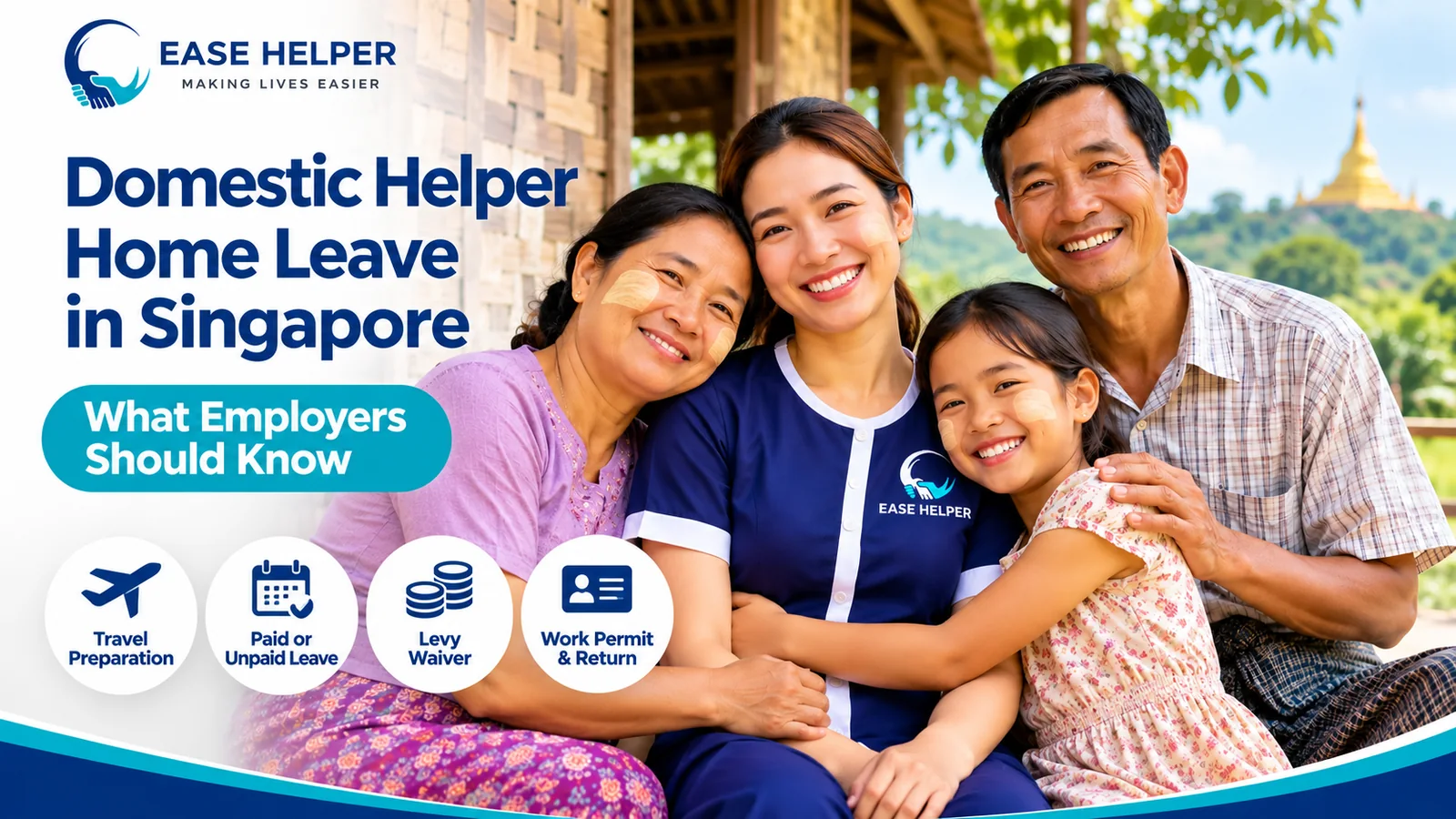
For example, a helper may request two weeks in Myanmar or Indonesia to spend time with relatives. The employer and helper should then discuss the dates, salary arrangements and travel costs.
Importantly, neither type of leave should be confused with mandatory weekly rest days.
| Leave Type | Purpose | Key Considerations |
|---|---|---|
| Annual leave | Agreed time away from work | Leave entitlement, salary and approval |
| Home leave | Temporary overseas travel | Airfare, travel documents and return date |
| Weekly rest day | Regular rest from household duties | MOM rest-day requirements and compensation |
| Unpaid leave | Agreed absence without salary | Written agreement and salary arrangements |
Is Annual Leave Mandatory for Domestic Helpers in Singapore?
Migrant domestic workers are not covered by the Employment Act’s annual leave provisions. Therefore, the statutory annual leave entitlement for employees covered by that Act does not automatically apply.
Instead, employers should review their employment agreements and any other applicable commitments.
For example, an employer may agree to provide paid leave after a specified period of employment. Alternatively, both parties may agree on a different arrangement.
However, employers should not change agreed terms without discussing the changes with their helpers.
MOM encourages employers and domestic helpers to establish clear employment contracts. Consequently, written agreements can help prevent misunderstandings.
For further guidance, read MOM’s employment contract guidance.
How Many Days of Home Leave Should Employers Offer?
There is no universal Employment Act home leave entitlement that automatically applies to every migrant domestic worker.
Nevertheless, employers should consider the helper’s family responsibilities and the terms of her employment agreement.
For reference, MOM has described 14 days of paid overseas leave for every two years worked as a common practice among some employers. However, this is not a universal statutory requirement.
Therefore, employers should avoid treating a common practice as a compulsory entitlement for every household.
Factors to Consider When Agreeing on Leave
- The helper’s length of service.
- Existing employment agreement terms.
- Important family commitments overseas.
- Household caregiving responsibilities.
- Available travel dates and flight arrangements.
- Whether the leave will be paid or unpaid.
Above all, both parties should understand the agreement before confirming travel plans.
Domestic Helper Home Leave and Employment Agreement Terms
A written agreement makes leave planning easier. In addition, it gives employers and helpers a clear reference if questions arise later.
For example, the agreement can explain whether the helper receives paid leave, how many days are available and whether the employer contributes to airfare.
What Should the Agreement Cover?
- Annual leave entitlement, if any.
- Approved home leave duration.
- Paid or unpaid leave arrangements.
- Airfare and related travel expenses.
- Expected departure and return dates.
- Procedures for extending leave.
- Arrangements if the helper cannot return.
Furthermore, employers should keep written records of any later changes. This helps both parties maintain consistent expectations.
Who Pays for Domestic Helper Home Leave Airfare?
For temporary home leave during ongoing employment, employers and helpers should check their agreed travel arrangements.
For example, the employment agreement may provide a return air ticket after a certain period of service. Alternatively, the parties may agree on another arrangement.
However, home leave travel costs should not be confused with an employer’s separate repatriation responsibilities when employment ends.
Travel Expenses to Discuss
- Return air tickets.
- Checked baggage allowance.
- Airport transport.
- Travel insurance, where appropriate.
- Flight changes and cancellation fees.
- Additional travel documents, if required.
Practical tip: Agree on who pays each expense before booking flights. Also, keep copies of travel confirmations and the agreed leave dates.
Is Domestic Helper Home Leave Paid or Unpaid?
Salary arrangements depend on the employment agreement and the leave terms accepted by both parties.
For instance, an employer may provide paid home leave as an employment benefit. In other cases, the employer and helper may agree to unpaid leave.
Therefore, employers should clarify the arrangement before departure rather than making unexpected salary adjustments afterward.
Confirm These Salary Details
- The number of paid leave days.
- The number of unpaid leave days, if any.
- The salary payment date.
- Any contractual leave benefits already earned.
- How additional leave will be handled.
Moreover, employers should maintain accurate salary records and avoid unilateral deductions that conflict with applicable obligations or agreed terms.
Domestic Helper Home Leave: Work Permit and Travel Requirements
Before overseas travel, employers should check the helper’s passport and Work Permit validity.
According to MOM, employers should also check the home country’s immigration requirements and ensure the helper has her passport and digital work pass or Work Permit card for re-entry.
Additionally, keep a copy of the travel ticket or departure itinerary.
Pre-Departure Checklist
- Check passport validity.
- Confirm the Work Permit remains valid.
- Review the home country’s immigration requirements.
- Check current Singapore entry requirements.
- Confirm the return flight date.
- Save travel documents and booking details.
- Discuss emergency contact arrangements.
For the official procedure, consult MOM’s overseas leave guidance for domestic helpers.
Can Employers Apply for a Levy Waiver During Home Leave?
Yes, employers may qualify for a levy waiver when their helper takes overseas leave.
However, the monthly levy does not stop automatically while the Work Permit remains active.
Under MOM’s current rules, qualifying overseas leave must last at least seven consecutive days. In addition, the waiver is capped at 60 calendar days per calendar year.
Generally, employers can apply after their helper returns to Singapore.
How to Prepare for a Levy Waiver
- Record the departure date.
- Confirm the return date.
- Check that the absence meets MOM’s qualifying conditions.
- Apply through the appropriate MOM service.
- Review the levy account after processing.
For current eligibility and application details, visit MOM’s domestic helper levy waiver page.
How Do Weekly Rest Days Differ From Annual Leave?
Weekly rest days are a separate legal requirement. Therefore, employers should not assume that agreed annual leave replaces their rest-day responsibilities.
MOM requires employers to provide one rest day each week. If the helper agrees to work on a rest day, the employer must provide at least one additional day’s salary.
However, at least one rest day each month cannot be replaced with compensation.
Consequently, employers should plan weekly rest days independently from annual leave and home leave arrangements.
For further information, read MOM’s rest-day requirements.
What If a Domestic Helper Does Not Return From Home Leave?
Occasionally, a helper may not return on the agreed date. This may happen because of family circumstances, travel disruptions or a decision not to continue employment.
First, employers should try to contact the helper and establish what happened.
However, if the helper does not return to Singapore, MOM requires the employer to cancel her Work Permit to stop the levy.
In addition, employers should retain the travel ticket or departure itinerary and follow MOM’s instructions concerning the Work Permit card and security bond.
Therefore, employers should not simply assume that an overseas absence automatically ends their administrative obligations.
For the official procedure, refer to MOM’s guidance on overseas leave and non-return.
How to Plan Domestic Helper Annual Leave and Home Leave Fairly
1. Discuss Leave Requests Early
Start planning before the intended departure date. As a result, both parties have more time to arrange travel and household support.
2. Agree on Payment Responsibilities
Clarify salary, airfare and other travel expenses. Then, document the agreed arrangements.
3. Check Travel Documents
Review passport validity, Work Permit status and immigration requirements before purchasing tickets.
4. Prepare Alternative Household Support
Arrange lawful childcare, elderly care or cleaning support where necessary. Meanwhile, avoid asking another household’s domestic helper to work for you without authorisation.
5. Respect Family Commitments
Recognise the importance of family relationships and significant events overseas. Consequently, approach leave discussions with reasonable flexibility.
6. Confirm the Return Plan
Agree on the expected return date and a suitable communication method if travel plans change.
Common Home Leave Mistakes Employers Should Avoid
| Common Mistake | Potential Problem | Recommended Approach |
|---|---|---|
| Confusing home leave with weekly rest days | Different rules apply | Manage the arrangements separately |
| Failing to confirm airfare responsibilities | Disputes over travel costs | Agree on expenses in writing |
| Booking flights without checking documents | Travel or re-entry difficulties | Verify passport and Work Permit validity |
| Assuming the levy stops automatically | Unexpected levy charges | Check MOM waiver conditions |
| Not preparing household support | Disruption to essential routines | Plan alternative arrangements early |
Frequently Asked Questions About Domestic Helper Home Leave
1. Is annual leave compulsory for domestic helpers in Singapore?
Domestic helpers are not covered by the Employment Act’s statutory annual leave provisions. Therefore, employers should review the employment agreement and any other applicable obligations.
2. Is 14 days of home leave mandatory after two years?
No universal Employment Act requirement imposes 14 days of home leave after two years. However, MOM has identified this as a common practice among some employers. Contractual commitments should still be honoured.
3. Must employers pay for home leave air tickets?
For temporary home leave, employers should review the agreed employment terms. However, separate repatriation responsibilities may apply when employment ends.
4. Can employers claim a levy waiver during home leave?
Yes, subject to MOM’s conditions. Currently, qualifying overseas leave must last at least seven consecutive days, with a maximum waiver of 60 calendar days per calendar year.
5. Can a domestic helper return using her existing Work Permit?
Generally, yes, provided the Work Permit remains valid and the helper meets the applicable immigration and entry requirements. Therefore, employers should verify all documents before travel.
How EaseHelper Supports Singapore Employers
Domestic helper annual leave and home leave planning can be easier when both parties communicate clearly and understand their responsibilities.
EaseHelper supports Singapore households with domestic helper recruitment and practical employment guidance. In addition, we encourage employers to maintain fair arrangements and refer to MOM for current regulatory requirements.
Need Help With Domestic Helper Employment Arrangements?
EaseHelper helps Singapore families navigate domestic helper recruitment, employment administration and important household considerations.
Explore EaseHelper ServicesDisclaimer: This article provides general information, not legal or immigration advice. Leave entitlements, salary arrangements and travel responsibilities may depend on employment agreements and individual circumstances. MOM and ICA requirements may change. Employers should verify the latest official guidance before making employment or travel decisions.