Blog
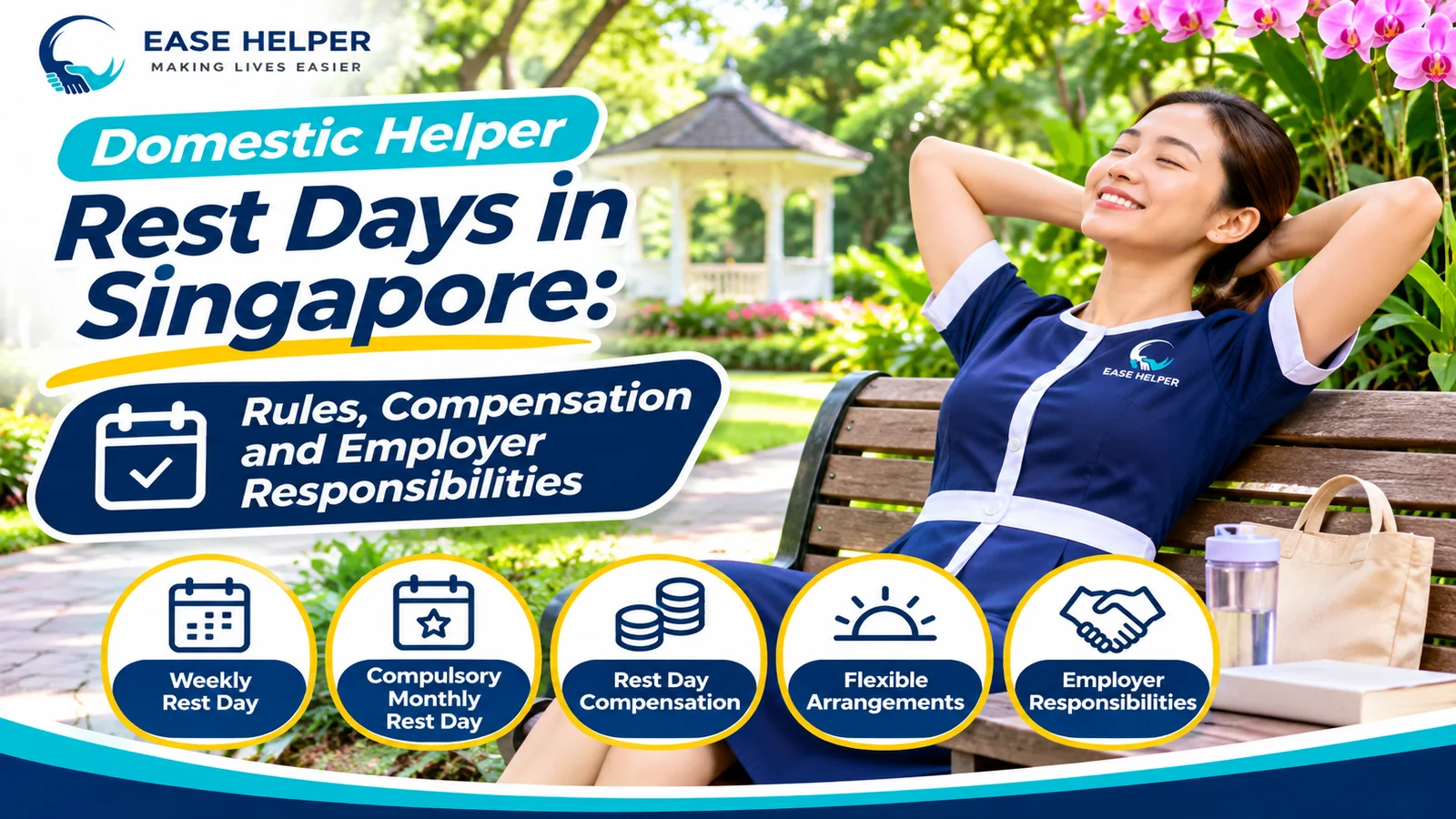
Domestic Helper Rest Days in Singapore: Rules, Compensation and Employer Responsibilities

Executive Summary
Domestic helper rest days in Singapore are an important part of an employer’s duties. Under Ministry of Manpower (MOM) rules, domestic helpers receive one rest day per week. In addition, employers must provide at least one rest day each month that they cannot replace with extra pay.
However, employers and helpers may agree on work arrangements for other rest days. When a helper agrees to work on an eligible rest day, the employer must pay at least one additional day’s salary.
This guide explains MOM’s rules, rest day pay, flexible schedules and employer responsibilities. It also offers practical tips to help Singapore families plan household care while respecting their helper’s right to rest.
1. What Are the Domestic Helper Rest Day Rules in Singapore?
MOM requires employers to provide one rest day per week for their domestic helpers. Both parties should agree on a suitable day and discuss how the schedule will work.
Since 1 January 2023, employers must also provide at least one compulsory rest day each month. They cannot replace this monthly rest day with money.
Key MOM rest day requirements
- Domestic helpers receive one rest day per week.
- Employers and helpers should agree on the rest day schedule.
- Every helper must take at least one rest day each month.
- Employers cannot replace that compulsory monthly rest day with extra pay.
- Both parties may agree on work during other eligible rest days.
- Employers should record rest day schedules and any changes.
For the latest requirements, visit MOM’s official rest day and well-being guide.
2. Is One Rest Day Per Month Compulsory?
Yes. Every domestic helper must take at least one rest day each month. Employers cannot offer extra salary instead of this compulsory rest day.
For example, consider a month with four weekly rest days. The helper must take at least one of those days. However, both parties may agree that she will work on the other three days.
In that case, the employer must pay the required extra salary for each eligible rest day worked.
Important: Employers cannot ask a helper to work every rest day and simply replace all her rest days with extra pay.
3. Can a Domestic Helper Work on Her Rest Day?
Yes, but the employer and helper must agree on the arrangement. In addition, the helper must still take her compulsory monthly rest day.
Employers should never pressure a helper to give up her rest days. Instead, both parties should discuss their needs and agree on a fair schedule.
How to discuss rest day arrangements
- Explain the household’s childcare or elderly care needs.
- Ask the helper which rest days she prefers.
- Discuss whether she wishes to work on any eligible rest days.
- Agree on the required extra pay.
- Record the arrangement in writing.
Clear communication should begin before employment starts. Therefore, employers should also discuss rest day expectations during the hiring process.
Our complete guide to hiring a domestic helper in Singapore explains other important employment responsibilities.
4. How Much Should Employers Pay for a Rest Day Worked?
When a helper agrees to work on an eligible rest day, the employer must pay at least one additional day’s salary.
MOM uses a simple formula to calculate this amount:
One day’s salary = Monthly basic salary ÷ 26
Example: Monthly salary of S$650
Suppose a helper earns a basic monthly salary of S$650.
S$650 ÷ 26 = S$25 per rest day worked.
Therefore, the employer must pay at least S$25 extra for each eligible rest day worked.
| Eligible rest days worked | Additional pay | Total monthly salary |
|---|---|---|
| 0 | S$0 | S$650 |
| 1 | S$25 | S$675 |
| 2 | S$50 | S$700 |
| 3 | S$75 | S$725 |
| 4 (month with five rest days) | S$100 | S$750 |
These examples assume that both parties agree on the arrangement. They also assume that the helper still takes her compulsory monthly rest day.
Employers should keep clear salary records. In addition, they should explain all extra payments to their helper.
For more information about salary planning, read our Domestic Helper Salary in Singapore: A Practical Guide for Employers.
For MOM’s calculation method, see the official rest day pay FAQ.
5. Can Domestic Helper Rest Days Be Split Into Half Days?
Yes. MOM allows flexible rest day schedules when both parties agree.
For example, a helper may take one full rest day or two half days. As a result, families can plan around household needs while still giving the helper time to rest.
Examples of flexible schedules
- One full rest day on Sunday.
- One full rest day on another agreed weekday.
- Two half-day rest periods.
MOM also allows a helper to defer a rest day by up to one month. However, she must take that deferred rest day by the end of the following month.
Employers should discuss any changes early. This helps both parties avoid confusion and plan ahead.
6. How Can Employers Plan Childcare and Elderly Care on Rest Days?
Many Singapore households rely on domestic helpers for childcare, elderly care and daily routines.
However, employers must still arrange suitable care when their helper takes a rest day.
Therefore, families should prepare alternative arrangements before the scheduled rest day.
Practical ways to prepare
- Share caregiving duties among family members.
- Arrange alternative childcare or elderly care when necessary.
- Prepare meals and essential supplies in advance.
- Keep emergency contact details nearby.
- Discuss rest day schedules before each month begins.
For example, parents may divide childcare duties during weekends. Meanwhile, other family members can help with meals or elderly care.
Good planning allows the helper to enjoy her rest day without disrupting essential household care.
Employers should also explain household routines during the helper’s first week. Our guide, Your Domestic Helper’s First Day in Singapore: A Step-by-Step Guide for Employers, provides useful orientation tips.
7. Should Employers Include Rest Days in the Employment Contract?
Yes. A written agreement helps employers and helpers understand their responsibilities.
For example, employers can record the usual rest day, the number of rest days each month and any agreed extra pay.
In addition, both parties should discuss how they will handle schedule changes.
What should the agreement cover?
- The normal weekly rest day.
- The compulsory monthly rest day.
- Any agreed work on eligible rest days.
- Extra pay for those rest days.
- How both parties will discuss schedule changes.
Clear written records can help prevent disputes. Moreover, they give both parties a useful reference when questions arise.
Employers can review MOM’s employment contract guidance for more details.
8. How Do Rest Days Affect the Total Cost of Hiring a Domestic Helper?
Rest day pay forms one part of the total cost of employing a domestic helper in Singapore.
In addition to the monthly salary, employers must plan for the applicable levy, required insurance and other employment costs.
Main costs employers should consider
- Basic salary: The monthly salary that both parties agree on.
- Rest day pay: Extra salary for eligible rest days worked by mutual agreement.
- Monthly levy: The applicable MOM levy, including any available concession.
- Insurance: Required medical and personal accident insurance.
- Other costs: Food, accommodation, medical care and other employment expenses.
For example, a family may need to budget for extra rest day pay during a busy month. However, the family must still provide the compulsory monthly rest day.
To understand monthly levy costs, read our Domestic Helper Levy in Singapore: Rates, Concessions and Payment Guide.
Likewise, employers should understand their insurance duties. Our guide, Domestic Helper Insurance in Singapore: What Employers Need to Know, explains the main coverage requirements.
By planning these costs early, employers can manage their household budget more effectively.
9. Common Rest Day Mistakes Employers Should Avoid
Replacing every rest day with extra salary
Employers must provide at least one compulsory rest day each month. Therefore, they cannot replace every rest day with money.
Assuming rest days must fall on Sunday
A rest day does not have to fall on Sunday. Instead, the employer and helper can agree on another suitable day.
Forgetting to pay extra salary
When a helper works on an eligible rest day by mutual agreement, the employer must pay the required extra salary.
Changing schedules without discussion
Sudden changes can create confusion. Therefore, employers should discuss new arrangements early and keep clear records.
Failing to arrange alternative care
Families should prepare childcare or elderly care arrangements before the helper takes her rest day.
10. Why Are Regular Rest Days Important?
Regular rest helps domestic helpers maintain their physical and emotional well-being.
Domestic work often involves long household routines. For example, a helper may handle cleaning, cooking, childcare and elderly care throughout the week.
Therefore, rest days give helpers time to recover, attend to personal matters and maintain social connections.
In addition, fair rest day arrangements can improve communication between employers and helpers.
When both parties respect the agreed schedule, they can build a more positive working relationship.
11. How EaseHelper Supports Employers
EaseHelper helps Singapore families understand the domestic helper hiring process and practical employment matters.
For example, employers should discuss salary, rest days and household expectations before employment begins.
In addition, families should choose an employment agency that offers suitable candidate screening, training and after-placement support.
Our guide, How to Choose a Reliable Domestic Helper Agency in Singapore, explains what employers should check before selecting an agency.
Some employers may also consider hiring a transfer helper. In that case, they should understand the transfer process and the responsibilities involved.
Our article, Domestic Helper Transfer in Singapore: A Complete Guide for Employers, explains the main steps and considerations.
By understanding these matters early, employers can make better hiring decisions and prepare a clear household routine.
12. Frequently Asked Questions About Domestic Helper Rest Days
How many rest days must a domestic helper receive in Singapore?
A domestic helper receives one rest day per week. In addition, she must take at least one compulsory rest day each month.
Can an employer pay extra instead of giving a rest day?
Employers may pay extra for eligible rest days worked by mutual agreement. However, they cannot replace the compulsory monthly rest day with money.
How much should an employer pay for a rest day worked?
The employer must pay at least one additional day’s salary. MOM calculates this amount by dividing the helper’s monthly basic salary by 26.
Must a domestic helper take her rest day on Sunday?
No. The employer and helper may agree on another day of the week.
Can a domestic helper take two half days instead?
Yes. MOM allows two half days instead of one full rest day when both parties agree.
Can a domestic helper postpone her rest day?
Yes. MOM allows a helper to defer a rest day by up to one month. However, she must take it by the end of the following month.
Should employers record rest day arrangements?
Yes. Written records help both parties understand their agreed schedule and extra pay.
13. Conclusion: Plan Domestic Helper Rest Days Fairly
Understanding domestic helper rest days in Singapore helps employers meet their responsibilities and support their helper’s well-being.
First, employers should provide the compulsory monthly rest day. Next, they should discuss weekly schedules and any agreed work on other eligible rest days.
In addition, employers should calculate extra pay correctly and prepare alternative household care when necessary.
By following these steps, families can create fair arrangements and build a positive working relationship.
Looking for a Domestic Helper in Singapore?
EaseHelper supports Singapore families with domestic helper placement and practical guidance on employment matters.
Speak with our team about finding suitable household support.
Visit EaseHelperDisclaimer
This article provides general information for employers in Singapore. It does not constitute legal advice. MOM requirements and procedures may change. Therefore, employers should verify current requirements directly with the Ministry of Manpower. The salary examples are illustrative and may not reflect every employment arrangement.