Blog
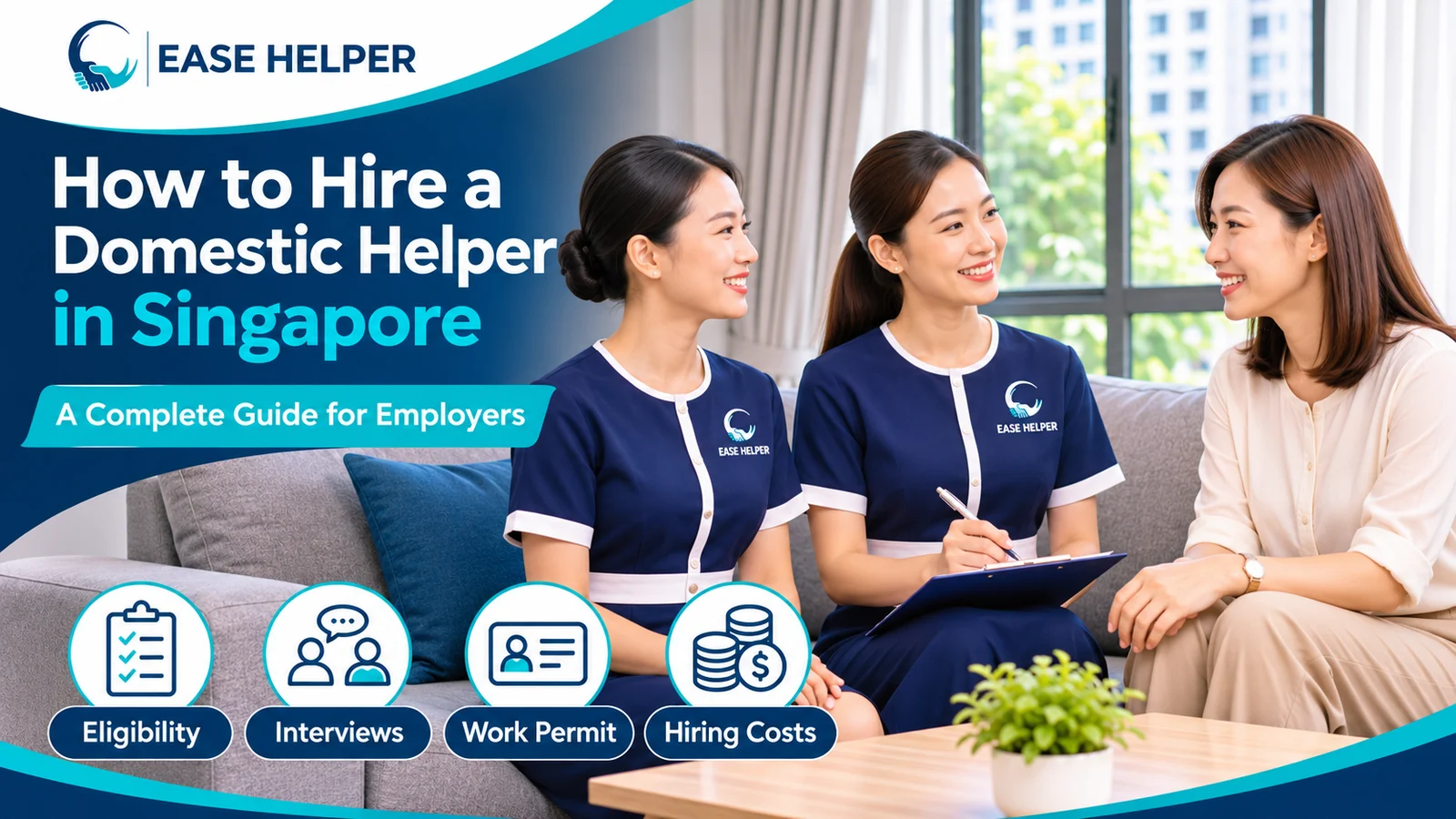
How to Hire a Domestic Helper in Singapore: A Complete Guide

Executive Summary
Hiring a domestic helper in Singapore can make everyday family life more manageable, especially for households with young children, elderly family members or demanding work schedules. However, choosing the right helper involves more than reviewing experience and arranging interviews. Employers must understand eligibility requirements, hiring costs, Work Permit procedures and their responsibilities under Singapore regulations.
This guide explains how to hire a domestic helper in Singapore, from identifying your household needs to preparing for your helper’s arrival. It also highlights how a licensed domestic helper agency such as EaseHelper can support employers throughout the hiring process.
Whether you are hiring a domestic helper for the first time or replacing an existing helper, understanding the process can help you make an informed decision and establish a positive working relationship.
1. Understand Your Household’s Needs
Before hiring a domestic helper, identify the responsibilities that matter most to your family. Every household has different expectations, routines and caregiving requirements.
Common Reasons for Hiring a Domestic Helper
- Childcare: Supporting parents with daily routines, children’s meals and age-appropriate supervision.
- Elderly care: Assisting older family members with mobility, personal care and daily activities.
- Housekeeping: Cleaning, laundry, ironing and maintaining an organised home.
- Cooking: Preparing family meals and maintaining kitchen hygiene.
- General household support: Helping busy families manage daily domestic responsibilities.
Make a list of essential duties and preferred skills before interviewing candidates. A clear job description helps employers identify a suitable domestic helper and reduces misunderstandings after employment begins.
Identify Your Priorities
Consider which responsibilities require previous experience and which tasks can be taught through training and supervision.
For example, a family with a newborn may prioritise verified infant care experience, while a household with elderly family members may require experience with mobility assistance and daily caregiving routines.
2. Check Your Eligibility to Hire a Domestic Helper in Singapore
Employers must satisfy the Ministry of Manpower’s (MOM) eligibility requirements before hiring a migrant domestic worker.
Eligibility depends on factors including the employer’s age, financial ability, residential arrangements and capacity to fulfil employer responsibilities.
General Employer Requirements
- Meet MOM’s minimum age requirement.
- Have the financial ability to employ and maintain a domestic helper.
- Provide acceptable accommodation and living conditions.
- Understand and comply with applicable employment responsibilities.
- Meet any additional requirements imposed by MOM.
First-time employers may also need to complete the Employers’ Orientation Programme (EOP), subject to applicable requirements and exemptions.
Employers should check the latest conditions through MOM’s official employer eligibility information.
3. Decide Between a Fresh and Experienced Domestic Helper
One of the most important decisions is whether to hire a first-time domestic helper or someone with previous employment experience.
Fresh Domestic Helpers
A fresh domestic helper generally has no previous employment experience as a migrant domestic worker in Singapore.
She may require more time to understand local household routines, appliances, communication expectations and safety procedures.
Employers who can provide structured guidance and reasonable adjustment time may consider a fresh candidate whose attitude and skills match their needs.
Experienced Domestic Helpers
An experienced domestic helper may have worked in Singapore or another overseas household.
Relevant experience can be valuable, especially when the family requires assistance with childcare, elderly care or specific household responsibilities.
However, previous employment alone does not guarantee suitability. Employers should verify the candidate’s actual responsibilities, communication abilities and practical skills.
Important: Choose based on the candidate’s individual experience, training, communication ability and suitability rather than assuming all fresh or experienced helpers have the same capabilities.
4. Choose Between Myanmar and Indonesian Domestic Helpers
Myanmar and Indonesia are approved source countries for migrant domestic workers in Singapore.
Both countries have candidates with different backgrounds, skills, employment histories and communication abilities.
Employers should compare individual candidates instead of relying on nationality-based assumptions.
What Should Employers Compare?
- Communication ability and understanding of household instructions.
- Previous childcare or elderly care experience.
- Cooking and housekeeping skills.
- Relevant practical training.
- Willingness to learn new household routines.
- Compatibility with the family’s expectations.
For a detailed comparison, read our Myanmar vs Indonesian Domestic Helper: Which Is Right for Your Family? guide.
5. Select a Licensed Domestic Helper Agency
Working with a licensed employment agency can help employers navigate the recruitment process, understand candidate information and arrange interviews.
A domestic helper agency may assist with candidate matching, recruitment arrangements, administrative procedures and relevant employment guidance.
What to Look for in a Domestic Helper Agency
- A valid Singapore employment agency licence.
- Clear explanations of service fees and applicable charges.
- Transparent information about candidate experience and training.
- Opportunities to interview suitable candidates.
- Clear communication about hiring procedures and timelines.
- Information about applicable replacement terms and after-placement support.
Employers can verify agency licensing information through MOM’s Employment Agencies Directory.
6. Shortlist and Interview Domestic Helper Candidates
Interviews are an important part of the hiring process. They allow employers to understand a candidate’s previous responsibilities, communication skills, practical knowledge and expectations.
Rather than relying only on a candidate’s employment history, ask questions related to the duties she would perform in your household.
Recommended Interview Questions
- What were your main responsibilities in your previous household?
- What experience do you have with babies, children or elderly persons?
- Which household tasks are you most confident performing?
- What meals can you prepare independently?
- What would you do if you did not understand an instruction?
- How would you respond to an accident or household emergency?
- What additional training would help you perform your duties?
- What are your expectations about household routines and rest days?
Assess Communication and Practical Skills
Employers should check whether candidates understand essential instructions and can communicate concerns when necessary.
For roles involving childcare or elderly care, safety awareness and the ability to follow instructions are especially important.
Where practical assessments are available, they may help employers understand a candidate’s existing skills and training needs.
7. Understand the Costs of Hiring a Domestic Helper
Before hiring a domestic helper in Singapore, employers should understand both the initial recruitment expenses and ongoing employment costs.
Actual expenses depend on the candidate, recruitment arrangement and applicable government requirements.
Common Hiring and Employment Expenses
| Expense | What Employers Should Know |
|---|---|
| Monthly salary | Depends on the agreed employment terms, experience and candidate expectations. |
| Agency service fees | Vary according to the agency and recruitment arrangement. |
| Work Permit fees | Application and issuance fees may apply. |
| Foreign worker levy | Monthly levy applies, with concessions available to eligible households. |
| Insurance and security bond | Employers must satisfy MOM’s applicable insurance and security bond requirements. |
| Medical examinations | Required examinations must be arranged according to MOM rules. |
| Accommodation and meals | Employers must provide suitable accommodation and adequate food. |
| Other recruitment expenses | May include travel, training and other applicable arrangements. |
Request a clear breakdown of costs and contractual terms before committing to a recruitment arrangement.
For current government requirements, refer to MOM’s Work Permit information for migrant domestic workers.
8. Apply for the Domestic Helper Work Permit
Foreign domestic helpers generally require a valid Work Permit to work legally in Singapore.
The application process must comply with MOM’s requirements, including eligibility, documentation, insurance and other relevant conditions.
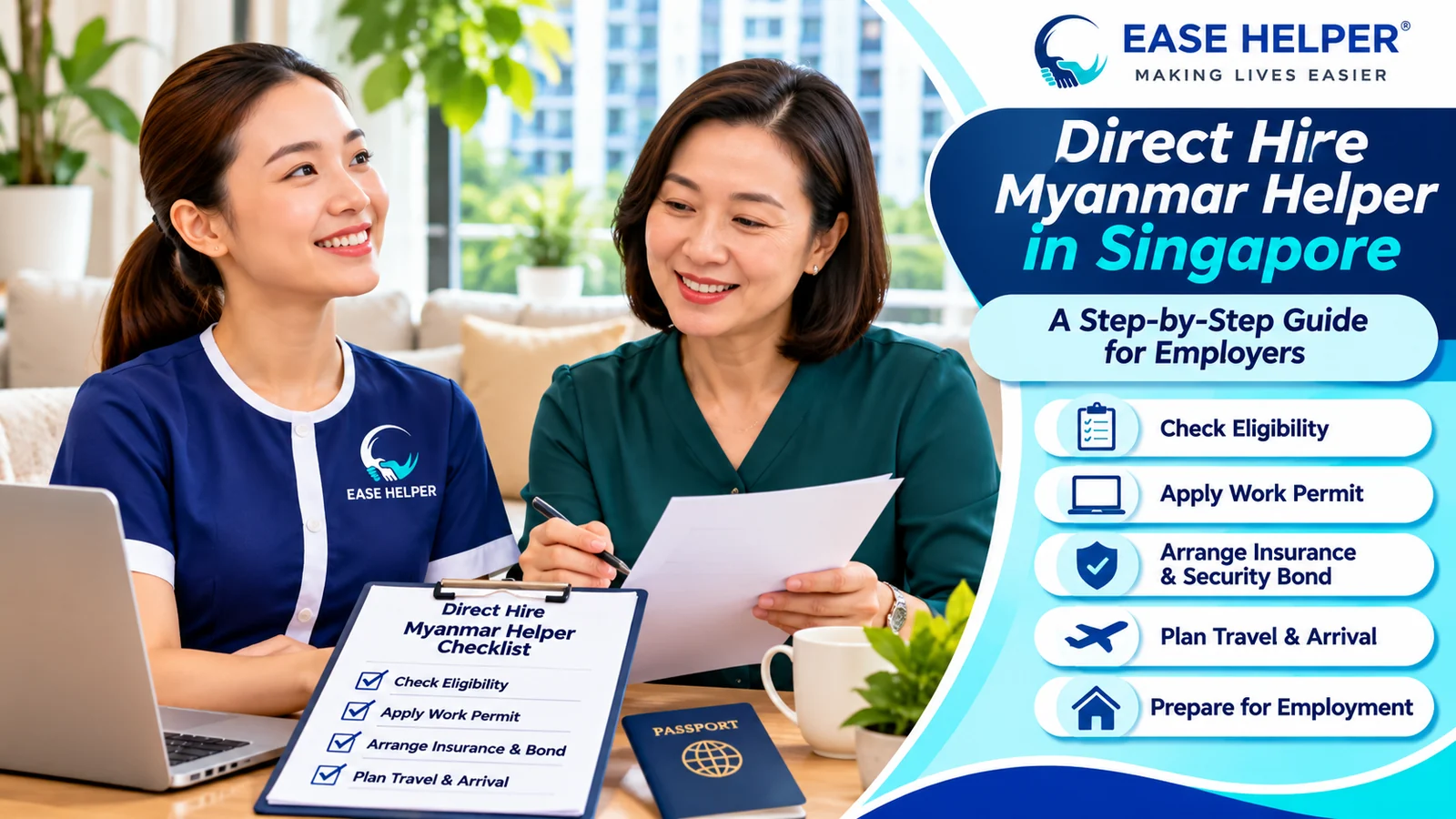
General Work Permit Process
- Confirm employer and candidate eligibility.
- Prepare the necessary documents and information.
- Submit the Work Permit application through the appropriate MOM service.
- Review the application outcome and any conditions of approval.
- Complete the required pre-arrival and arrival arrangements.
- Arrange applicable medical examinations and orientation requirements.
- Complete Work Permit issuance and other MOM formalities.
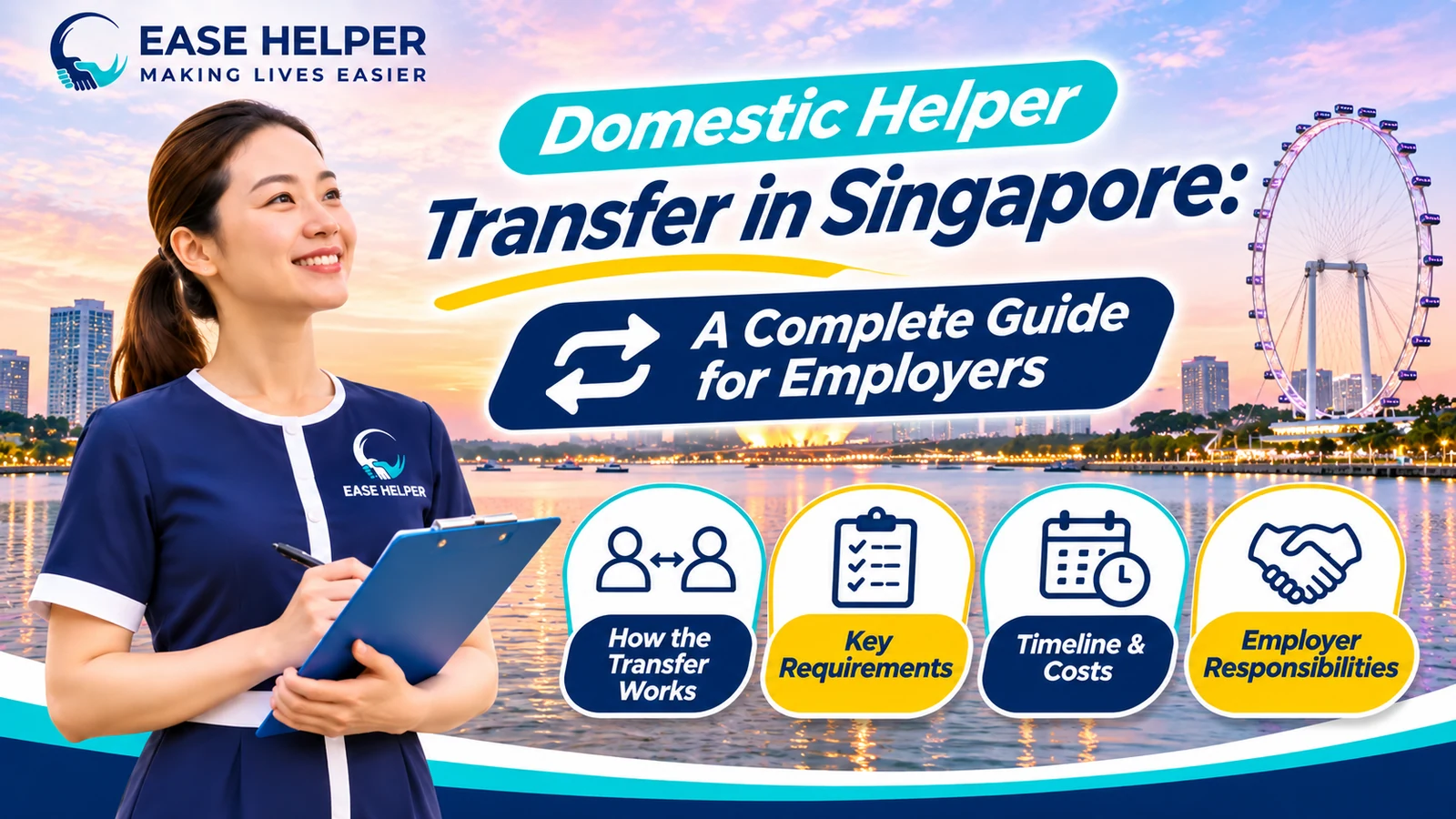
The exact process can differ depending on whether the helper is arriving from overseas or transferring from another employer in Singapore.
Refer to MOM’s official Work Permit application instructions for the latest procedures.
9. Understand Employer Responsibilities
Hiring a domestic helper creates ongoing responsibilities for the employer.
Employers must comply with applicable MOM requirements relating to salary, accommodation, food, medical care, rest days, employment conditions and the helper’s general well-being.
Important Employer Responsibilities
- Pay the helper’s salary according to the agreed terms and applicable rules.
- Provide safe and acceptable accommodation.
- Provide adequate food and necessary daily living arrangements.
- Meet required medical care and insurance obligations.
- Comply with rest day requirements.
- Ensure the helper performs only permitted duties.
- Treat the helper respectfully and maintain clear communication.
Employers should review the latest guidance from Singapore’s Ministry of Manpower.
10. Prepare Your Home Before the Helper Arrives
A well-prepared household can make the transition easier for both the employer and the domestic helper.
Before the helper arrives, consider preparing her accommodation, explaining household expectations and organising the equipment she will use.
Pre-Arrival Checklist
- Prepare a suitable sleeping area and personal storage space.
- Identify important household safety procedures.
- Prepare instructions for commonly used appliances.
- Organise cleaning supplies and household equipment.
- Plan an initial household orientation.
- Prepare a reasonable daily routine and priority list.
- Discuss communication arrangements and emergency contacts.
Clear preparation can reduce confusion during the first few days of employment.
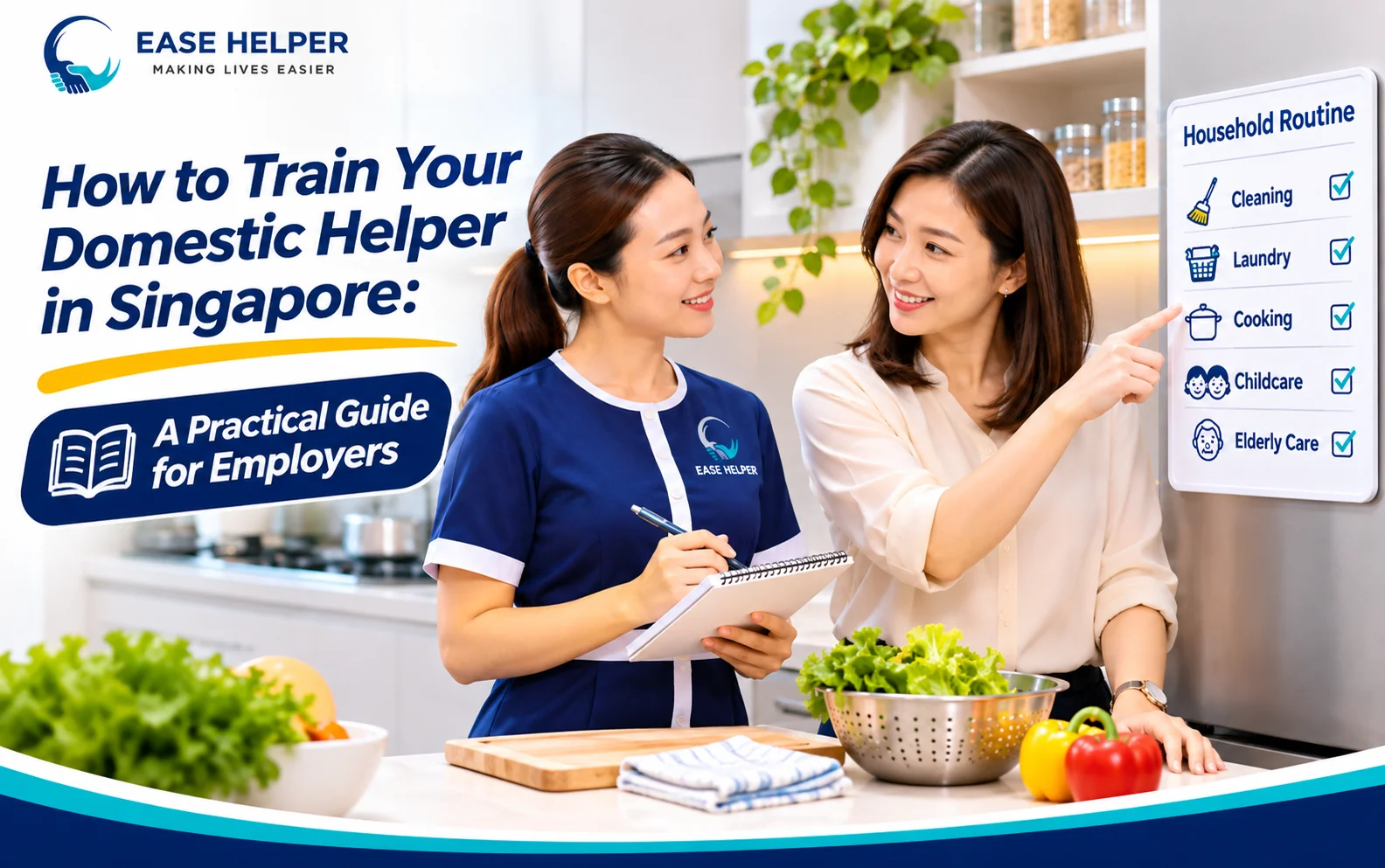
11. Provide Orientation and Practical Training
Even experienced domestic helpers need time to understand a new household’s routines, expectations and preferences.
Employers should not assume that a helper automatically knows how to use every appliance or perform every task according to the family’s standards.
Useful Training Areas
- Kitchen hygiene and food preparation.
- Cleaning procedures and safe chemical handling.
- Laundry, ironing and fabric care.
- Childcare routines and safety instructions.
- Elderly mobility assistance and fall prevention.
- Emergency procedures and household communication.
Where specialised care is required, employers should arrange appropriate professional guidance rather than expecting the helper to perform unfamiliar medical or nursing tasks independently.
12. Build a Positive Working Relationship
A successful domestic helper placement depends on more than the initial recruitment decision.
Clear communication, reasonable expectations, practical training and mutual respect can help establish a stable working relationship.
Good Practices for Employers
- Explain household priorities clearly.
- Give instructions in a way the helper understands.
- Allow reasonable time to learn unfamiliar tasks.
- Provide constructive feedback.
- Encourage questions when instructions are unclear.
- Discuss problems early rather than allowing misunderstandings to develop.
- Respect the helper’s well-being and applicable employment rights.
Regular communication is especially useful during the first few weeks of employment.
13. Common Mistakes to Avoid When Hiring a Domestic Helper
Some hiring difficulties arise because employers focus on limited information or do not establish clear expectations before employment begins.
Mistakes Employers Should Avoid
- Choosing a candidate based only on nationality.
- Assuming previous employment guarantees all required skills.
- Failing to explain the household’s actual responsibilities.
- Skipping important interview questions.
- Not reviewing recruitment costs and contractual terms.
- Expecting a new helper to understand routines immediately.
- Providing insufficient safety training or supervision.
A structured recruitment process helps employers make more informed decisions and prepare for a successful placement.
14. How EaseHelper Supports Domestic Helper Recruitment
EaseHelper helps Singapore families explore suitable Myanmar and Indonesian domestic helper candidates based on household requirements.
Our approach focuses on understanding the employer’s priorities and considering individual candidates according to their relevant skills, experience, communication abilities and training needs.
Support During the Hiring Process
- Understanding the household’s requirements.
- Considering suitable candidate options.
- Arranging candidate interviews.
- Providing information about recruitment arrangements.
- Guiding employers through relevant hiring procedures.
- Helping employers prepare for the placement process.
Employers who are deciding between candidates from different source countries can also read our Myanmar vs Indonesian domestic helper comparison guide.
Frequently Asked Questions
How do I hire a domestic helper in Singapore?
Start by confirming your eligibility, identifying household requirements, interviewing suitable candidates, understanding the hiring costs and completing the applicable Work Permit procedures.
Do I need an employment agency to hire a domestic helper?
Employers may be able to handle certain hiring arrangements directly, subject to MOM requirements. A licensed employment agency can assist with candidate selection, recruitment arrangements and relevant administrative procedures.
How much does it cost to hire a domestic helper in Singapore?
Costs vary depending on salary, agency fees, Work Permit expenses, insurance, levy and other applicable recruitment or employment arrangements. Employers should request a detailed cost breakdown.
Can I hire a Myanmar domestic helper in Singapore?
Yes. Myanmar is an approved source country for migrant domestic workers, subject to MOM’s eligibility and Work Permit requirements.
Can I hire an Indonesian domestic helper in Singapore?
Yes. Indonesia is also an approved source country. Candidates must meet the applicable requirements before working legally in Singapore.
Is a fresh or experienced domestic helper better?
The most suitable choice depends on your household’s needs. Fresh helpers may require additional training, while experienced helpers may have relevant practical knowledge. Individual suitability should be assessed through interviews and appropriate checks.
How long does it take to hire a domestic helper?
Hiring timelines depend on candidate availability, documentation, Work Permit processing and other recruitment arrangements. Employers should confirm the expected timeline before proceeding.
What should I prepare before my helper arrives?
Prepare suitable accommodation, household instructions, safety guidance, necessary supplies and an initial orientation plan. Clear communication can help the helper settle into her new working environment.
Conclusion: Make an Informed Hiring Decision
Hiring a domestic helper in Singapore involves several important steps, from understanding employer eligibility and selecting suitable candidates to managing costs, Work Permit procedures and employment responsibilities.
The most successful hiring decisions begin with a clear understanding of household needs, realistic expectations and careful candidate assessment.
By preparing thoroughly and maintaining open communication, employers can create a more supportive household environment and build a positive long-term working relationship.
Looking for a Domestic Helper in Singapore?
EaseHelper supports Singapore families seeking suitable Myanmar and Indonesian domestic helpers.
Whether you need assistance with childcare, elderly care, cooking or general household responsibilities, our team can help you explore suitable hiring options.
Contact EaseHelperDisclaimer
This article is provided for general information only and does not constitute legal or employment advice. Hiring requirements, Work Permit procedures, fees and employer obligations may change. Employers should refer to the latest official guidance from Singapore’s Ministry of Manpower before making employment decisions.