Blog
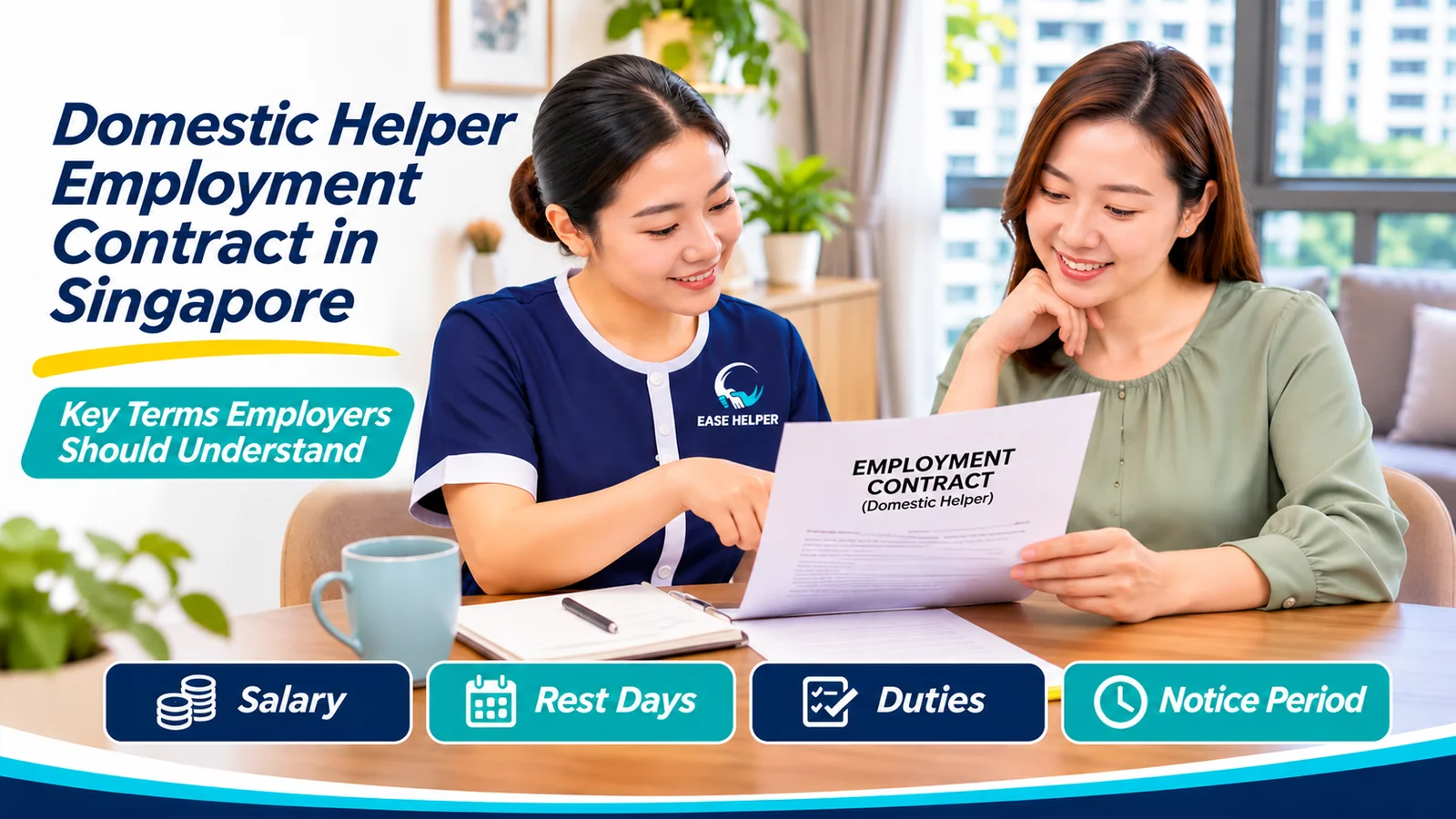
Domestic Helper Employment Contract in Singapore: Key Terms Employers Should Understand

Executive Summary
A clear domestic helper employment contract in Singapore helps employers and domestic helpers understand their working relationship. Although the Ministry of Manpower (MOM) encourages written contracts rather than generally requiring them, a well-prepared agreement can prevent misunderstandings.
Employers should discuss salary, payment dates, rest days, household responsibilities, placement loans, notice periods and early termination. In addition, they must follow MOM’s employment rules regardless of what the contract says.
This guide explains the key terms, common mistakes and practical steps employers should take before signing an agreement.
1. What Is a Domestic Helper Employment Contract in Singapore?
A domestic helper employment contract is an agreement between an employer and a domestic helper. It records the employment terms that both parties accept.
For example, the contract may explain monthly salary, rest-day arrangements, household duties and the notice period for ending employment.
Although a verbal understanding may seem sufficient, a written document provides a useful reference. Therefore, both parties can review the agreed terms whenever questions arise.
MOM encourages employers to sign a written employment contract with their migrant domestic workers. However, domestic workers are not covered by Singapore’s Employment Act. Instead, employers must follow the applicable Employment of Foreign Manpower Act requirements and Work Permit conditions.
For official guidance, read MOM’s employment contract and safety agreement guidance.
2. Is a Written Employment Contract Mandatory?
MOM strongly encourages a written employment contract, but it does not generally make one compulsory for domestic helper employment.
Nevertheless, employers should not confuse the employment contract with the separate safety agreement. The safety agreement is required in applicable hiring situations and covers important safety rules, including exterior window cleaning.
Employment contract versus safety agreement
| Document | Purpose | MOM position |
|---|---|---|
| Employment contract | Records agreed employment terms | Encouraged |
| Safety agreement | Confirms important safety requirements | Required in applicable cases, with exceptions such as renewing an existing helper’s contract |
Before employment begins, employers should check which documents apply to their situation.
3. Essential Terms to Include in the Contract
A useful contract should explain the main responsibilities of both parties. Moreover, employers should use clear language that their helper can understand.
3.1 Monthly salary and payment arrangements
State the agreed monthly salary, salary period, payment method and payment date. Also, make sure the salary does not fall below the amount declared to MOM.
MOM requires employers to pay their helper every month, no later than seven days after the salary period ends. The salary period cannot exceed one month.
Employers should keep proper payment records. For more information, consult MOM’s salary guidelines for domestic workers.
3.2 Placement loan arrangements
If the helper has an applicable placement loan, the contract should clearly explain the agreed amount and repayment arrangements.
Before signing, both parties should review the relevant agency documents and understand any lawful deductions. Employers should avoid unclear financial arrangements that may create disputes later.
3.3 Weekly rest days
Every domestic helper is entitled to a weekly rest day. Employers and helpers should agree on the rest-day schedule together.
Where a helper agrees to work on an eligible rest day, the employer must provide at least one day’s salary as additional compensation.
However, every helper must receive at least one rest day each month that cannot be replaced by compensation. Therefore, a contract cannot remove this mandatory entitlement.
Read MOM’s rest-day and well-being requirements for the current rules.
3.4 Notice period and early termination
The contract should explain how either party may end employment. For example, it can state the agreed notice period and any payment required instead of serving notice.
According to MOM, both employers and domestic helpers may terminate their employment contract by giving the contractual notice or paying salary in lieu of notice. They may also mutually agree to waive the notice period.
As a result, employers should not assume that a two-year employment arrangement prevents early termination.
4. Household Duties and Daily Responsibilities
Beyond the core employment terms, a contract can explain the household’s general expectations. However, employers should discuss the actual workload before employment begins.
Typical domestic duties may include:
- General household cleaning and laundry.
- Meal preparation and kitchen cleaning.
- Childcare within the helper’s experience and training.
- Elderly support within the helper’s abilities.
- Basic household organisation and daily routines.
Rather than expecting one person to perform every task simultaneously, employers should identify priorities. For example, a family caring for an elderly parent may place safety and mobility assistance above non-urgent cleaning.
Additionally, employers must follow MOM’s rules on where a domestic helper may work. A helper cannot simply be assigned to another employer or unrelated commercial work.
5. Accommodation, Meals and Well-Being
Employers must provide suitable accommodation, adequate food and appropriate medical care. These responsibilities apply even if the employment contract does not list every detail.
Nevertheless, discussing household arrangements in advance can help the helper settle in.
Discuss practical living arrangements
- Where the helper will sleep and store her belongings.
- Meal arrangements and reasonable dietary needs.
- Daily rest and personal time.
- Household privacy and communication expectations.
- How to report illness, safety concerns or emergencies.
For a smoother introduction, employers can also review our complete guide to hiring a domestic helper in Singapore.
6. Medical Care and Insurance Responsibilities
A domestic helper’s health and safety should remain a priority throughout employment.
Employers must meet the applicable medical examination, insurance and medical-care requirements. Furthermore, they should explain how the helper can seek assistance if she becomes unwell.
For instance, employers can identify the clinic they normally use, explain emergency contact procedures and clarify how medical appointments will be arranged.
These arrangements support the employment relationship, but they do not replace MOM’s mandatory requirements.
7. How to Explain the Contract Before Signing
A written agreement works best when both parties understand it. Therefore, employers should allow time for questions rather than rushing through the document.
Use clear, practical language
Explain each important clause in simple terms. If necessary, seek appropriate language assistance so that the helper understands the agreement.
Discuss realistic household examples
For example, explain how rest days will be arranged, when salary will be paid and who the helper should contact when an urgent problem occurs.
Give both parties a copy
After signing, keep a copy of the agreement and provide one to the helper. This allows both parties to refer to the same terms.
8. Common Contract Mistakes Employers Should Avoid
Some disagreements begin because expectations were never clearly discussed. Fortunately, employers can prevent many problems with a careful review.
- Unclear salary terms: Specify the amount, payment schedule and applicable loan arrangements.
- Missing rest-day details: Record the agreed schedule and follow MOM’s mandatory requirements.
- Vague household duties: Explain priorities and avoid unrealistic workloads.
- No termination clause: Include a mutually agreed notice period and payment-in-lieu terms.
- Unexplained documents: Give the helper enough time to understand the agreement.
- Outdated terms: Review the agreement when both parties agree to significant changes.
Most importantly, no contractual clause should override Singapore’s applicable legal requirements.
9. Employment Contract Checklist for Employers
Before signing, use this checklist to confirm the important details.
| Contract item | What to confirm |
|---|---|
| Employer and helper details | Correct names and relevant employment information |
| Employment start date | Agreed commencement date |
| Monthly salary | Amount, payment method and payment schedule |
| Placement loan | Applicable amount and lawful repayment arrangements |
| Rest days | Weekly arrangements and mandatory monthly rest day |
| Household duties | General responsibilities and priorities |
| Accommodation and meals | Suitable living arrangements |
| Notice period | Agreed termination notice and payment in lieu |
| Signatures | Both parties understand and accept the agreement |
10. Can Employers Change the Contract Later?
Household circumstances may change after employment begins. For example, an elderly family member may need additional support, or the family may adjust its daily routine.
When changes affect agreed employment terms, employers should discuss them with their helper. Both parties should then record mutually accepted amendments in writing.
However, employers must continue to follow MOM requirements. An agreement cannot justify removing mandatory rest days, withholding salary or assigning prohibited work.
11. What Happens When an Employment Contract Ends?
When either party decides to end employment, they should first review the termination clause. Then, they can discuss the notice period, final salary and practical handover arrangements.
Employers must also handle the relevant Work Permit and departure or transfer procedures, where applicable.
In some situations, a transfer arrangement may offer a practical alternative. However, both parties should understand the applicable MOM process before making a decision.
For guidance on termination rights, see MOM’s FAQ on ending a domestic helper employment contract early.
12. How EaseHelper Supports Employers
At EaseHelper, we understand that clear expectations can make the hiring process easier for families and domestic helpers.
Our team can help employers understand the practical hiring process, discuss candidate suitability and prepare for important conversations about employment expectations.
In addition, we encourage employers to ask questions before making a hiring decision. Clear communication helps both parties begin their working relationship with greater confidence.
Frequently Asked Questions
Is an employment contract compulsory for a domestic helper in Singapore?
MOM encourages employers and domestic helpers to sign a written employment contract. However, it is not generally mandatory. A separate safety agreement is required in applicable situations.
What should a domestic helper employment contract include?
Important terms include monthly salary, placement loans, rest-day arrangements, compensation for eligible rest days worked, termination notice and payment in lieu of notice.
Can a domestic helper resign before completing two years?
Yes. A domestic helper may terminate the employment contract by serving the agreed notice or paying salary in lieu of notice. Both parties may also mutually agree to waive notice.
Can an employer replace mandatory rest days with extra salary?
No. Although compensation may apply to certain rest days worked by mutual agreement, employers must provide at least one rest day every month that cannot be compensated away.
Can an employment agency help prepare the contract?
Yes. MOM states that employers may ask their employment agency to draft an employment contract for them and their domestic helper.
Conclusion
A clear domestic helper employment contract in Singapore creates a useful foundation for a positive working relationship. It explains what both parties have agreed to and provides a reference when questions arise.
Therefore, employers should review the contract carefully, discuss expectations openly and follow MOM’s current requirements. With proper preparation, families can reduce misunderstandings and support a more stable employment arrangement.
Looking for a Domestic Helper in Singapore?
EaseHelper helps Singapore families explore suitable domestic helper options and prepare for a smoother hiring experience.
Speak with our team to discuss your household’s needs and hiring requirements.
Explore EaseHelper ServicesDisclaimer
This article provides general information for Singapore employers and does not constitute legal advice. Employment rules and administrative requirements may change. Always refer to the Ministry of Manpower for the latest requirements. Specific contractual terms should be reviewed according to the circumstances of the employer and domestic helper.