
Blog
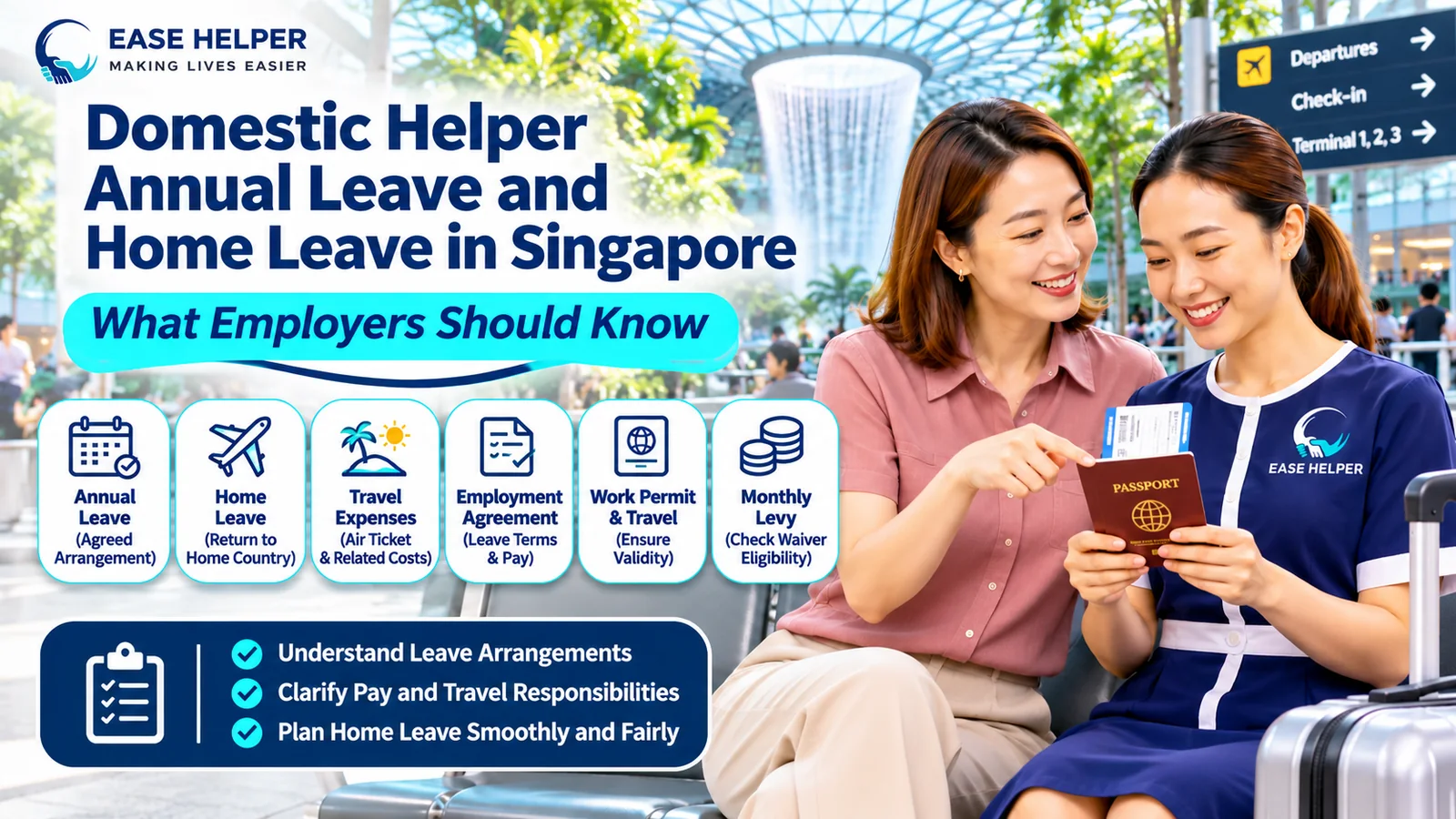
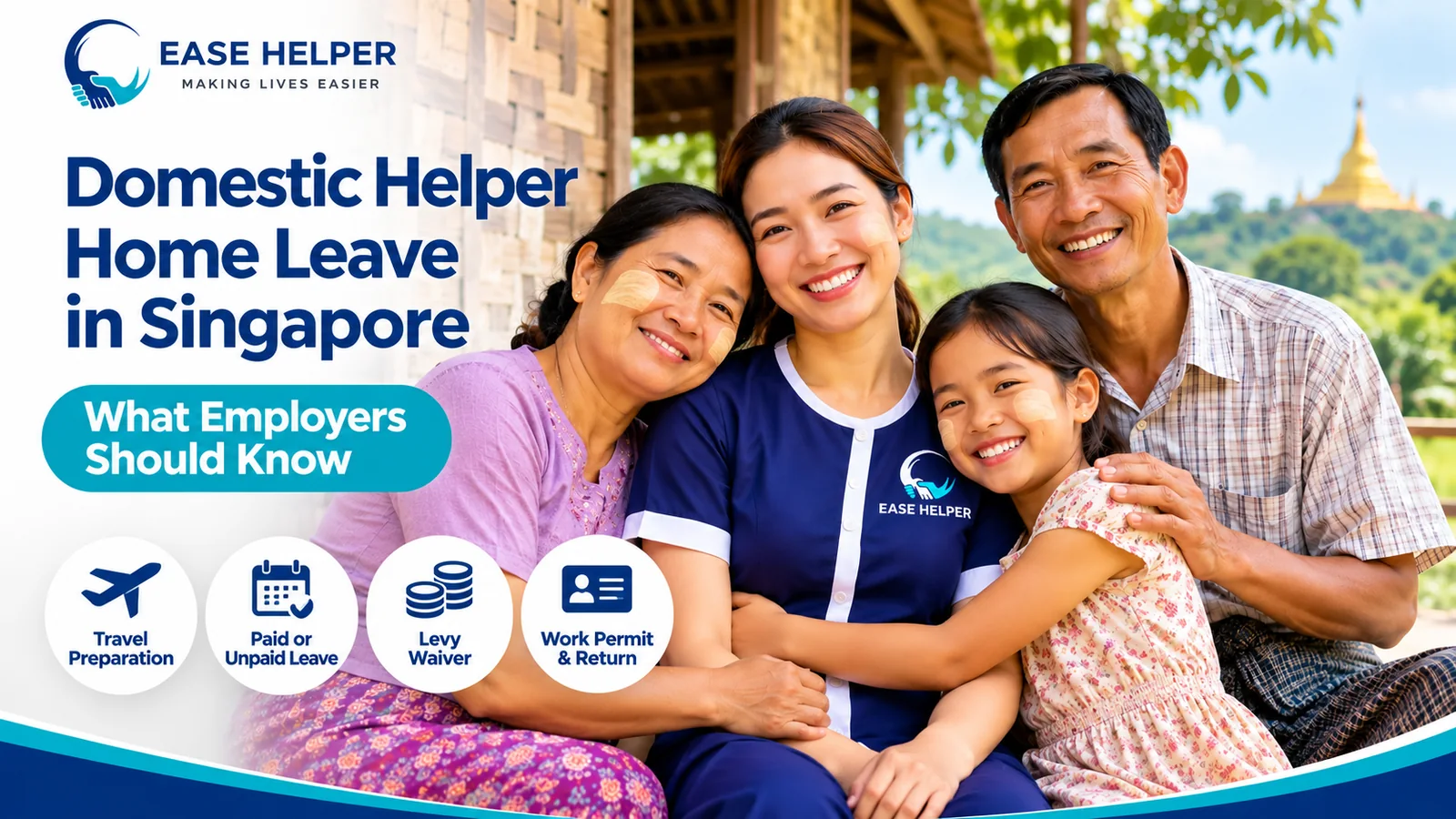
Domestic Helper Home Leave in Singapore: What Employers Should Know

Executive Summary
Domestic helper home leave in Singapore allows a helper to travel overseas, often to visit family, while her employment may continue. However, employers should plan carefully before approving the travel dates.
First, discuss whether the leave will be paid or unpaid. Next, check passport and Work Permit validity, immigration requirements and return arrangements. Employers should also understand MOM’s levy waiver rules, which may apply when overseas leave lasts at least seven consecutive days.
This guide explains how to prepare for home leave, manage the period of absence and respond if your domestic helper cannot return as planned.
1. What Is Domestic Helper Home Leave?
Home leave generally refers to a period when a domestic helper travels to her home country to visit family or attend to personal matters.
For example, she may wish to spend time with her children, visit elderly parents or attend an important family event.
Unlike the regular weekly rest day, overseas home leave usually involves advance planning and travel arrangements. Therefore, employers and helpers should agree on the dates and employment terms before booking tickets.
If you are new to employing a helper, read our guide to hiring a domestic helper in Singapore to understand the wider responsibilities of an employer.
2. Is Home Leave Compulsory for Domestic Helpers in Singapore?
There is no universal MOM requirement that every domestic helper must receive exactly 14 days of paid overseas home leave after two years.
Instead, employers should review the employment contract and discuss the proposed leave arrangement with their helper.
MOM notes that offering 14 days of paid overseas leave for every two years worked is a common practice. However, this example does not create an automatic statutory entitlement for every household.
What Employers Should Check
- Does the employment contract provide for home leave?
- How many days have the parties agreed upon?
- Will the leave be paid, unpaid or partly paid?
- Who will pay for the travel arrangements?
- What happens if the return date changes?
Discuss these questions early. Moreover, record the agreement in writing so both parties understand the arrangements.
Important: Home leave is different from the employer’s repatriation responsibilities when employment ends. Do not automatically apply end-of-employment travel rules to a temporary holiday.
3. Paid or Unpaid Home Leave: What Should Employers Consider?
Some employers provide paid home leave as part of their employment agreement. Others agree on unpaid leave or a combination of paid and unpaid days.
Therefore, the first step is to check the contract rather than assume that one arrangement applies to every domestic helper.
| Arrangement | What It Means | What to Clarify |
|---|---|---|
| Paid home leave | The helper receives salary for the agreed paid leave period. | Number of paid days and the salary payment schedule. |
| Unpaid home leave | The parties agree that specified leave days will be unpaid. | Exact dates, salary calculation and written agreement. |
| Partly paid leave | Some days are paid while the remaining days are unpaid. | Which dates fall into each category. |
| Contractual home-leave benefit | The employment agreement provides a particular leave entitlement. | Whether the agreed benefit has been fulfilled. |
For example, an employer might agree to 14 days of paid home leave, followed by additional unpaid days. However, this is only an example of a possible agreement, not a mandatory MOM formula.
Additionally, settle any outstanding salary matters before departure and document agreed deductions or adjustments properly.
4. Discuss the Travel Dates Early
Before confirming home leave, consider your family’s caregiving and household needs.
For instance, families with young children or elderly members may need additional time to arrange temporary support.
Nevertheless, employers should discuss dates respectfully and try to reach a reasonable agreement.
Questions to Discuss Before Booking
- When does your helper want to leave Singapore?
- When does she plan to return?
- Does she have an important family commitment?
- Will your household need temporary support?
- What should happen if a flight is delayed?
Once both parties agree, write down the departure and return dates. Then, confirm the flight details together.
5. Documents Needed Before Overseas Home Leave
MOM advises employers to ensure that their domestic helper has the necessary documents before travelling.
First, check that her passport remains valid for the journey. Next, review the Work Permit and any applicable immigration requirements.
| Document or Item | What to Check |
|---|---|
| Passport | Validity and the entry requirements of the destination and any transit countries. |
| Work Permit | Whether it remains valid for her return to Singapore. |
| Digital work pass or card | Ensure she can present her digital work pass in SGWorkPass or her physical Work Permit card. |
| Flight ticket | Correct travel dates, passenger details and baggage allowance. |
| Embassy requirements | Any additional immigration or travel documents required by her home country. |
| Contact details | A practical way for the employer and helper to communicate during the trip. |
For the official checklist, visit MOM’s overseas leave guidance for domestic helpers.
6. Should Employers Cancel the Work Permit During Home Leave?
Usually, employers who expect their helper to return should first consider keeping the Work Permit valid during the agreed overseas leave.
However, employers may consider cancellation if the helper will remain overseas for an extended period.
Before choosing that option, remember that cancelling the Work Permit ends its validity. Consequently, the employer must apply for a new Work Permit to employ the helper again.
This can involve additional administrative steps, costs and eligibility checks.
Therefore, compare the options carefully before cancelling a permit solely because the helper is travelling home.
7. Domestic Helper Levy During Home Leave
Employers continue to incur the monthly domestic helper levy while the Work Permit remains valid, even when the helper is overseas.
However, MOM allows eligible employers to apply for a levy waiver for qualifying overseas leave.
When Can Employers Apply for a Levy Waiver?
Under MOM’s published rules, overseas leave must last at least seven consecutive days. In addition, the overseas leave waiver is capped at 60 calendar days per calendar year.
For a helper who returns to Singapore, employers can apply for the waiver after her return.
| Situation | General MOM Position |
|---|---|
| Overseas leave shorter than seven consecutive days | Does not meet the minimum duration for the overseas leave levy waiver. |
| Overseas leave of seven consecutive days or longer | May qualify, subject to MOM’s conditions. |
| More than 60 days of overseas leave in a calendar year | The overseas leave waiver is capped at 60 calendar days for that year. |
| Helper does not return | Different waiver application steps apply, and the employer must cancel the Work Permit if it remains valid. |
Employers can review the procedure on MOM’s domestic helper levy waiver page.
Practical reminder: A levy waiver is not automatic simply because your helper leaves Singapore. Check eligibility and submit the relevant application through MOM’s process.
8. How to Apply for a Levy Waiver After Your Helper Returns
Once your helper returns, confirm her arrival date. Then, follow MOM’s online levy waiver application process.
- Access MOM’s levy waiver application service.
- Select the overseas leave reason.
- Enter the date your helper departed Singapore.
- Enter the date she returned to Singapore.
- Review the application details before submission.
MOM’s current guidance states that supporting documents are not required for the standard overseas leave waiver application. Nevertheless, employers should retain the travel itinerary and relevant records in case clarification becomes necessary.
Also, remember that levy waiver eligibility and paid leave arrangements are separate matters. A levy waiver does not determine whether home leave should be paid or unpaid.
9. What If the Six-Monthly Medical Examination Falls During Home Leave?
Domestic helpers may need to complete a six-monthly medical examination, commonly called the 6ME.
However, the examination date may fall during an approved overseas trip.
In that situation, employers can request a postponement under MOM’s applicable procedures.
Therefore, check the 6ME due date before finalising the travel dates. If a postponement is necessary, submit the request rather than simply allowing the deadline to pass.
See MOM’s six-monthly medical examination guidance.
10. Travel Costs and Air Tickets: Who Should Pay?
Travel expenses can become a source of disagreement if the parties do not discuss them before booking.
For temporary home leave, check the employment contract and any agreed home-leave benefit to determine who will pay for the ticket and related expenses.
Some employers offer a return air ticket as part of their contractual benefits. Others may have different arrangements.
Therefore, clarify the following items:
- Who pays for the outbound and return flights?
- Does the agreement cover checked baggage?
- Who pays for additional travel documents?
- What happens if either party changes the travel dates?
- Who bears any extra cost caused by a voluntary extension?
Record the agreement in writing before purchasing tickets.
Importantly, employers have separate obligations when sending a domestic helper home after employment ends. Do not confuse those obligations with an ordinary home-leave holiday.
11. Staying in Contact During Overseas Leave
Before departure, agree on a reasonable way to communicate about travel arrangements.
For example, your helper may use WhatsApp, another messaging service or a local telephone number while overseas.
However, remember that international roaming may not work as expected. Therefore, an alternative contact method can be helpful.
Respect her personal time and privacy during leave. Routine communication should focus on necessary matters, such as return travel or unexpected changes.
12. What If Your Domestic Helper Cannot Return on Time?
Unexpected events can affect international travel. For example, flights may be cancelled, a family emergency may occur or immigration documents may require attention.
First, contact your helper and establish what has happened. Then, assess whether a revised return date is realistic.
Next, review the Work Permit’s validity and any upcoming medical examination deadlines.
If the situation remains uncertain, contact MOM or your employment agency for guidance.
Above all, avoid cancelling the Work Permit without understanding the consequences for continued employment and re-entry.
13. What If Your Domestic Helper Does Not Return?
Sometimes a helper may decide not to return after travelling home.
In that situation, try to establish whether she intends to end the employment relationship.
If she will not return, MOM requires the employer to cancel her Work Permit. MOM’s cancellation guidance specifies that when a helper has left Singapore and will not return to work, the employer must cancel the permit within one week of her departure date.
Because that deadline may already have passed by the time an employer learns of the decision, contact MOM promptly if the situation becomes clear later.
Steps to Take
- Try to contact your helper and confirm her intentions.
- Keep relevant messages and departure records.
- Cancel the Work Permit through MOM’s prescribed process.
- Review whether a levy waiver application applies.
- Follow MOM’s instructions concerning the Work Permit card and security bond.
MOM advises employers to keep the departure itinerary and instruct a helper who remains overseas not to return on a cancelled Work Permit.
For official instructions, read MOM’s Work Permit cancellation guide.
Important: Work Permit cancellation, levy liability and security bond discharge are separate administrative matters. Follow MOM’s instructions for each instead of assuming they all conclude on the same date.
14. Common Home Leave Mistakes Employers Should Avoid
| Common Mistake | Better Approach |
|---|---|
| Assuming every helper automatically receives 14 paid days. | Check the employment contract and agree on the leave terms. |
| Booking flights without checking passport validity. | Review travel documents and destination requirements first. |
| Allowing the Work Permit to expire during the trip. | Check permit validity and renewal requirements before departure. |
| Assuming levy stops when the helper leaves Singapore. | Review eligibility and apply for a levy waiver where appropriate. |
| Forgetting an upcoming 6ME. | Check the due date and request postponement when required. |
| Cancelling a valid Work Permit without considering reapplication. | Understand the consequences and costs before cancellation. |
| Failing to discuss unexpected travel delays. | Agree on a practical communication and contingency plan. |
15. Domestic Helper Home Leave Checklist
Use this checklist before your helper travels overseas:
- ☐ Agree on departure and return dates.
- ☐ Confirm paid or unpaid leave terms in writing.
- ☐ Clarify who will pay for travel expenses.
- ☐ Check passport validity and destination requirements.
- ☐ Confirm that the Work Permit remains valid for re-entry.
- ☐ Ensure the helper has her digital work pass or Work Permit card.
- ☐ Keep a copy of the travel itinerary.
- ☐ Check whether the 6ME falls during the trip.
- ☐ Review the levy waiver conditions.
- ☐ Agree on reasonable contact arrangements.
- ☐ Plan temporary household support if needed.
- ☐ Confirm the helper’s return before submitting a standard overseas leave levy waiver application.
After completing the checklist, review the details together. This helps both parties understand the arrangements before departure.
16. Frequently Asked Questions
Is 14 days of paid home leave compulsory for domestic helpers?
No. MOM describes 14 days of paid overseas leave for every two years worked as a common practice, not a universal statutory requirement. Check the employment contract and agreed terms.
Can a domestic helper travel home without cancelling her Work Permit?
Yes. A helper can travel overseas while her Work Permit remains valid, provided she meets the applicable travel and re-entry requirements.
Does the domestic helper levy stop during home leave?
No. The levy continues while the Work Permit remains valid. However, employers may qualify for a levy waiver under MOM’s conditions.
How many days of overseas leave qualify for a levy waiver?
At least seven consecutive days of overseas leave are required. The overseas leave waiver is capped at 60 calendar days per calendar year.
Can an employer apply for the levy waiver before the helper returns?
For a helper who returns to Singapore, MOM directs employers to apply after her return. Different procedures apply if she does not return.
What happens if the helper’s 6ME is due during home leave?
Employers can request to postpone the examination under MOM’s procedures. Check the due date and arrange the postponement where necessary.
What if the helper decides not to return to Singapore?
Confirm the situation and promptly follow MOM’s Work Permit cancellation and levy waiver procedures. Keep the relevant travel records.
17. How EaseHelper Can Support Employers
Planning domestic helper home leave involves several practical decisions. Therefore, employers should review the arrangements carefully and communicate clearly with their helpers.
EaseHelper can assist employers with general hiring and employment-related enquiries, including understanding household expectations and preparing for changes in domestic helper arrangements.
However, employers remain responsible for complying with MOM’s requirements. For case-specific regulatory questions, seek clarification directly from MOM.
Need Guidance on Domestic Helper Arrangements?
EaseHelper supports Singapore employers throughout the domestic helper hiring journey.
Explore our services and prepare for your household’s needs with greater confidence.
Explore EaseHelper ServicesDisclaimer
This article provides general information and does not constitute legal, immigration or employment advice. MOM requirements, administrative procedures and immigration conditions may change. Employers should verify current requirements through the Ministry of Manpower and consult the relevant embassy or immigration authority when necessary. Contractual arrangements may differ between households.