
Blog
Domestic Helper Agency Fees in Singapore: What Employers Should Check

Executive Summary
Domestic helper agency fees in Singapore can vary depending on the recruitment services, candidate arrangements and support included. Before signing an agreement, employers should request an itemised quotation, distinguish agency service fees from third-party expenses, and understand any placement loan arrangements. They should also check replacement terms and statutory refund rights. This guide explains the main charges, important contract clauses and practical questions to ask before engaging a licensed employment agency.
What Are Domestic Helper Agency Fees in Singapore?
Domestic helper agency fees are charges for recruitment and placement-related services provided by an employment agency. Depending on the package, these services may include candidate matching, interviews, administrative coordination and placement assistance.
However, agencies do not necessarily provide identical services. Consequently, two quotations with different prices may represent different levels of assistance.
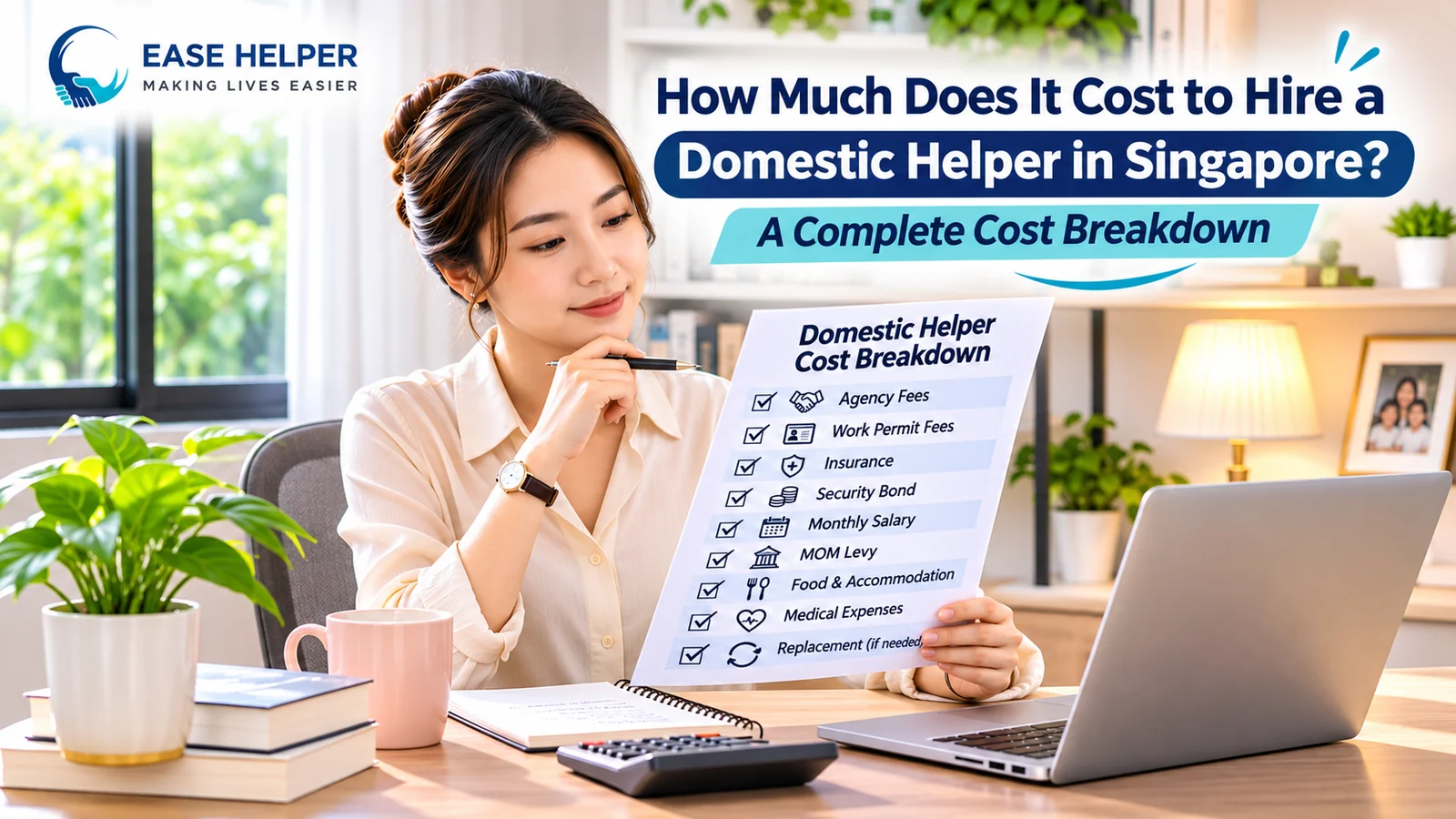
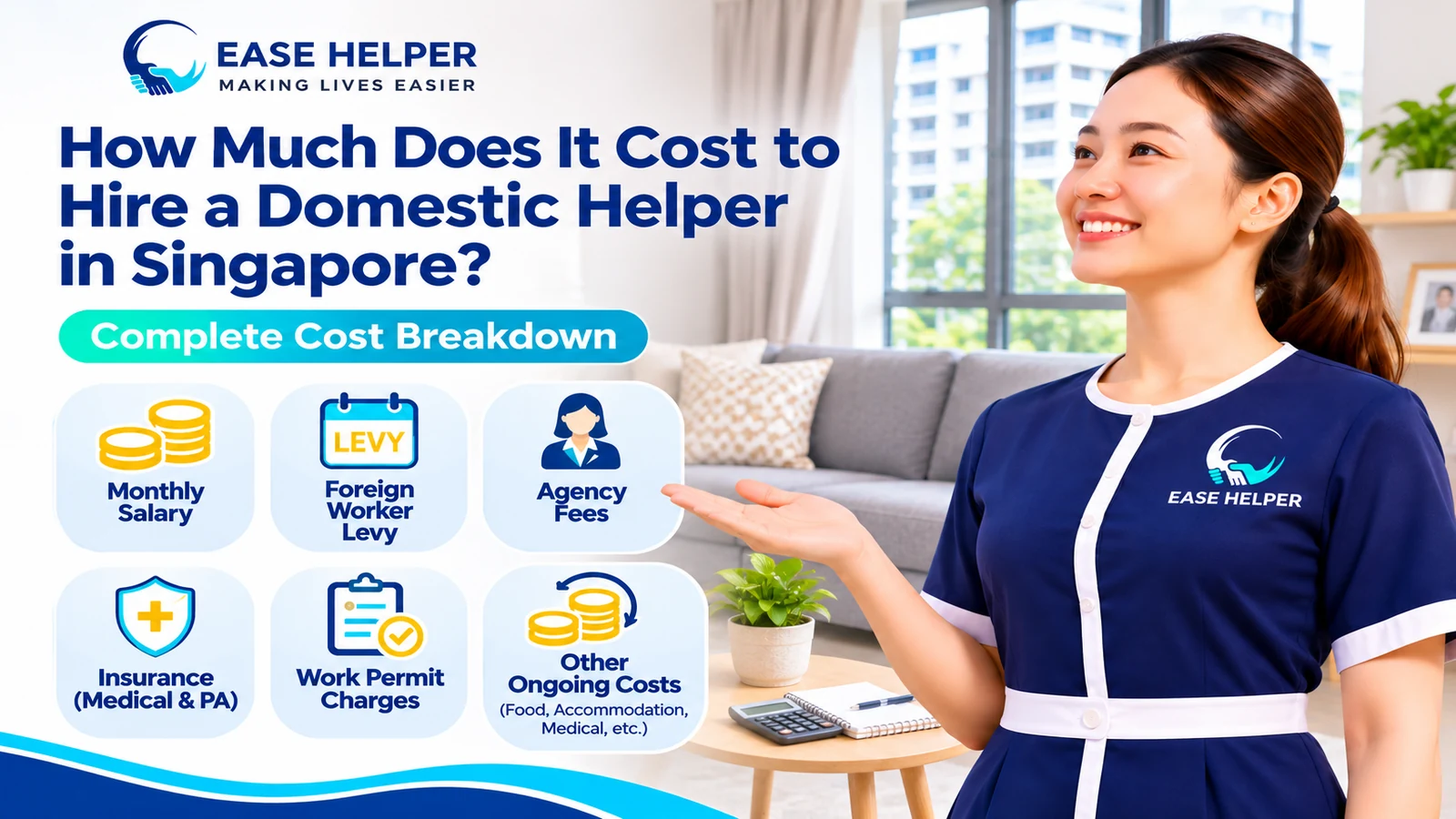
Employers should also distinguish agency fees from the broader cost of hiring and employing a domestic helper. For example, government charges, insurance and ongoing employment expenses may appear separately.
Before selecting an agency, review its quotation and written service agreement carefully.
How Much Do Domestic Helper Agencies Charge?
There is no single standard agency service fee that applies to every domestic helper placement in Singapore. Agencies determine their service packages and prices, subject to applicable laws and regulatory requirements.
According to a January 2026 Ministry of Manpower (MOM) parliamentary answer, the median upfront recruitment outlay for a new migrant domestic worker was approximately S$4,700. About half of this amount represented a placement loan that employers subsequently recover.
Importantly, that figure represents overall upfront recruitment outlay. It is not a standard agency service fee or a quotation from EaseHelper.
Therefore, employers should obtain a current, itemised quotation based on their recruitment needs rather than rely on a single advertised amount.
What Charges Might Appear in an Agency Quotation?
A quotation may contain several types of charges. However, not every item represents income earned by the agency.
| Charge | What It May Cover | What Employers Should Check |
|---|---|---|
| Agency service fee | Candidate matching, recruitment and placement services | Services included and applicable refund terms |
| Administrative service fee | Documentation and application assistance | Whether this is included in the main service fee |
| Work Permit charges | Applicable government application and issuance fees | Current official rates and payment responsibility |
| Insurance | Required insurance coverage | Coverage, exclusions, insurer and policy duration |
| Medical examination | Required medical screening | Whether the cost is included or separate |
| Travel arrangements | Relevant transport and arrival expenses | Who pays and which journeys are covered |
| Training | Practical preparation or additional training services | What training is included and who provides it |
| Placement loan | Amounts advanced on the helper’s behalf under an applicable arrangement | Loan amount, repayment terms and documentation |
| GST | Goods and Services Tax, where applicable | Whether the quotation includes GST |
Because packages differ, employers should ask whether each listed charge is compulsory, optional, included or payable separately.
Agency Service Fees vs Placement Loans
One of the most important distinctions is the difference between an agency service fee and a domestic helper’s placement loan.
Agency Service Fees
An agency service fee generally covers the agency’s recruitment and placement services. Employers pay for the services specified in the agreement.
For the purpose of MOM’s employer service-fee refund rules, certain third-party and regulatory costs are excluded from the definition of refundable service fees.
Placement Loans
A placement loan is different. Under some arrangements, an employer advances certain recruitment-related amounts on behalf of the domestic helper and subsequently recovers them according to a documented agreement and applicable requirements.
Employers should not confuse the loan with the agency’s own service fee. Moreover, they should confirm how much is being advanced, who receives the money and how repayment will work.
In particular, employers should not treat the helper’s entire salary as an unrestricted source of deductions. Any repayment arrangement must comply with the applicable rules and employment terms.
Important: Ask the agency to identify the placement loan separately from its service fees. Request clear written records of the amount, repayment arrangement and any applicable refund conditions.
What Must a Domestic Helper Agency Service Agreement Include?
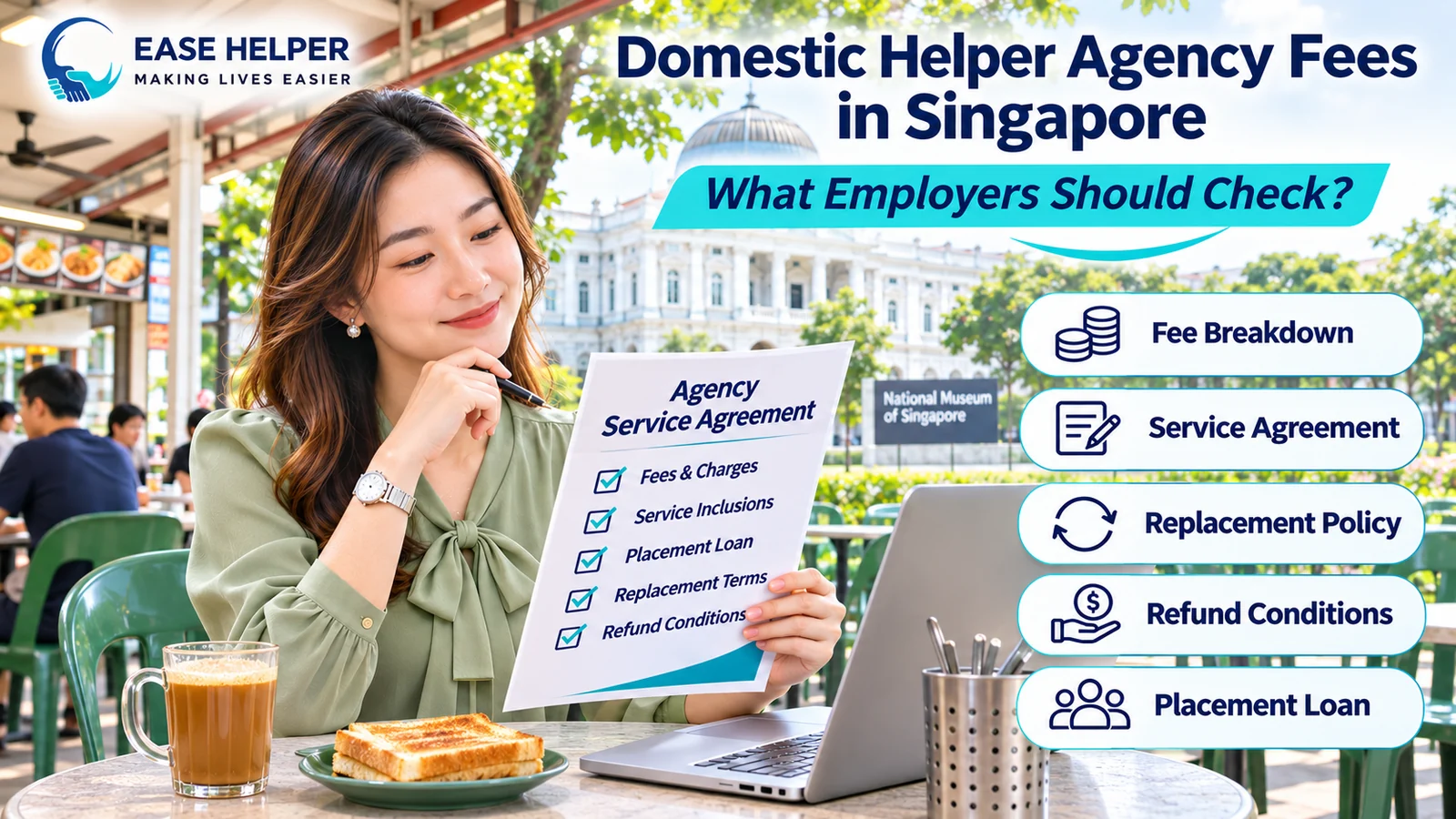
MOM requires employment agencies to enter into a written service agreement with domestic helper employers.
The agreement should clearly explain the services provided and the rights and responsibilities of both parties.
Under MOM’s employment agency licence conditions, relevant agreement details include:
- The validity period of the agreement.
- A clear breakdown of fees and applicable taxes.
- Relevant amounts paid upfront on behalf of the helper.
- Refund arrangements for different placement outcomes.
- Replacement arrangements and associated conditions.
- Relevant responsibilities and dispute resolution procedures.
Consequently, employers should read the entire agreement before paying or signing.
For official guidance, refer to MOM’s requirements for employment agency service agreements.
Domestic Helper Agency Refund Rules in Singapore
Refund arrangements deserve particular attention because a placement may end earlier than expected.
The Statutory 50% Service-Fee Refund
Under MOM’s rules, an employment agency must refund at least 50% of qualifying service fees paid by an employer when the domestic helper’s employment ends within the first six months and the applicable conditions are met.
This requirement applies to qualifying agency contracts entered into on or after 1 June 2022.
However, not every payment forms part of the refundable service-fee amount. MOM excludes specified costs, including certain local entry requirements, relevant home-country requirements, qualifying third-party training costs and the helper’s placement loan.
When Might the Statutory Refund Not Apply?
MOM identifies specific exceptions. For example, the refund requirement may not apply when:
- The agency performed administrative work only and provided no matching service.
- The employer breached employment laws or committed an offence against the helper.
- The employer failed to notify the agency within a reasonable time before the relevant cancellation, transfer or repatriation action.
- The applicable replacement limits under the refund framework have been reached.
- A specified caregiving arrangement ends because care is no longer needed under the circumstances described by MOM.
Therefore, employers should not assume that every early termination automatically produces a refund.
For qualifying cases, MOM states that agencies must provide the refund within 14 working days after the employer’s written refund request or the Work Permit cancellation, whichever occurs later.
Read the full MOM service-fee refund rules before relying on a refund entitlement.
Replacement Policies: What Should Employers Check?
A replacement arrangement may allow an employer to request assistance finding another helper when the original placement ends.
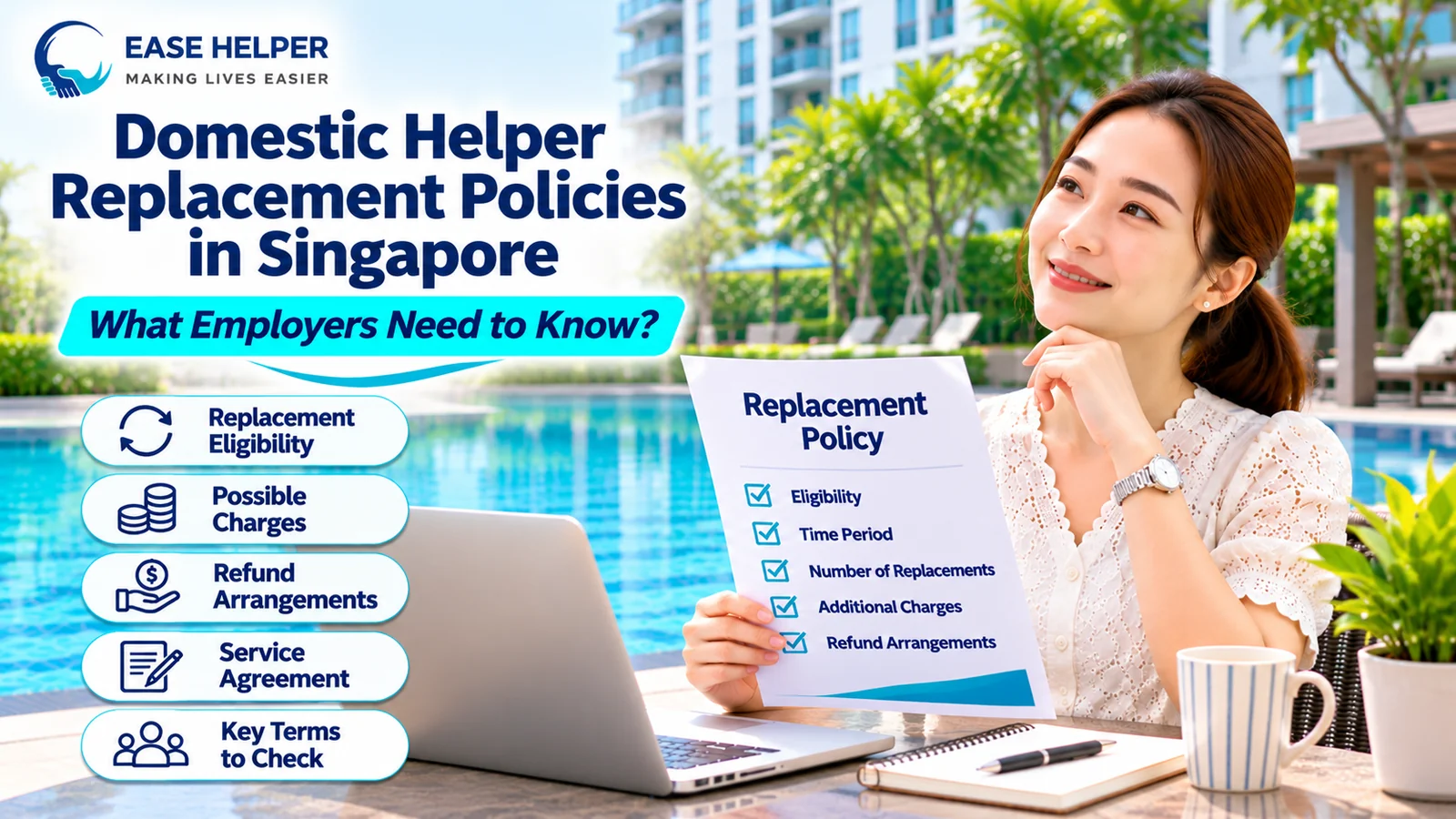
However, replacement services differ between agencies. Some packages may include a specified number of replacements, while others may impose additional service charges or conditions.
Before signing, ask:
- How many replacements does the package include?
- How long does the replacement entitlement remain valid?
- Will additional recruitment or administrative charges apply?
- What happens if no suitable replacement is available?
- How does choosing a replacement affect any statutory refund entitlement?
- What happens if the employer declines a proposed replacement?
Importantly, contractual replacement terms cannot override an employer’s statutory rights under MOM’s service-fee refund rules.
How to Compare Two Agency Quotations Fairly
Comparing only the advertised price can be misleading. Instead, evaluate the services and conditions behind each quotation.
| Comparison Point | Agency A | Agency B |
|---|---|---|
| Agency service fee | Request amount | Request amount |
| Administrative charges | Included or separate? | Included or separate? |
| Insurance and medical costs | Confirm coverage | Confirm coverage |
| Candidate screening | Confirm scope | Confirm scope |
| Training | Confirm availability | Confirm availability |
| Replacement support | Check conditions | Check conditions |
| Refund terms | Review agreement | Review agreement |
| Total upfront payment | Calculate total | Calculate total |
Next, consider the agency’s communication, clarity and ability to explain its services. A transparent quotation should help you understand what you are purchasing.
Warning Signs Employers Should Watch For
Before making a payment, watch for arrangements that are difficult to understand or verify.
- Unclear differences between agency fees and placement loans.
- Unexpected charges not explained in the quotation.
- Pressure to sign without reviewing the agreement.
- Vague replacement or refund conditions.
- Verbal promises that do not appear in writing.
- Unclear information about the agency’s licence or services.
If something is unclear, request an explanation in writing. Additionally, verify the agency’s licensing information through MOM’s official resources.
Questions to Ask Before Paying Agency Fees
Use this checklist when discussing a recruitment package:
- What is the total amount payable before the helper arrives?
- Which portion represents the agency’s service fee?
- Which expenses go to government bodies or third-party providers?
- Is GST included in the quoted price?
- Is there a placement loan? If so, how does repayment work?
- What screening and training services are included?
- What replacement assistance does the agreement provide?
- Which fees may be refunded if the placement ends early?
- Will I receive the written agreement and relevant receipts?
- Who can I contact if I have a question after placement?
These questions help employers understand both the initial payment and the services they can expect.
Frequently Asked Questions
Are domestic helper agency fees fixed in Singapore?
No single agency service fee applies to every placement. Fees depend on the services and arrangements offered. Employers should request a current, itemised quotation.
Is the placement loan the same as an agency fee?
No. A placement loan is distinct from the agency’s service fee. Employers should request separate documentation and understand the applicable repayment arrangements.
Can I get a refund if my domestic helper leaves within six months?
Potentially. MOM requires a refund of at least 50% of qualifying employer-paid agency service fees when employment ends within six months and the statutory conditions are met.
Does the 50% refund cover every recruitment expense?
No. MOM excludes certain specified costs from the definition of service fees, including the helper’s placement loan and various regulatory or third-party expenses.
Can an agency offer a replacement instead of a refund?
Replacement arrangements may be available under the service agreement. However, employers should review how those arrangements interact with MOM’s statutory refund requirements.
Should I choose the agency with the lowest fees?
Not necessarily. Compare the complete service package, candidate matching, training, administrative assistance, replacement terms and total upfront costs.
How EaseHelper Helps Employers Understand Recruitment Fees
EaseHelper believes employers should understand the recruitment services and costs before making a hiring decision.
Our team can explain available recruitment arrangements, candidate matching, relevant documentation and the scope of our services. In addition, our in-house training approach focuses on preparing domestic helpers for practical household responsibilities.
Before proceeding, employers can discuss their household requirements and request information about applicable charges and service terms.
Planning to Hire a Domestic Helper?
Contact EaseHelper to discuss your household needs, available recruitment services and the fees applicable to your preferred arrangement.
Explore EaseHelper ServicesDisclaimer: This article provides general information for Singapore employers and does not constitute legal or financial advice. Recruitment charges, agency packages, government requirements and applicable refund conditions may change. Always review the agency’s written service agreement and consult the latest Ministry of Manpower guidance. Any market-wide recruitment figures mentioned are not quotations or advertised prices from EaseHelper.