Blog
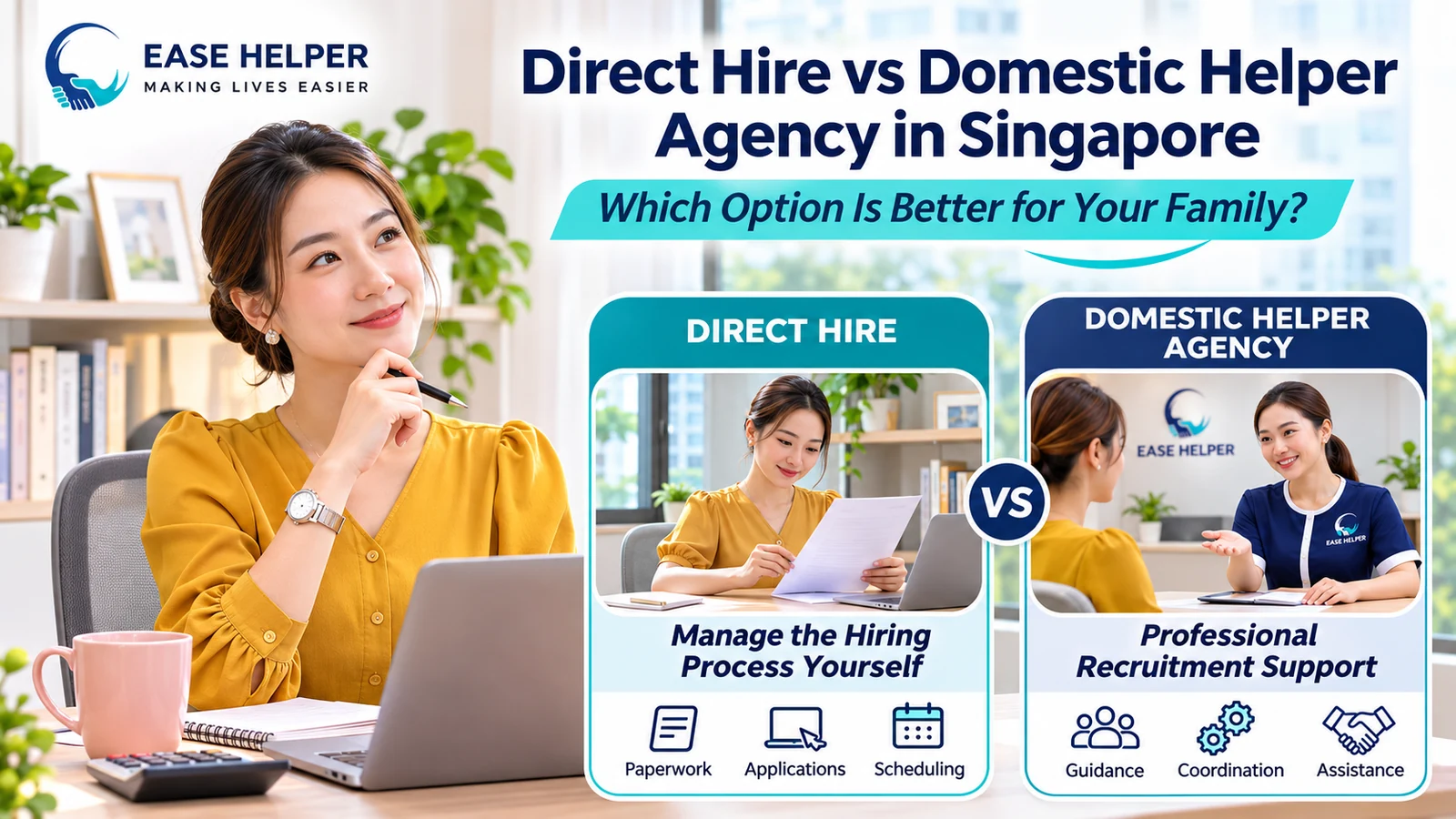
Direct Hire vs Domestic Helper Agency in Singapore: Which Option Is Better?

Executive Summary
Singapore employers can hire a domestic helper directly or engage a licensed employment agency. Direct hiring offers greater control over recruitment and may reduce agency service fees. However, employers must manage more of the screening, documentation and arrival process themselves. An agency can assist with candidate matching, Work Permit procedures and placement support, although its services involve additional charges. This guide compares both options, explains their responsibilities and helps families choose a suitable approach.
Can You Hire a Domestic Helper Without an Agency in Singapore?
Yes. The Ministry of Manpower (MOM) allows eligible employers to apply for a migrant domestic worker’s Work Permit themselves or through an authorised employment agency.
Therefore, using an agency is not compulsory for every domestic helper recruitment. Nevertheless, employers must meet the relevant eligibility criteria and complete the required procedures regardless of their recruitment method.
MOM confirms this in its guidance on hiring a domestic helper without an agency.
Before choosing a recruitment method, employers can also read our complete guide to hiring a domestic helper in Singapore.
Direct Hire vs Domestic Helper Agency: Key Differences
| Factor | Direct Hire | Licensed Domestic Helper Agency |
|---|---|---|
| Candidate search | Employer identifies potential candidates | Agency assists with sourcing and matching |
| Screening | Employer conducts checks and interviews | Agency may assist with screening and interviews |
| Work Permit | Employer manages the application | Authorised agency can handle the application |
| Recruitment fees | Agency matching fees may be avoided | Agency service charges usually apply |
| Documentation | Employer coordinates required documents | Agency may coordinate paperwork |
| Training | Employer assesses training needs and arranges support | Agency may offer training, depending on its services |
| Replacement assistance | Employer generally manages a new search | Support depends on the service agreement and applicable rules |
| Time commitment | More direct involvement is usually required | Some administrative work can be delegated |
| Employer obligations | Remain with the employer | Remain with the employer |
Neither method guarantees a successful placement. Instead, the outcome depends on careful screening, clear expectations and a suitable match between the helper and household.
What Is Direct Hiring?
Direct hiring means the employer identifies and recruits a domestic helper without engaging an employment agency for candidate matching.
For example, a family may already know a prospective helper through a personal recommendation. Alternatively, an employer may identify a suitable candidate through another lawful recruitment channel.
However, direct hiring does not remove the need for proper immigration and employment procedures. The employer must still satisfy MOM’s requirements.
Advantages of Direct Hiring
- Greater recruitment control: Employers can manage interviews and selection personally.
- Potential savings: Families may avoid some agency matching and service fees.
- Direct communication: Employers can discuss expectations with the prospective helper.
- Flexibility: Families can manage the recruitment process according to their circumstances.
These advantages may appeal to employers who understand the process and already have a suitable candidate in mind.
Disadvantages of Direct Hiring
- More administrative work: Employers must coordinate the necessary application and arrival steps.
- Screening responsibility: Families must assess the candidate’s experience and suitability.
- Possible overseas requirements: Additional procedures may apply in the helper’s home country.
- Limited placement support: Employers may need to resolve recruitment difficulties themselves.
- Replacement arrangements: Finding another helper can require a fresh recruitment process.
As a result, direct hiring may involve less agency expenditure but more time, coordination and uncertainty.
What Does a Domestic Helper Agency Do?
A licensed domestic helper agency assists employers with recruitment-related services. Depending on its service package, it may help with candidate matching, interviews, documentation, Work Permit applications and placement arrangements.
Some agencies also provide practical training and post-placement guidance. However, employers should confirm which services the agency actually offers rather than assume every package is identical.
Advantages of Using a Domestic Helper Agency
- Candidate matching: Agencies can help shortlist candidates based on household needs.
- Administrative assistance: An authorised agency can manage relevant Work Permit transactions.
- Recruitment guidance: Employers can ask about required procedures and documents.
- Training options: Some agencies provide practical household-skills preparation.
- After-placement support: Agencies may assist with communication or placement concerns.
Therefore, agency recruitment may suit families who prefer professional coordination or have limited time to manage the process themselves.
Disadvantages of Using an Agency
- Agency service fees increase the initial recruitment budget.
- Service quality and candidate availability vary between agencies.
- Replacement and cancellation arrangements require careful review.
- Some services may attract additional charges outside the advertised package.
Consequently, employers should request an itemised quotation and read the written service agreement before committing.
Is Direct Hiring Cheaper Than Using an Agency?
Direct hiring can reduce certain recruitment expenses because the employer may avoid agency matching fees. However, this does not automatically make it the cheapest option overall.
Both recruitment methods can involve government charges, insurance, medical examinations, travel arrangements and ongoing employment expenses. In addition, overseas recruitment requirements may affect the final cost.
To compare both methods fairly, consider:
- One-time recruitment and administrative costs.
- Government fees and required insurance arrangements.
- Travel and arrival expenses.
- Time spent arranging interviews and documentation.
- Training and post-placement support.
- Potential costs if the initial placement does not work out.
Importantly, monthly salary, the applicable levy, food, accommodation and medical responsibilities remain relevant regardless of the recruitment method.
Budgeting tip: Compare the total cost of hiring and employment, not only the upfront agency fee. Ask for written quotations and confirm current government charges before making a decision.
Work Permit Responsibilities: What Employers Must Know
Whether employers hire directly or use an agency, MOM’s Work Permit requirements still apply.
The application process generally involves obtaining the helper’s written consent, submitting the application, preparing for arrival, meeting insurance and security bond requirements where applicable, and completing Work Permit issuance.
Employers should also check whether the prospective helper must meet additional requirements in her home country.
For the official procedure, refer to MOM’s Work Permit application guide.
Although an agency may handle authorised transactions, the employer remains responsible for complying with the applicable employment conditions.
What About Screening and Training?
Screening a Domestic Helper
A good recruitment decision starts with understanding the household’s requirements. For example, families may need assistance with cooking, cleaning, childcare or elderly care.
During interviews, discuss relevant experience, practical skills, communication ability and daily routines. In addition, explain the household’s expectations clearly.
Employers should not assume that a candidate’s previous experience guarantees suitability for every household. Instead, assess whether her skills match the work she will actually perform.
Training and Household Preparation
Training can help a domestic helper become familiar with household tasks and safety practices. However, the availability and scope of training differ between agencies.
At EaseHelper, in-house training forms part of our approach to preparing helpers for everyday household responsibilities.
Nevertheless, employers should continue providing clear instructions and appropriate guidance after the helper arrives. Every household has different routines, equipment and expectations.
Replacement and Refund Policies: Why the Details Matter
One important difference between recruitment methods is the support available when a placement ends early.
When an employer engages a licensed agency for matching services, the written service agreement should explain applicable replacement arrangements, charges and refund conditions.
Under MOM’s service-fee refund rules, agencies must refund at least 50% of qualifying service fees paid by the employer if the helper’s employment ends within the first six months and the applicable conditions are met. Certain situations are excluded, including arrangements where an agency provides only administrative services without matching.
Therefore, employers should not assume that every payment is refundable or that every placement qualifies. Read MOM’s official agency service-fee refund guidance for the full conditions.
For direct hiring without an agency matching service, the employer generally cannot rely on an agency’s replacement package. Consequently, a new candidate search may require additional time and expense.
Which Hiring Method Is Better for Your Family?
Consider Direct Hiring If…
- You already know a suitable prospective helper.
- You understand the required recruitment procedures.
- You have time to coordinate interviews and documents.
- You are comfortable managing recruitment without agency matching support.
Consider a Domestic Helper Agency If…
- You need assistance identifying suitable candidates.
- You prefer help coordinating recruitment documentation.
- You value structured interviews or practical training options.
- You want to understand available post-placement support.
- You prefer a written service arrangement setting out agency responsibilities.
Ultimately, the better option depends on your household’s needs, available time, budget and confidence in managing recruitment.
Questions to Ask Before Choosing an Agency
If you decide to engage an agency, ask these questions before signing:
- Is the employment agency licensed in Singapore?
- What candidate screening and matching services are included?
- Can I interview prospective helpers before deciding?
- Does the agency provide practical training?
- What are the total fees, including any third-party charges?
- What replacement assistance is available?
- How do the refund and cancellation terms work?
- Who should I contact if a placement concern arises?
In addition, check the agency’s licence and available information through MOM’s official employment agency resources.
Frequently Asked Questions
Is it legal to hire a domestic helper directly in Singapore?
Yes. Eligible employers can apply for a domestic helper’s Work Permit directly through MOM. However, all relevant requirements must still be met.
Do I need an agency to renew a domestic helper’s Work Permit?
No. MOM allows eligible employers to renew the Work Permit themselves through the relevant eService.
Is hiring through an agency always faster?
Not necessarily. Recruitment timelines depend on candidate availability, documentation, processing and other requirements. An agency can assist with coordination, but it cannot guarantee government approval or a fixed completion date.
Does an agency guarantee that the helper will be suitable?
No. An agency can support screening and matching, but employers should still conduct interviews and explain household expectations.
Can an agency handle only the Work Permit paperwork?
Some agencies may offer administrative-only services. However, the scope, fees and applicable refund arrangements can differ from a full recruitment and matching package.
Do employers remain responsible after hiring through an agency?
Yes. Employers must continue meeting applicable obligations concerning salary, levy, accommodation, food, medical care and other employment conditions.
How EaseHelper Supports Your Recruitment Decision
EaseHelper helps Singapore employers explore suitable domestic helper recruitment arrangements based on household needs.
Our approach includes understanding employer requirements, facilitating candidate selection and providing information about recruitment procedures and available services. We also operate an in-house training centre that prepares helpers for practical household tasks.
Before proceeding, employers can discuss the scope of services, applicable fees and recruitment expectations with our team.
Looking for a Suitable Domestic Helper?
Explore your recruitment options with EaseHelper and learn more about candidate matching, training and placement assistance.
Explore EaseHelper ServicesDisclaimer: This article provides general information for Singapore employers and does not constitute legal advice. Recruitment procedures, government requirements, agency fees and refund conditions may change. Check the latest MOM guidance and review your agency’s written service agreement before making a hiring decision. Services and terms vary by provider.