Blog
Domestic Helper Language Barriers in Singapore: How to Improve Communication

Executive Summary
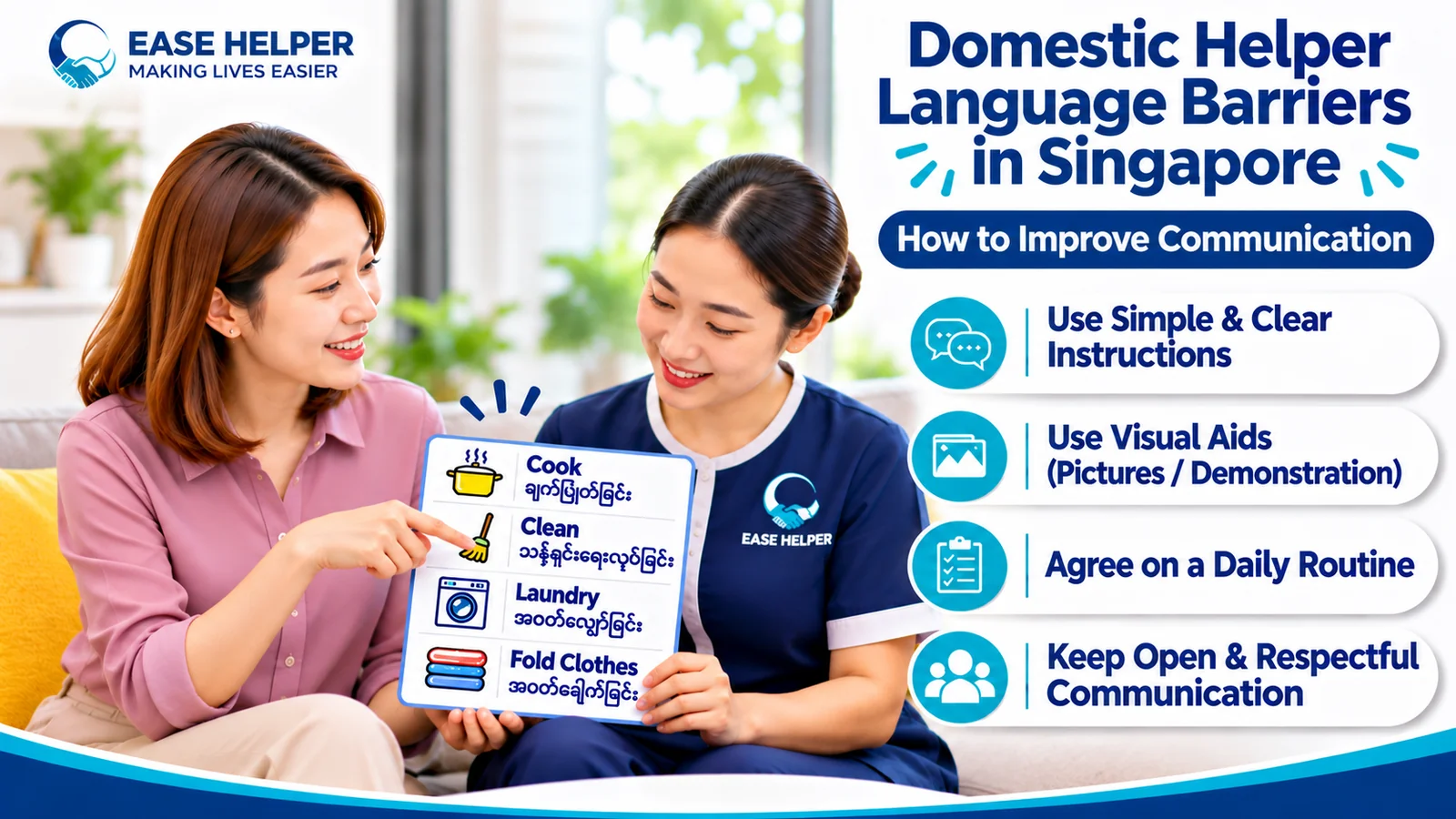
Domestic helper language barriers in Singapore can create misunderstandings about household duties, safety procedures and daily expectations. However, employers can improve communication through patience, simple language and practical demonstrations.
Instead of repeating long instructions, use short sentences, visual checklists and supervised practice. Most importantly, confirm understanding without embarrassing your helper.
This guide explains common communication challenges, useful tools, everyday examples and a step-by-step approach to building clearer communication at home.
1. Why Do Language Barriers Happen?
Singapore households may employ domestic helpers from Myanmar, Indonesia and other approved source countries. Each helper brings different language abilities, experiences and cultural expectations.
For example, a helper may understand everyday English but struggle with unfamiliar appliance instructions or specific childcare terms.
Likewise, employers sometimes speak quickly, use slang or give several instructions at once. Consequently, a helper may miss important details even when she is trying her best.
Language differences do not necessarily indicate poor ability or unwillingness to learn. Instead, they often highlight a need for clearer explanations and practice.
2. Common Communication Problems in Singapore Households
Misunderstandings can affect everyday routines, particularly during a helper’s first few weeks.
| Situation | Possible Misunderstanding | Better Approach |
|---|---|---|
| Cooking | The helper misunderstands ingredients or quantities. | Show ingredients and demonstrate measurements. |
| Cleaning | She uses the wrong product on a surface. | Label products and explain where each can be used. |
| Laundry | Clothes are washed at the wrong temperature. | Demonstrate settings and use a simple laundry chart. |
| Childcare | Feeding or nap instructions are unclear. | Provide written times and confirm the routine. |
| Elderly care | Mobility instructions are misunderstood. | Demonstrate safe procedures and arrange training where needed. |
| Emergency | The helper does not understand what action to take. | Practise emergency instructions and keep contacts visible. |
Therefore, employers should identify safety-sensitive instructions and explain them particularly carefully.
3. Use Simple English and Short Sentences
One of the easiest ways to improve communication is to use clear, direct language.
For instance, avoid combining five tasks into one long sentence. Instead, explain the first task, confirm understanding and then move to the next.
Examples of Clearer Instructions
| Less Clear | Clearer Instruction |
|---|---|
| “Sort everything out before lunch.” | “Please wash the dishes first. Then wipe the kitchen table.” |
| “Do the laundry properly.” | “Wash the white clothes separately from the coloured clothes.” |
| “Make sure the baby is ready.” | “Please prepare the baby’s clean clothes and nappies before bath time.” |
| “Keep an eye on Mum.” | “Please stay nearby when Mum walks to the bathroom. Tell me if she feels dizzy.” |
| “Clean this when you have time.” | “Please clean the dining table after breakfast.” |
Additionally, use familiar words consistently. Changing the name of an appliance or household item every day can create unnecessary confusion.
4. Demonstrate Tasks Instead of Only Explaining Them
Some household activities are easier to understand through demonstration.
For example, showing a helper how to operate a washing machine may be more effective than describing every button verbally.
A Four-Step Teaching Method
- Explain: State the purpose of the task using simple language.
- Show: Demonstrate the correct procedure slowly.
- Practise: Let your helper repeat the task under supervision.
- Confirm: Ask her to explain or demonstrate the important steps.
Afterwards, give specific feedback and allow time for improvement.
However, do not use trial and error for dangerous activities. For example, chemical handling and infant safety require clear instructions before independent work.
5. Create Visual Household Checklists
Visual instructions can reduce the need for repeated verbal explanations.
For instance, a simple kitchen checklist might show photographs of the correct cleaning products, storage locations and appliance settings.
Likewise, a laundry chart can explain which clothes should be washed separately.
Useful Visual Guides
- Kitchen cleaning steps with pictures.
- Washing machine settings and clothing categories.
- Daily meal preparation routines.
- Childcare feeding and nap schedules.
- Safe storage of household chemicals.
- Emergency contacts and evacuation instructions.
Keep each checklist short. Moreover, update it when household routines change.
6. Use Translation Tools Carefully
Translation apps can help employers explain unfamiliar words or instructions. However, automated translations sometimes contain errors.
Therefore, avoid relying on a translation app alone for medication instructions, emergencies or other safety-critical matters.
Instead, combine translated text with demonstrations, pictures and confirmation of understanding.
Tips for Better Translations
- Translate one short instruction at a time.
- Avoid slang, abbreviations and complicated expressions.
- Use pictures alongside translated text.
- Check important details through a demonstration.
- Ask a qualified professional for help with specialised medical instructions.
Additionally, respect your helper’s privacy when using digital tools. Avoid uploading unnecessary personal or sensitive information.
7. Confirm Understanding Without Asking Only “Do You Understand?”
Some helpers may say “yes” because they feel nervous, wish to be polite or do not know how to explain their confusion.
As a result, simply asking whether someone understands may not reveal a misunderstanding.
Instead, use a friendly teach-back approach.
Better Questions to Ask
- “Can you show me which setting you will use?”
- “What will you do first?”
- “Which cleaning product is safe for this surface?”
- “Who will you call if there is an emergency?”
- “Can you tell me when the next feeding time is?”
These questions allow employers to identify gaps without blaming the helper.
8. Communicate Household Priorities Clearly
Even when individual instructions are understood, a helper may struggle to decide which task should come first.
Therefore, explain priorities as well as tasks.
For example, child supervision should take priority over folding laundry when a young child needs active attention.
Similarly, helping an elderly family member move safely may be more urgent than routine cleaning.
Use a simple daily schedule to show essential duties, flexible tasks, meals and rest periods.
However, avoid overloading the schedule. Clear communication cannot solve an unrealistic workload.
9. Avoid Singlish and Unfamiliar Expressions at First
Singapore employers may naturally use Singlish expressions such as “later then do” or “can already”. However, a newly arrived helper may interpret these phrases differently.
For example, “later” might mean ten minutes to one person and several hours to another.
Instead, use specific times and straightforward instructions.
As your helper becomes more familiar with the household, she may gradually understand commonly used expressions. Nevertheless, clarity remains more important than speed.
10. Explain Feedback Calmly and Specifically
Misunderstandings can be frustrating, especially when employers are busy. However, raising your voice may make communication more difficult.
Instead, describe the problem and demonstrate the preferred method.
Example: Incorrect Laundry Sorting
Less helpful: “You always wash the clothes wrongly.”
More helpful: “Please put white clothes in this basket and coloured clothes in the other basket. Let me show you.”
Next, ask the helper to demonstrate the sorting process.
Finally, acknowledge improvement when she follows the instructions correctly.
Constructive feedback helps build confidence while maintaining clear expectations.
11. Encourage Your Helper to Ask Questions
Communication should work in both directions.
Therefore, tell your helper that she can ask for clarification whenever instructions are unclear.
For example, you might say, “If you are not sure, please ask me before you start.”
Additionally, set aside a few minutes for regular check-ins. Ask whether any household tasks remain confusing or require further training.
When helpers feel comfortable asking questions, employers can often prevent mistakes before they occur.
12. Communication During Childcare
Childcare instructions require particular care because misunderstandings may affect a child’s safety.
For instance, feeding routines, allergies, medication and emergency procedures must be explained accurately.
Childcare Communication Checklist
- Write down feeding and nap routines.
- Clearly identify known allergies.
- Demonstrate safe handling and supervision practices.
- Explain which activities require immediate employer notification.
- Keep emergency contact details accessible.
- Confirm important instructions through teach-back.
Furthermore, never assume that a helper understands a safety procedure simply because she has previous childcare experience.
13. Communication During Elderly Care
Similarly, elderly care can involve complex instructions about mobility, meals and medical appointments.
Employers should explain the care routine clearly and arrange appropriate professional training where needed.
For example, demonstrate how to assist with a walking frame safely. However, do not expect a helper to perform clinical procedures or unsafe lifting without appropriate training and support.
Additionally, prepare clear instructions for contacting family members if the elderly person’s condition changes.
14. What If Language Barriers Continue?
Some communication difficulties improve quickly. Others may require more time and structured support.
First, identify whether the issue concerns vocabulary, task knowledge, confidence or unclear instructions.
Next, adjust the teaching method. For instance, try photographs or demonstrations instead of longer verbal explanations.
Then, review progress over a reasonable period.
If serious misunderstandings persist, employers may seek appropriate language or household-skills training and discuss available support with their employment agency.
However, avoid assuming that every mistake results from language differences. Workload, insufficient training and unclear expectations may also contribute.
15. Common Communication Mistakes to Avoid
| Common Mistake | Better Approach |
|---|---|
| Giving several instructions at once. | Explain tasks in short, manageable steps. |
| Speaking louder when misunderstood. | Use simpler words and demonstrate the task. |
| Assuming “yes” means full understanding. | Ask the helper to show or explain the steps. |
| Using unfamiliar slang. | Use straightforward English and specific times. |
| Relying entirely on translation apps. | Check translations and demonstrate important tasks. |
| Criticising without explaining the correction. | Give specific, respectful feedback. |
| Discouraging questions. | Invite clarification and schedule short check-ins. |
16. Daily Communication Checklist for Employers
- ☐ Use short, clear instructions.
- ☐ Explain one unfamiliar task at a time.
- ☐ Demonstrate new household procedures.
- ☐ Provide pictures or visual checklists where useful.
- ☐ Confirm understanding through teach-back.
- ☐ Avoid slang and vague time references.
- ☐ Explain safety-sensitive instructions carefully.
- ☐ Encourage questions without embarrassment.
- ☐ Give constructive feedback calmly.
- ☐ Review household priorities regularly.
- ☐ Allow reasonable time for learning.
- ☐ Seek additional training or support when necessary.
17. Frequently Asked Questions
How can employers overcome domestic helper language barriers in Singapore?
Use simple English, short instructions, demonstrations and visual checklists. Additionally, confirm understanding by asking your helper to explain or demonstrate important steps.
Should employers use translation apps?
Translation apps can help with everyday vocabulary. However, employers should verify important translations and avoid relying on them alone for safety-critical instructions.
What if a domestic helper keeps saying “yes” but makes mistakes?
Use a teach-back approach. Ask her to demonstrate the task or explain what she will do first. This can reveal misunderstandings without creating unnecessary pressure.
Is it helpful to prepare a written daily schedule?
Yes. A simple schedule can clarify household priorities, task timing and rest arrangements. Pictures may help when written English is difficult.
Should employers speak Singlish to a newly arrived helper?
Clear, standard English is generally easier at first. Avoid unfamiliar expressions and explain specific times or actions directly.
How long does it take for communication to improve?
Improvement varies according to language ability, previous experience, task complexity and the support provided. Regular practice and patient explanations can help.
What if communication difficulties affect safety?
Pause the affected task until the instructions are understood. Use demonstrations, suitable training or professional assistance where necessary.
18. How EaseHelper Supports Better Communication
At EaseHelper, we recognise that clear communication plays an important role in successful domestic helper placements.
Our team helps employers consider candidate suitability, household expectations and practical training needs.
However, every home has different routines. Employers should continue explaining household-specific instructions and encouraging open communication after the helper arrives.
Looking for a Domestic Helper in Singapore?
EaseHelper can help you explore suitable domestic helper options and discuss your household’s expectations.
Build clearer communication and a more positive working relationship from the beginning.
Explore EaseHelper ServicesDisclaimer
This article provides general household communication guidance and does not constitute legal, medical or professional training advice. Employers remain responsible for safe instructions, reasonable household expectations and compliance with applicable Singapore requirements. For official domestic helper employment information, consult the Ministry of Manpower.