
Blog
How to Interview a Domestic Helper in Singapore: 15 Essential Questions for Employers

Executive Summary
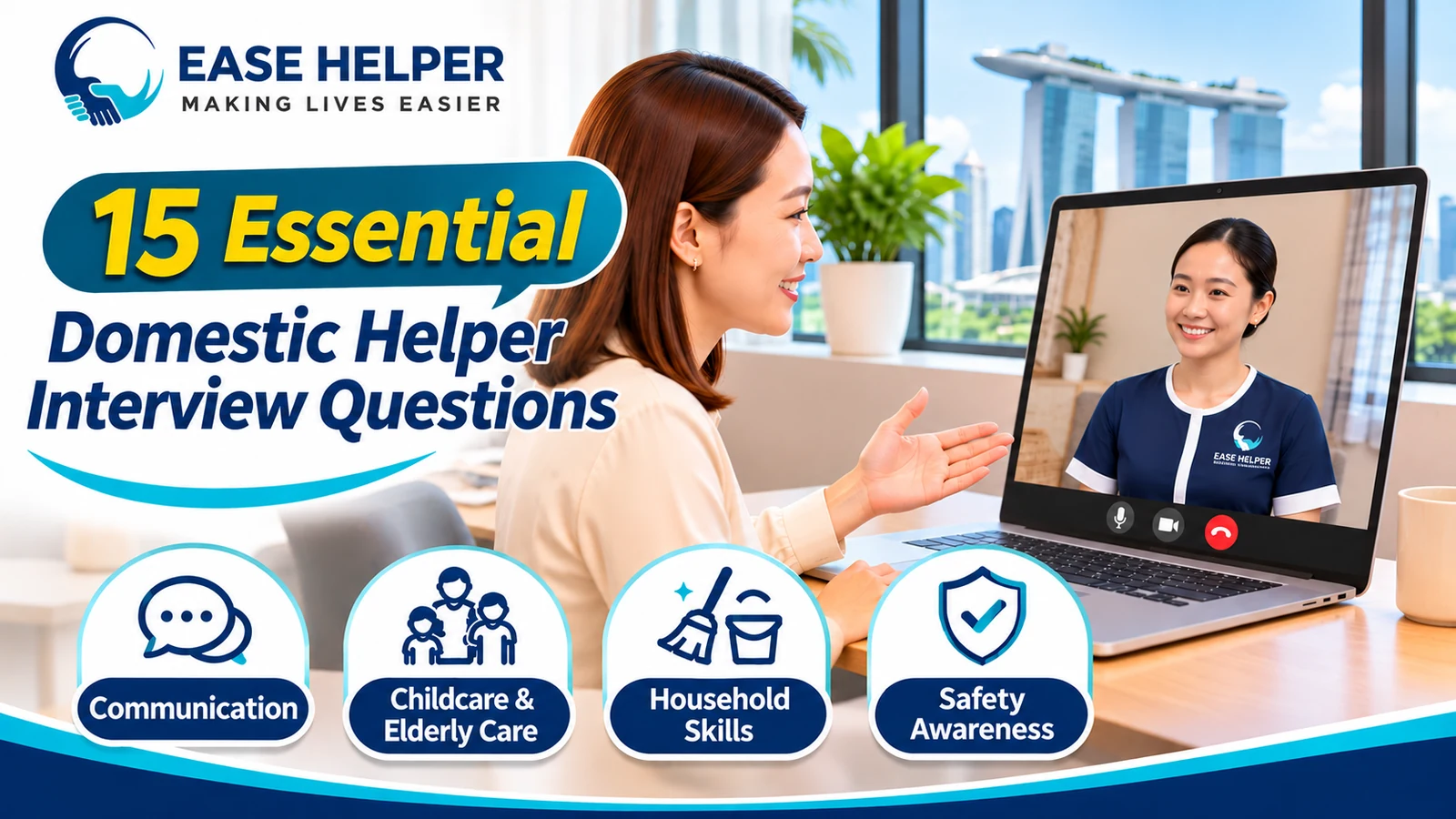
Interviewing a domestic helper is one of the most important steps in hiring household support in Singapore. A structured interview helps employers understand a candidate’s communication skills, practical experience, safety awareness, attitude and suitability for the family’s daily needs.
Rather than relying only on nationality, employment history or general impressions, employers should ask relevant questions about childcare, elderly care, cooking, housekeeping, emergencies and household expectations.
This guide provides 15 essential domestic helper interview questions, practical evaluation tips and a simple comparison checklist to help Singapore families make informed hiring decisions.
If you are beginning the recruitment process, read our complete guide to hiring a domestic helper in Singapore for an overview of employer responsibilities and Work Permit considerations.
1. Why Is a Domestic Helper Interview Important?
A domestic helper may become an important part of a household’s daily routine. Employers therefore need to understand whether a candidate can perform the required responsibilities safely and communicate effectively with family members.
An interview also gives candidates an opportunity to understand the employer’s expectations, living arrangements, duties and working conditions.
What Employers Should Evaluate
- Communication and understanding of instructions.
- Previous household employment and practical skills.
- Childcare or elderly care experience, where relevant.
- Cooking, cleaning and laundry abilities.
- Safety awareness and emergency responses.
- Willingness to learn and adapt.
- Compatibility with the household’s expectations.
Employers should avoid judging candidates solely on confidence or fluency. A quieter candidate may have strong practical abilities, while an experienced candidate may still require household-specific training.
2. How to Prepare Before the Interview
Before interviewing candidates, employers should identify the household’s essential requirements.
Prepare a Clear Job Description
- Number of household members.
- Children’s ages and childcare responsibilities.
- Elderly care or mobility support requirements.
- Cooking preferences and dietary restrictions.
- Cleaning, laundry and housekeeping duties.
- Any pets or special household arrangements.
- Expected routines, rest arrangements and communication needs.
Separate essential skills from skills that can reasonably be taught after employment begins.
Interview tip: Ask candidates the same core questions where possible. This makes comparisons more consistent and reduces the risk of selecting someone based only on first impressions.
3. Fifteen Essential Domestic Helper Interview Questions
The following questions cover the main responsibilities commonly discussed during domestic helper interviews in Singapore.
Question 1: Can You Tell Me About Your Previous Work Experience?
Ask the candidate to describe her previous responsibilities, including the household size and tasks she performed.
What to assess: Whether her experience is relevant to your household and whether she can explain her duties clearly.
Question 2: Why Do You Want to Work in Singapore?
This question helps employers understand the candidate’s motivation and expectations.
What to assess: Whether she understands the general nature of domestic work and has realistic expectations about the position.
Question 3: Which Household Tasks Can You Perform Independently?
Ask about cleaning, laundry, ironing, cooking and household organisation.
What to assess: Specific abilities rather than general statements such as “I can do everything.”
Question 4: What Would You Do If You Did Not Understand an Instruction?
Good communication is important for both household efficiency and safety.
What to assess: Whether the candidate is comfortable asking questions, requesting clarification and confirming instructions.
Question 5: Have You Cared for Babies or Young Children?
Ask about the ages of children she has cared for and the duties she performed.
What to assess: Relevant experience with feeding, hygiene, supervision and following parents’ routines.
For newborn care, ask additional practical questions and verify training rather than assuming previous childcare experience is sufficient.
Question 6: How Would You Respond If a Child Had an Accident?
Present a simple scenario, such as a child falling and becoming injured.
What to assess: Whether the candidate prioritises immediate safety, seeks appropriate emergency assistance and informs the employer promptly.
Question 7: Have You Assisted Elderly Family Members Before?
Ask whether she has helped with walking, meals, bathing, companionship or daily routines.
What to assess: Relevant practical experience and understanding of safe caregiving boundaries.
Question 8: What Would You Do If an Elderly Person Fell?
This question evaluates basic safety awareness.
What to assess: Whether the candidate avoids unsafe lifting, checks for immediate danger, seeks appropriate help and informs the employer.
Question 9: What Types of Food Can You Cook?
Ask about dishes she has prepared and whether she can follow recipes.
What to assess: Cooking experience, kitchen hygiene and willingness to learn the family’s preferences.
Question 10: How Do You Handle Raw Meat and Cooked Food Safely?
Food safety is an important household responsibility.
What to assess: Understanding of handwashing, avoiding cross-contamination, proper storage and clean food preparation.
Question 11: How Would You Clean a Bathroom Safely?
Ask the candidate to explain the cleaning process and how she would handle cleaning chemicals.
What to assess: Basic hygiene, ventilation, correct product use and awareness that certain chemicals must never be mixed.
Question 12: How Would You Organise Several Tasks in One Morning?
For example, the employer may need breakfast prepared, laundry completed and the kitchen cleaned.
What to assess: Prioritisation, time management and willingness to clarify which tasks are most urgent.
Question 13: What Would You Do If You Accidentally Damaged Something?
This question explores communication and problem-solving.
What to assess: Whether the candidate would report the incident honestly and discuss what happened.
Question 14: What Would You Do in a Household Emergency?
Ask about situations such as a fire, gas smell or sudden medical emergency.
What to assess: Safety-first thinking, knowing when to leave a dangerous area, contacting emergency services when necessary and informing the employer.
Question 15: Do You Have Any Questions About Our Household?
Allow the candidate to ask about responsibilities, routines, rest arrangements and other employment conditions.
What to assess: Whether expectations are understood by both parties. A good interview should be a two-way conversation.
4. Domestic Helper Interview Evaluation Checklist
Employers can use the following checklist to compare candidates consistently.
| Evaluation Area | What to Look For | Suggested Assessment |
|---|---|---|
| Communication | Understands and clarifies instructions | Needs support / Suitable / Strong |
| Housekeeping | Explains cleaning and laundry routines | Needs support / Suitable / Strong |
| Cooking | Relevant cooking skills and food hygiene | Needs support / Suitable / Strong |
| Childcare | Relevant experience and safety awareness | Needs support / Suitable / Strong |
| Elderly care | Relevant caregiving ability and safe practices | Needs support / Suitable / Strong |
| Emergency awareness | Prioritises safety and seeks help | Needs support / Suitable / Strong |
| Learning attitude | Open to instruction and feedback | Needs support / Suitable / Strong |
| Household suitability | Understands duties and employment expectations | Needs support / Suitable / Strong |
These categories are intended as a practical interview aid, not a formal qualification system. Employers should give greater weight to the skills that matter most for their household.
5. Interviewing Fresh vs Experienced Domestic Helpers
Interview questions should reflect the candidate’s actual employment background.
For Fresh Domestic Helpers
- Ask about training and practical demonstrations.
- Assess willingness to learn unfamiliar routines.
- Check understanding of household safety.
- Discuss the level of supervision available.
For Experienced Domestic Helpers
- Ask for specific examples of previous duties.
- Clarify which tasks were performed independently.
- Discuss differences between previous and new household routines.
- Check whether previous experience matches your needs.
Read our fresh vs experienced domestic helper comparison for more detailed guidance.
6. Should You Interview Myanmar and Indonesian Helpers Differently?
Employers should apply the same core evaluation principles to Myanmar and Indonesian candidates.
Individual communication ability, experience, training and household compatibility are more useful indicators than assumptions based on nationality.
Where language differences arise, allow reasonable time for clarification and use practical demonstrations when appropriate.
For further guidance, see our Myanmar vs Indonesian domestic helper comparison.
7. Common Interview Mistakes Employers Should Avoid
Relying Only on Yes-or-No Questions
Questions such as “Can you cook?” often provide limited information. Ask candidates to explain a dish they have prepared or describe the cooking process.
Assuming Experience Guarantees Ability
Previous employment may be relevant, but it does not prove competence in every household task.
Asking Too Many Questions at Once
Use simple, clear language and allow sufficient time for responses.
Failing to Explain Household Expectations
Candidates should understand the main duties, household routines, rest arrangements and employment conditions before accepting an offer.
Ignoring Practical Safety Questions
Safety awareness is especially important in households with children, elderly family members or specialised caregiving needs.
8. Interview Warning Signs: What Should Employers Watch For?
Some responses may indicate that further clarification or training is needed.
- Difficulty explaining tasks the candidate claims to have performed.
- Unsafe answers to common household emergency scenarios.
- Major inconsistencies in employment history that remain unexplained.
- Unclear expectations about the role or working arrangements.
- Communication difficulties affecting essential safety instructions.
These observations should prompt follow-up questions rather than automatic rejection. Nervousness, language barriers and unfamiliar interview formats can affect performance.
Important: Interviews should remain respectful and job-related. Avoid intrusive personal questions or discriminatory assumptions unrelated to the candidate’s ability to perform the role.
9. Should Employers Request a Practical Skills Demonstration?
Where appropriate, a short practical demonstration can help employers understand a candidate’s existing abilities.
Examples include explaining how to sort laundry, demonstrating safe kitchen hygiene or describing the steps for cleaning a bathroom.
Any demonstration should be safe, reasonable and conducted with the candidate’s agreement. It should not involve dangerous tasks or unpaid productive work for the employer.
Training videos or other relevant materials may also help employers understand which skills a candidate has practised, although these should not replace individual assessment.
10. What to Do After the Domestic Helper Interview
After interviewing candidates, review your notes against the household’s essential requirements.
- Compare candidates using the same evaluation criteria.
- Clarify unanswered questions or inconsistencies.
- Consider any training or supervision required.
- Confirm the proposed duties and employment expectations.
- Review applicable recruitment and Work Permit requirements.
- Make a decision based on individual suitability.
A thoughtful selection process can reduce misunderstandings and help establish clearer expectations from the beginning.
11. MOM Requirements and Employer Responsibilities
Interviewing a candidate is only one part of the domestic helper hiring process in Singapore.
Employers must also comply with applicable Ministry of Manpower requirements concerning eligibility, Work Permits, employment conditions and other responsibilities.
Refer to the official resources below for current information:
- MOM: Work Permit for Migrant Domestic Workers
- MOM: Domestic Worker Eligibility
- MOM: Employment Agencies and Personnel Search
12. How EaseHelper Supports Domestic Helper Interviews
EaseHelper assists Singapore employers in exploring suitable Myanmar and Indonesian domestic helper candidates according to their household requirements.
Our team can help employers consider relevant work experience, communication abilities, practical skills and training needs when evaluating candidates.
Employers should have the opportunity to ask questions, clarify expectations and assess individual suitability before making a hiring decision.
Our goal is to support a clear and informed recruitment process for both employers and domestic helpers.
Frequently Asked Questions
How many questions should I ask during a domestic helper interview?
There is no fixed number. The 15 questions in this guide provide a useful starting point, but employers should prioritise questions relevant to their household’s needs.
How long should a domestic helper interview take?
The duration depends on the candidate and household requirements. Allow enough time to discuss essential responsibilities, safety scenarios, communication and employment expectations without rushing.
Can I interview a domestic helper online?
Video or telephone interviews can be useful when candidates are overseas. Employers should confirm the available interview arrangements with the agency and assess communication and experience carefully.
What should I ask a domestic helper about childcare?
Ask about the ages of children previously cared for, daily responsibilities, feeding and hygiene routines, supervision and responses to common safety incidents.
What questions should I ask about elderly care?
Discuss previous caregiving responsibilities, mobility assistance, fall prevention, daily routines and how the candidate would respond to an emergency.
Should I interview fresh and experienced helpers differently?
Use the same core questions but add questions appropriate to each candidate’s background. Fresh candidates may need more training-related questions, while experienced candidates should be asked for specific examples of previous duties.
Can EaseHelper help employers assess candidates?
EaseHelper can support employers in exploring candidate suitability and considering relevant skills, experience and household requirements during the hiring process.
Conclusion: A Better Interview Leads to a More Informed Hiring Decision
A successful domestic helper interview is not simply about finding a candidate who answers every question confidently.
It is about understanding her actual skills, experience, safety awareness, communication ability and willingness to work within your household’s expectations.
By preparing relevant questions, evaluating candidates fairly and explaining responsibilities clearly, Singapore employers can make more informed hiring decisions and establish a stronger foundation for a positive working relationship.
Looking for a Suitable Domestic Helper in Singapore?
EaseHelper helps Singapore families explore Myanmar and Indonesian domestic helper candidates according to their household needs.
Whether your priorities include childcare, elderly care, cooking or general housekeeping, our team can guide you through candidate selection and the hiring process.
Contact EaseHelperDisclaimer
This article is provided for general information only and does not constitute legal or employment advice. Candidate experience and suitability vary, and Ministry of Manpower requirements may change. Employers should verify current hiring conditions, Work Permit requirements and employer responsibilities through official government sources before making employment decisions.