

Blog
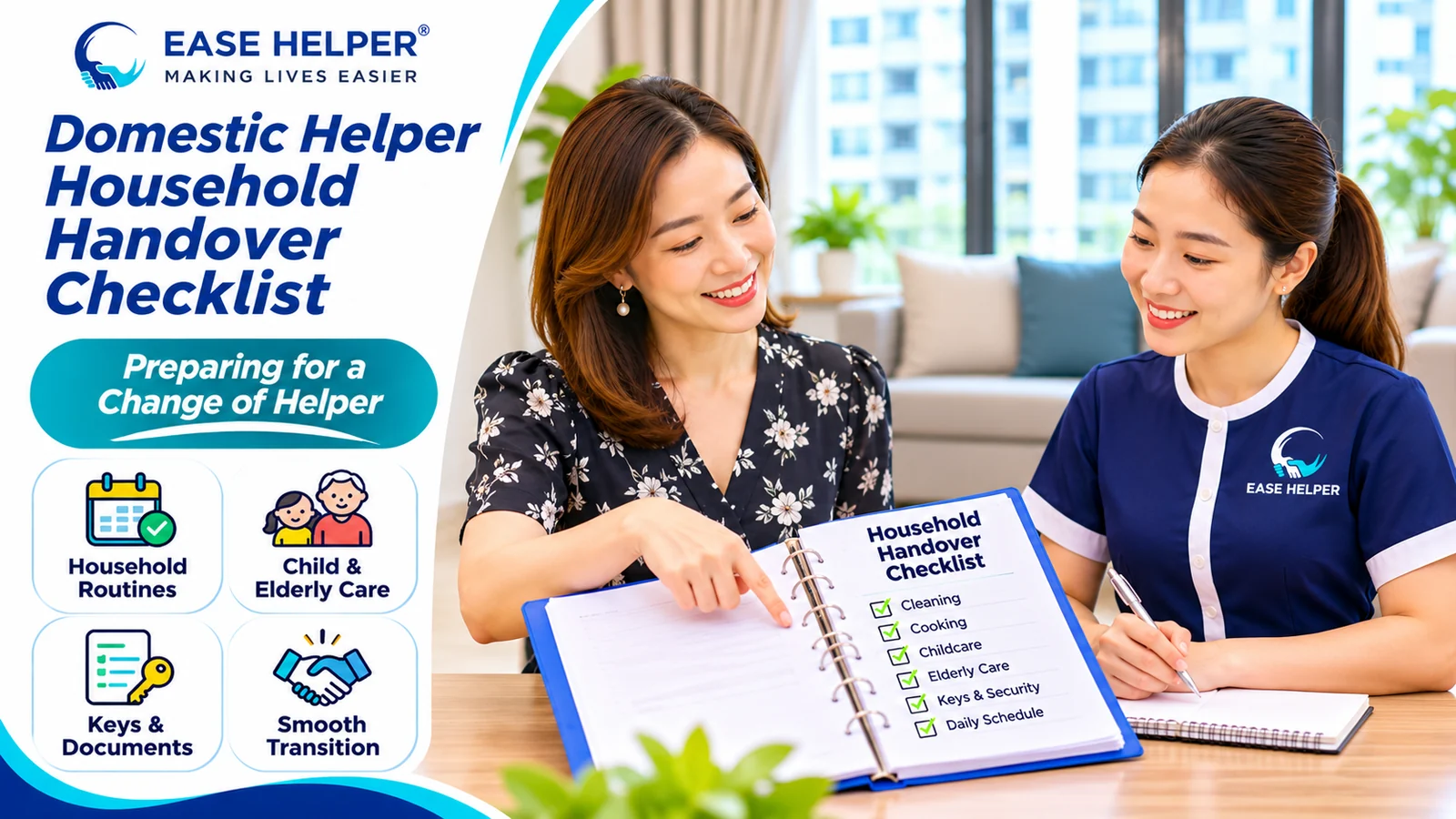
Domestic Helper Household Handover Checklist: Preparing for a Change of Helper

Executive Summary
A practical domestic helper handover checklist should cover household routines, family care needs, cooking preferences, cleaning procedures, shopping records, keys, emergency contacts and outstanding administrative matters.
Employers should prepare written instructions, arrange appropriate training for the incoming helper and complete the outgoing helper’s employment obligations in accordance with current Ministry of Manpower requirements.
Most importantly, a respectful transition protects the outgoing helper’s dignity while helping the new helper understand the family’s expectations.
Why a Domestic Helper Handover Checklist Matters
Every Singapore household has its own routines. One family may need assistance with young children, while another relies on a helper for elderly care, cooking or general housekeeping.
Consequently, a replacement helper may not immediately understand where items are stored, how appliances work or which responsibilities require special attention.
A written handover checklist helps employers:
- Maintain continuity in essential household routines.
- Reduce misunderstandings during the transition.
- Identify important safety and care instructions.
- Keep household records organised.
- Review access permissions and security arrangements.
- Set realistic expectations for the incoming helper.
Furthermore, a structured handover reduces unnecessary pressure on both helpers and allows employers to identify tasks that require additional training.
1. Plan the Helper Transition Timeline
Start preparing before the outgoing helper’s final working day. The amount of preparation required depends on the family’s needs, the employment arrangements and whether the two helpers will have an opportunity to meet.
Suggested Handover Timeline
| Stage | Recommended Action | Employer’s Responsibility |
|---|---|---|
| Before the transition | Prepare household instructions and review employment arrangements. | Confirm dates, responsibilities and required procedures. |
| Several days before departure | Review routines, inventories and outstanding matters. | Identify missing information and settle questions. |
| Final working period | Complete appropriate handover and return household property. | Review final payments and administrative obligations. |
| Incoming helper’s first day | Introduce household members, facilities and safety procedures. | Provide orientation and clear instructions. |
| First one to two weeks | Review task performance and answer questions. | Provide practical guidance and reasonable adjustments. |
This timeline is illustrative. Employers should adapt it to the actual Work Permit and employment arrangements.
2. Prepare a Household Information File
A household information file helps the incoming helper locate essential instructions without repeatedly interrupting the employer.
However, employers should avoid including unnecessary confidential information, such as banking passwords or unrestricted access credentials.
Information to Include
- Daily and weekly household schedules.
- Approved emergency contact numbers.
- Locations of cleaning supplies and equipment.
- Instructions for household appliances.
- Grocery shopping procedures.
- Important family care routines.
- Waste disposal and recycling arrangements.
- Approved visitor and delivery procedures.
Use short sentences, photographs and practical demonstrations where appropriate. Clear instructions are particularly helpful when the incoming helper is unfamiliar with the household’s preferred language.
3. Document Daily Cleaning and Housekeeping Routines
Cleaning expectations can differ considerably between households. Therefore, employers should provide a clear schedule rather than assuming the incoming helper will follow the outgoing helper’s methods.
Housekeeping Handover Checklist
- Identify daily cleaning priorities.
- Explain weekly and occasional cleaning tasks.
- Show where cleaning products are stored.
- Demonstrate safe use of equipment.
- Explain which surfaces require special care.
- Separate cleaning tools used for bathrooms and kitchens.
- Clarify laundry and ironing preferences.
Additionally, employers should explain which tasks are time-sensitive and which can be completed later. This helps the new helper manage competing responsibilities safely.
4. Record Cooking Preferences and Kitchen Procedures
Food preparation is another important part of a domestic helper handover checklist. Families may have particular dietary requirements, cooking preferences or food allergies.
Kitchen Handover Items
- Family meal preferences and usual meal times.
- Known food allergies and dietary restrictions.
- Common recipes and portion sizes.
- Food storage and expiry-date checking procedures.
- Approved grocery suppliers and shopping arrangements.
- Safe operation of kitchen appliances.
- Cleaning procedures for food preparation areas.
For example, the employer can demonstrate how to use the rice cooker, induction hob and microwave rather than expecting the incoming helper to learn through trial and error.
Furthermore, explain safe handling of raw meat, seafood and cooked food to reduce cross-contamination risks.
Training tip: During the first few days, demonstrate important kitchen tasks and allow the new helper to practise under suitable supervision. Avoid introducing too many unfamiliar appliances at once.
5. Prepare a Childcare Handover Checklist
When a household includes children, the handover should prioritise safety, routines and clear communication with parents.
Children may also need time to adjust emotionally when a familiar caregiver leaves.
Childcare Information to Review
- School and childcare centre schedules.
- Authorised collection arrangements.
- Meal times and food allergies.
- Homework and enrichment routines.
- Bedtime and personal hygiene arrangements.
- Age-appropriate supervision requirements.
- Emergency contact procedures.
- Any relevant medical instructions supplied by parents.
Employers should explain how the helper should respond when a child becomes unwell, refuses food or experiences a behavioural difficulty.
However, parents remain responsible for major decisions about discipline, education and medical treatment.
6. Prepare an Elderly Care Handover Checklist
Families caring for elderly relatives may require more detailed handover arrangements, particularly when mobility limitations or health conditions are involved.
Therefore, employers should provide accurate instructions and arrange appropriate practical training.
Elderly Care Information
- Usual waking, sleeping and meal routines.
- Mobility assistance requirements.
- Fall prevention measures.
- Approved walking aids and mobility equipment.
- Dietary requirements.
- Medical appointments and emergency contacts.
- Medication instructions from authorised caregivers or healthcare professionals.
- Symptoms or changes that must be reported promptly.
Importantly, employers should not expect an untrained helper to perform specialised nursing procedures or unsafe lifting tasks.
Where necessary, seek guidance from qualified healthcare professionals before transferring complex care responsibilities.
7. Review Household Keys and Security Access
Security arrangements should be reviewed whenever a domestic helper leaves or joins a household.
However, employers should distinguish between household property and the helper’s personal belongings.
Security Handover Checklist
- Record household keys and access cards issued for work.
- Confirm the return of relevant household property.
- Review digital lock access credentials.
- Update authorised access permissions when appropriate.
- Explain visitor and delivery procedures to the incoming helper.
- Demonstrate emergency exit arrangements.
- Check that household security equipment functions properly.
Where digital locks support individual credentials, employers can deactivate outdated access and create a separate authorised access method for the incoming helper.
Nevertheless, security procedures should remain proportionate and respectful.
8. Check Household Inventory and Shopping Records
Some helpers manage grocery purchases, household supplies or small amounts of money for approved expenses.
Before the transition, employers should review these records together and clarify any outstanding questions.
Inventory and Expense Checklist
- Check cleaning products and household supplies.
- Review pantry and refrigerator inventories.
- Confirm pending grocery orders.
- Reconcile approved shopping advances.
- Collect outstanding receipts where available.
- Explain the household’s budgeting procedures.
Employers should maintain transparent records and avoid making unsupported accusations if an item or receipt cannot immediately be located.
For the incoming helper, explain spending limits and approval procedures before assigning purchasing responsibilities.
9. Review Employment Documents and Outstanding Payments
A domestic helper handover checklist should include an administrative review. This is particularly important when the outgoing helper’s employment is ending.
Employers should verify the applicable requirements with the Ministry of Manpower (MOM).
Administrative Matters to Review
- Final salary and any outstanding salary payments.
- Applicable rest day compensation arrangements.
- Employment contract obligations.
- Work Permit transfer, cancellation or other required procedures.
- Travel and repatriation arrangements where applicable.
- Relevant insurance and employment documentation.
- Any lawful outstanding reimbursements or agreed expenses.
Keep clear records of payments and arrangements. Do not assume that the same procedure applies to every transfer, contract completion or early termination.
Furthermore, employers should not retain a helper’s passport or personal documents as leverage over unresolved matters.
Important: A household handover does not replace MOM’s employment and Work Permit procedures. Check the current requirements for the specific situation before arranging a transfer, departure or replacement.
10. Respect the Outgoing Helper’s Personal Belongings and Privacy
A respectful departure is an important part of good household management.
The outgoing helper should have a reasonable opportunity to organise her personal belongings and review any employment-related matters.
Respectful Departure Practices
- Clearly explain the expected final working arrangements.
- Allow the helper to organise her personal possessions.
- Distinguish personal belongings from household property.
- Respect private messages and personal documents.
- Discuss outstanding payments transparently.
- Avoid unnecessary confrontation during the handover.
Employers should also avoid sharing unnecessary personal details about the outgoing helper with the incoming helper.
For example, a new helper needs to understand the household’s cooking preferences, but she does not need access to the outgoing helper’s private employment disputes.
11. Arrange Direct Handover Only When Appropriate
In some households, the outgoing and incoming helpers may have an opportunity to discuss practical routines.
However, direct handover is not always possible or necessary. It must also fit the relevant employment and Work Permit arrangements.
Useful Direct Handover Topics
- Locations of commonly used household items.
- Daily cleaning priorities.
- Usual meal preparation procedures.
- Approved shopping routines.
- School collection arrangements.
- Important household safety reminders.
Employers should remain involved in explaining expectations. The outgoing helper should not become solely responsible for training her replacement.
If direct handover is unavailable, written instructions and employer-led demonstrations can provide an effective alternative.
12. Conduct a First-Day Orientation for the New Helper
Even when the household has detailed written instructions, the incoming helper needs time to understand the home and its routines.
Therefore, prioritise safety and essential responsibilities on the first day.
First-Day Orientation Checklist
- Introduce household members and explain important needs.
- Show the helper her accommodation and personal facilities.
- Explain the daily schedule and rest arrangements.
- Demonstrate door locks and emergency exits.
- Identify first-aid supplies and emergency contacts.
- Explain essential kitchen and bathroom safety rules.
- Review the most important household responsibilities.
- Invite questions and clarify uncertainties.
Avoid overwhelming the helper with every possible task immediately. Instead, provide gradual training and repeat important instructions when necessary.
13. Use a Domestic Helper Handover Checklist Table
The following table can serve as a practical starting point for employers preparing for a change of helper.
| Handover Area | Items to Review | Responsible Person |
|---|---|---|
| Daily routine | Working schedule, priorities and household expectations | Employer |
| Cleaning | Equipment, supplies and cleaning procedures | Employer / outgoing helper where appropriate |
| Cooking | Recipes, food safety and kitchen appliances | Employer |
| Childcare | School routines, supervision and emergency procedures | Parent / authorised caregiver |
| Elderly care | Mobility, care routines and medical instructions | Employer / qualified professional where needed |
| Household security | Keys, access cards and visitor procedures | Employer |
| Shopping and supplies | Inventory, receipts and purchasing instructions | Employer |
| Employment matters | Payments, documentation and applicable MOM procedures | Employer / agency where relevant |
| New helper orientation | Demonstrations, questions and training priorities | Employer |
Employers can adapt this table to their household and record the completion date for each item.
14. Common Domestic Helper Handover Mistakes
Even well-intentioned families can overlook important details during a helper transition.
| Common Mistake | Better Approach |
|---|---|
| Waiting until the final day to prepare | Start documenting important routines in advance. |
| Assuming the incoming helper already knows the household | Provide practical demonstrations and clear instructions. |
| Forgetting childcare or elderly care details | Prioritise safety and essential care information. |
| Failing to review access permissions | Update keys, cards and digital credentials appropriately. |
| Leaving payments or employment matters unclear | Review obligations and keep transparent records. |
| Expecting immediate full performance | Allow a reasonable adjustment and training period. |
15. Support the Incoming Helper During the First Two Weeks
A successful handover continues after the outgoing helper leaves. The incoming helper may need additional practice with cooking, childcare, appliances or household organisation.
Therefore, employers should review progress and provide constructive feedback.
Suggested First-Two-Week Review
- Confirm that safety procedures are understood.
- Review daily routines and task priorities.
- Identify areas requiring further demonstrations.
- Check whether the workload is realistic.
- Clarify communication preferences.
- Encourage the helper to raise questions early.
- Adjust written instructions where necessary.
Moreover, employers should recognise that a new helper may perform familiar tasks differently. Focus on safety, reasonable household standards and clear outcomes rather than insisting that every action must match the previous helper’s habits.
16. When Should Employers Seek Agency Assistance?
Some helper transitions involve additional complications, such as unexpected departures, replacement arrangements, communication difficulties or uncertainty about administrative requirements.
In these situations, a licensed employment agency may help employers understand available placement options and coordinate relevant recruitment steps.
However, employers should confirm the scope of any agency service, applicable fees and responsibilities before proceeding.
For official employment requirements, always refer to MOM’s current guidance.
Frequently Asked Questions
1. What should be included in a domestic helper handover checklist?
A domestic helper handover checklist should cover daily routines, cleaning, cooking, childcare or elderly care, household security, shopping records, emergency contacts and relevant employment matters. Employers should adapt the checklist to their family’s needs.
2. Is a direct handover between the outgoing and incoming helpers necessary?
Not necessarily. Direct handover can be helpful when appropriate and permitted by the relevant arrangements, but employers can also provide written instructions and practical training themselves.
3. What should employers do before their domestic helper leaves Singapore?
Employers should review outstanding salary and other applicable obligations, confirm Work Permit procedures and arrange any required departure or repatriation matters. Check the current MOM requirements for the specific employment situation.
4. How long should a new domestic helper take to learn household routines?
The adjustment period varies according to experience, language familiarity and household complexity. Employers should prioritise safety, provide clear demonstrations and review progress during the first one to two weeks and beyond when necessary.
5. How can employers make a change of helper less stressful for children or elderly family members?
Explain the transition calmly, maintain familiar routines where possible and introduce the incoming helper gradually. Provide clear care instructions and remain involved in important emotional, medical and supervision needs.
Planning to Change Your Domestic Helper in Singapore?
EaseHelper helps Singapore families explore domestic helper placement options based on their household requirements. Whether you are preparing for a replacement or hiring a new helper, clear expectations and practical training can support a smoother transition.
Explore EaseHelper ServicesDisclaimer: This article provides general household handover guidance for Singapore employers. Employment, Work Permit, salary, transfer, cancellation and repatriation requirements depend on the circumstances and may change. Always check current Ministry of Manpower rules and obtain professional advice where necessary. This article is not legal or medical advice.