Blog
Domestic Helper Replacement Policies in Singapore: What Employers Need to Know

Executive Summary
Domestic helper replacement policies in Singapore explain what happens when an employment arrangement does not work out and an employer wishes to hire another helper. However, replacement eligibility, service charges, time limits and procedures can differ between employment agencies. Before signing, employers should check the written service agreement, understand any additional costs and distinguish contractual replacement benefits from MOM’s statutory agency service-fee refund requirements. This guide explains the key considerations and practical steps for making an informed decision.
What Is a Domestic Helper Replacement Policy?
A domestic helper replacement policy sets out the assistance an employment agency may provide when an employer needs to recruit another helper after an unsuccessful placement.
For example, a household’s caregiving needs may change. Alternatively, an employer and helper may discover that their working expectations do not match. Sometimes, a helper may also decide to end her employment.
In these situations, an agency may help identify another suitable candidate, coordinate interviews and assist with the relevant administrative process.
However, a replacement does not necessarily mean that every service or expense will be free. Therefore, employers should check the agreement before relying on any replacement benefit.
Are Domestic Helper Replacement Policies Mandatory in Singapore?
Singapore does not impose one identical replacement package on every domestic helper agency. Instead, agencies set out their replacement arrangements in their written service agreements, subject to applicable regulatory requirements.
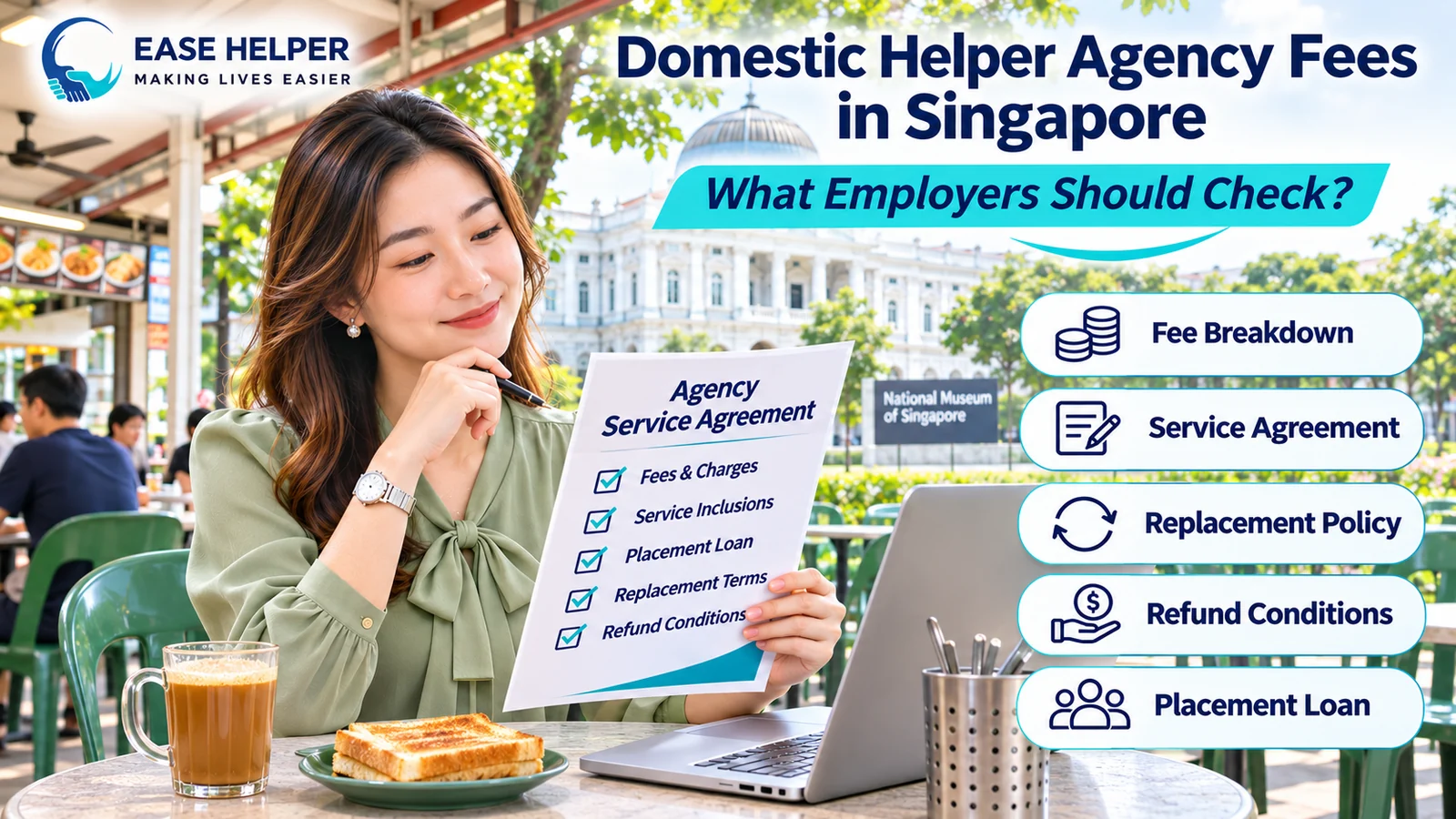
MOM requires employment agencies to sign written service agreements with employers of migrant domestic workers. These agreements must address relevant replacement scenarios, refund conditions and dispute resolution procedures.
Consequently, employers should distinguish between:
- Contractual replacement arrangements: The agency’s agreed services, eligibility conditions and charges.
- Statutory refund requirements: MOM rules governing qualifying refunds of agency service fees when employment ends early.
Both matter, but they do not provide exactly the same rights.
See MOM’s guidance on employment agency service agreements.
When Might an Employer Request a Replacement?
1. The Helper’s Skills Do Not Match Household Needs
An employer may discover that the helper needs more training in cooking, cleaning or caregiving than originally expected.
First, identify the specific gaps. Then, consider whether practical demonstrations, additional training and clearer instructions could resolve them.
If the household’s essential requirements still cannot be met, discuss the available options with the agency.
2. Communication Difficulties Continue
Language differences and unclear expectations can create misunderstandings. However, these difficulties do not always require a replacement.
Employers can try simple instructions, visual demonstrations and a written daily routine. If serious communication problems continue, the agency may help review the situation.
3. Household Circumstances Change
Family needs sometimes change after recruitment. For instance, an elderly family member may require different care, or an employer’s working schedule may change.
In such cases, discuss the revised requirements with the agency. A replacement may be one option, depending on the agreement and the helper’s circumstances.
4. The Helper Wishes to End Her Employment
A domestic helper may decide to terminate her employment in accordance with the applicable contract terms.
Employers should handle the situation respectfully, settle outstanding salary obligations and follow the relevant MOM procedures. Meanwhile, they can ask the agency about replacement support.
Seven Replacement Policy Terms Employers Should Check
Before choosing an agency, review the following points in the written agreement.
| Policy Term | What to Check | Why It Matters |
|---|---|---|
| Replacement period | How long the entitlement lasts and when it begins | A request outside the agreed period may not qualify |
| Number of replacements | How many placements the package covers | Additional replacements may have different terms |
| Eligibility conditions | When and why a replacement can be requested | Not every situation may qualify for the same benefits |
| Additional charges | Agency fees, administration and third-party expenses | Replacement does not always mean zero additional cost |
| Candidate selection | Whether replacement candidates must meet agreed criteria | Helps protect the household’s essential requirements |
| Refund arrangements | How contractual refunds interact with statutory rights | Employers need to understand their available options |
| Processing and support | Expected coordination, communication and documentation | Helps employers plan the transition |
Additionally, ask what happens if the agency cannot find a suitable candidate within the agreed period.
Does a Free Replacement Mean No Additional Costs?
Not necessarily. The phrase “free replacement” may refer only to the agency’s replacement service fee.
Depending on the arrangement, employers may still need to pay applicable expenses such as:
- Work Permit application or issuance charges.
- Insurance premiums or policy adjustments.
- Required medical examinations.
- Travel and arrival-related expenses.
- Other clearly disclosed third-party charges.
Moreover, any placement loan arrangement should be explained separately. Employers should understand how outstanding amounts are handled if the original employment ends.
Practical tip: Ask the agency to provide an itemised replacement quotation. Confirm which charges are waived, which remain payable and whether GST applies.
Replacement Policies vs MOM’s 50% Agency Fee Refund Rule
One of the most important issues is the relationship between a replacement and a refund.
Under MOM’s regulatory framework, employment agencies must refund at least 50% of qualifying service fees paid by an employer when the domestic helper’s employment ends within the first six months and the applicable conditions are met.
However, the refund is not automatic in every case. MOM specifies exceptions, including certain employer conduct, notification failures and circumstances involving multiple replacements.
How Do Multiple Replacements Affect Refund Eligibility?
MOM’s framework considers the employment history of replacement helpers placed by the same agency with the same employer.
For example, MOM explains that the statutory refund requirement may cease to apply when a replacement helper has worked for more than six months. It also specifies an exception when a third replacement helper has been provided.
Therefore, employers should not assume that the statutory six-month refund entitlement restarts without limitation each time a replacement arrives.
Does the Refund Cover Every Payment?
No. The statutory refund framework applies to qualifying agency service fees. Certain regulatory, third-party and placement-loan amounts are excluded.
Consequently, employers should request a clear breakdown of the original payment and any refundable portion.
What If the Agency Offers a Replacement?
Discuss the available replacement and refund options before making a decision. The agency’s contract should explain the applicable arrangements, while MOM’s statutory rules continue to govern qualifying refunds.
For complete conditions and examples, read MOM’s official agency service-fee refund guidance.
What Should Employers Do Before Requesting a Replacement?
Step 1: Identify the Main Problem
Write down specific concerns rather than relying on general impressions. For example, distinguish between a safety issue, a communication difficulty and a skill that requires additional training.
Step 2: Discuss Expectations Respectfully
Where appropriate, speak with the helper and explain the concerns clearly. Give her an opportunity to respond. If necessary, ask the agency to assist with communication.
Step 3: Review the Service Agreement
Check the replacement period, eligibility conditions, possible charges and relevant refund clauses.
Step 4: Notify the Agency Promptly
Contact the agency before taking irreversible steps. This is particularly important because MOM’s statutory refund framework includes notification requirements.
Step 5: Discuss Suitable Replacement Candidates
Explain your household’s actual needs, including caregiving duties, working routines and essential skills.
Then, review suitable candidates through the agency’s permitted one-to-one recruitment process. Avoid requesting or circulating applicants’ personal biodata through public advertisements.
Step 6: Plan the Employment Transition
Confirm how the current employment will end, whether a transfer is possible and what documentation is required.
Additionally, settle salary and other employment obligations. Follow MOM’s Work Permit procedures and do not assume that an agency replacement arrangement automatically transfers employment responsibility.
Should Employers Request a Replacement or Provide More Training?
Not every early difficulty means that a replacement is necessary. Some issues improve with clearer routines, practical demonstrations and regular feedback.
| Situation | Possible First Response |
|---|---|
| Unfamiliar with household appliances | Provide demonstrations and supervised practice |
| Difficulty understanding instructions | Use simpler language and visual guidance |
| Unclear daily priorities | Create a realistic household schedule |
| Needs additional cooking practice | Introduce recipes gradually and provide feedback |
| Persistent mismatch in essential caregiving needs | Discuss suitability and replacement options with the agency |
| Serious safety concerns | Protect those involved and seek appropriate professional assistance promptly |
Ultimately, employers should consider the seriousness of the problem, the household’s needs and the helper’s ability to improve with reasonable support.
How to Avoid Replacement Problems Before Hiring
A successful placement starts with realistic expectations and careful candidate matching.
Before hiring, employers should:
- Identify essential household duties and caregiving requirements.
- Explain working arrangements clearly during interviews.
- Ask relevant questions about practical skills and experience.
- Review the agency’s replacement and refund policies.
- Discuss available training and post-placement support.
- Prepare a reasonable orientation plan for the helper’s first weeks.
For broader recruitment planning, read our guide to hiring a domestic helper in Singapore.
Employers can also consult MOM’s advice on selecting a reliable employment agency.
Frequently Asked Questions
How many free replacements can an employer receive?
There is no single contractual replacement package that applies to every agency. The number of replacements and applicable conditions depend on the written agreement, subject to statutory requirements.
Can an employer request a replacement after six months?
Possibly, if the agency’s contractual replacement policy allows it. However, MOM’s statutory service-fee refund framework generally concerns qualifying employment terminations within the first six months.
Does a replacement automatically include a refund?
No. Replacement assistance and refunds are different arrangements. Check the written agreement and MOM’s statutory refund requirements.
Can an employer reject a proposed replacement candidate?
Employers should check how the agreement handles candidate selection and rejection. They should also clarify whether declining a candidate affects contractual replacement benefits or refunds.
Who pays the new helper’s insurance and Work Permit costs?
Employers should confirm the applicable charges and payment arrangements with the agency. A waived agency service fee does not necessarily waive government or third-party expenses.
What if a domestic helper wants to leave before her contract ends?
Both employers and helpers may terminate employment according to applicable notice or payment-in-lieu provisions. Employers must also meet their salary and other legal obligations.
How EaseHelper Supports Employers
EaseHelper understands that every household has different expectations and responsibilities. Therefore, careful candidate matching, practical preparation and clear communication are important parts of recruitment.
Our team can discuss household requirements, available recruitment arrangements and the applicable service terms before an employer proceeds.
Where concerns arise after placement, employers should contact the agency to review their situation and the options available under their agreement.
Need Guidance on Domestic Helper Recruitment?
Contact EaseHelper to discuss your household needs, recruitment arrangements and applicable replacement policy terms.
Explore EaseHelper ServicesDisclaimer: This article provides general information for employers in Singapore and does not constitute legal advice. Replacement entitlements, service charges and refund arrangements depend on the applicable agreement and current MOM requirements. Always review your signed contract and the latest official guidance. EaseHelper’s specific replacement terms should be confirmed directly before engaging its services.