
Blog
Domestic Helper Security Bond in Singapore: Requirements and Employer Responsibilities

Executive Summary
Employers hiring a migrant domestic worker in Singapore generally need to arrange a S$5,000 security bond for a non-Malaysian helper. The bond is a financial guarantee to the Ministry of Manpower (MOM), not a fee automatically paid to the Government. Employers must comply with Work Permit conditions, arrange the required bond before the helper arrives where applicable, and complete proper employment-ending procedures. This guide explains the security bond, possible forfeiture, insurance arrangements and common questions employers should understand before hiring.
What Is a Domestic Helper Security Bond in Singapore?
A domestic helper security bond is a financial guarantee that supports compliance with Singapore’s Work Permit conditions.
When an employer hires a non-Malaysian migrant domestic worker, MOM generally requires a S$5,000 security bond.
The bond helps ensure that the employer fulfils applicable responsibilities under the Work Permit framework.
However, the security bond is not the same as the helper’s salary, an employment agency fee or a monthly government levy.
For the latest official requirements, refer to MOM’s migrant domestic worker Work Permit information.
How Much Is the Security Bond for a Domestic Helper?
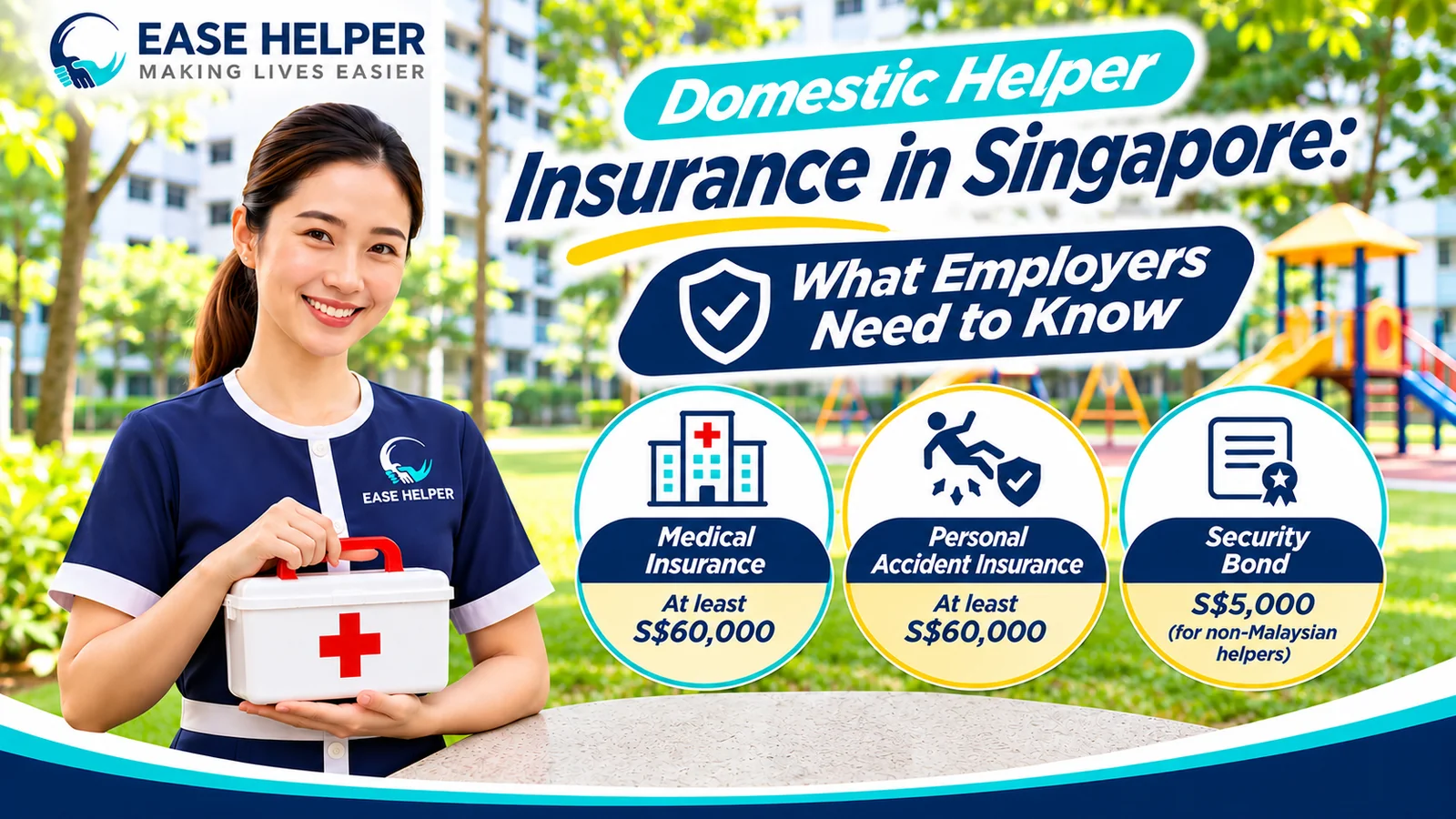
The standard MOM security bond for a non-Malaysian migrant domestic worker is S$5,000.
Nevertheless, employers should understand the difference between the bond amount and the amount they pay for an insurance or guarantee arrangement.
| Item | What It Means | Employer Consideration |
|---|---|---|
| MOM security bond | A S$5,000 financial guarantee for a non-Malaysian helper | Compliance with applicable Work Permit conditions |
| Security bond guarantee or insurance arrangement | A financial institution or insurer may provide the required guarantee | Premiums, fees, exclusions and reimbursement obligations depend on the product |
| Medical insurance | Separate mandatory insurance protection for the helper | Must meet MOM’s prevailing requirements |
| Personal accident insurance | Separate mandatory accident protection | Must meet MOM’s prevailing requirements |
Important: The S$5,000 bond amount does not mean every employer must pay S$5,000 upfront as an insurance premium. However, an employer may still face financial exposure if the bond is forfeited or the guarantor seeks reimbursement under the agreement.
Who Needs to Provide a Security Bond?
MOM generally requires employers to provide a security bond when hiring a non-Malaysian migrant domestic worker.
For example, this requirement ordinarily applies to employers hiring eligible domestic helpers from Myanmar or Indonesia.
In contrast, MOM does not require the same security bond for Malaysian migrant domestic workers.
Before proceeding, confirm the requirements that apply to your selected candidate and Work Permit application.
When Must Employers Arrange the Security Bond?
For a helper recruited from overseas, the employer must arrange the applicable security bond before the helper arrives in Singapore.
In addition, the bond must take effect on the required date under MOM’s instructions.
Employers should therefore avoid waiting until the last moment to complete the necessary insurance and guarantee arrangements.
Before the Helper Arrives
- Confirm whether a security bond is required.
- Review the insurer’s or guarantor’s terms.
- Arrange the required guarantee.
- Check the effective date and related documentation.
- Complete other mandatory insurance arrangements.
If you use an employment agency, ask which arrangements the agency will coordinate and which responsibilities remain with you.
Can Employers Lose the S$5,000 Security Bond?
Yes. MOM may forfeit all or part of the security bond when an employer breaches relevant bond conditions.
However, forfeiture is not automatic whenever an employment problem occurs.
MOM assesses the circumstances and the applicable conditions. Therefore, employers should not assume that every resignation, disagreement or unexpected departure leads to the loss of the full bond.
Examples of Compliance Risks
Potential risks include failing to meet relevant Work Permit obligations or not completing required employment-ending arrangements.
Employers should pay particular attention to the following:
- Employing the helper only in permitted domestic work arrangements.
- Paying the helper’s salary and meeting applicable employment obligations.
- Providing appropriate accommodation, food and medical care.
- Following MOM’s requirements when employment ends.
- Making the necessary arrangements for the helper’s departure where required.
These examples are not a complete list of bond conditions. Always check MOM’s current requirements and the actual security bond terms.
What Happens If a Domestic Helper Runs Away?
An employer may worry about the security bond if a helper leaves the household without notice.
However, employers should not assume that the entire S$5,000 will automatically be forfeited.
MOM has specific procedures and assessment criteria for missing migrant domestic workers.
For example, employers may need to report the situation promptly, cooperate with the authorities and provide relevant information.
In certain circumstances, MOM may limit the employer’s financial liability when the employer has fulfilled the relevant responsibilities.
Practical advice: If a helper goes missing, contact MOM promptly and follow its official instructions. Avoid relying on informal advice about bond forfeiture or assuming that an insurance policy removes all financial exposure.
Does Security Bond Insurance Protect Employers?
Insurance or guarantee products may help employers satisfy the security bond requirement without providing the full bond amount directly.
However, different products have different contractual terms.
Some arrangements may include additional protection, while others may require the employer to reimburse the insurer or guarantor if a claim is paid.
Consequently, employers should review the policy carefully before purchasing it.
Questions to Ask Before Buying
- What is the premium or guarantee fee?
- Does the product include any bond-related protection?
- What exclusions apply?
- Could the insurer recover money from the employer?
- Are there deductibles or reimbursement conditions?
- What happens when the helper’s employment ends?
Do not confuse the insurer’s guarantee to MOM with comprehensive insurance against every possible bond loss.
Security Bond vs Medical Insurance: What Is the Difference?
The security bond and mandatory medical insurance serve different purposes.
The bond relates to compliance with relevant Work Permit conditions. Medical insurance, meanwhile, helps cover eligible medical expenses according to the policy and MOM’s requirements.
Personal accident insurance provides a separate category of protection.
Therefore, arranging a security bond does not remove the employer’s responsibility to obtain the required insurance coverage.
When Is the Security Bond Discharged?
The security bond does not necessarily end on the helper’s final working day.
Instead, the employer must complete the applicable Work Permit cancellation, departure or transfer procedures.
For example, when a helper returns to her home country after employment ends, MOM must be satisfied that the relevant requirements have been met before discharging the bond.
Employers should keep records of the cancellation and departure arrangements.
Important Steps When Employment Ends
- Confirm the final employment date.
- Settle outstanding salary and other applicable payments.
- Follow the required Work Permit cancellation or transfer procedure.
- Arrange the helper’s departure where required.
- Keep relevant records and confirmations.
- Check the bond discharge status with the relevant parties.
Additionally, remember that insurance and guarantee agreements may have separate administrative procedures.
Common Security Bond Mistakes Employers Should Avoid
| Common Mistake | Why It Matters | Better Approach |
|---|---|---|
| Assuming S$5,000 is a government fee | The bond is a financial guarantee | Understand the difference between the bond amount and product premiums |
| Assuming insurance removes all liability | Some products contain exclusions or recovery clauses | Review the complete policy terms |
| Arranging the bond too late | Required pre-arrival arrangements may be incomplete | Confirm effective dates before arrival |
| Ignoring Work Permit conditions | Non-compliance can create financial and regulatory risks | Follow MOM requirements throughout employment |
| Assuming the bond ends immediately after employment | Cancellation, departure or transfer requirements may remain | Complete the relevant procedures and retain records |
Frequently Asked Questions
1. Is the domestic helper security bond refundable?
The security bond is a financial guarantee rather than an ordinary deposit or agency fee. MOM can discharge the bond when the relevant conditions are satisfied. However, any premium paid for an insurance or guarantee product is governed by that product’s contractual terms.
2. Do employers need to pay S$5,000 upfront?
Not necessarily. Employers may arrange the required bond through an eligible financial institution or insurer. However, they should understand any premiums, guarantee conditions and potential reimbursement obligations.
3. Does the security bond apply to Indonesian and Myanmar domestic helpers?
Yes. Employers generally need the S$5,000 security bond for non-Malaysian migrant domestic workers, including eligible helpers from Indonesia and Myanmar.
4. Will MOM automatically forfeit the bond if a helper runs away?
No. MOM assesses the circumstances and relevant conditions. Employers should report the matter promptly and follow official instructions. The outcome depends on the specific case.
5. Can an employment agency arrange the security bond?
An employment agency may assist with coordinating insurance and guarantee arrangements. Nevertheless, the employer remains responsible for complying with the applicable Work Permit and security bond conditions.
How EaseHelper Can Assist Employers
Understanding the security bond is an important part of preparing to hire a domestic helper in Singapore.
EaseHelper can help employers understand the recruitment process, identify relevant administrative requirements and coordinate applicable arrangements as part of its recruitment services.
However, employers should always review their own insurance documents and confirm regulatory obligations with MOM.
Need Help Understanding Domestic Helper Hiring Requirements?
EaseHelper can guide you through the recruitment process and help you prepare for the responsibilities involved in employing a domestic helper in Singapore.
Explore EaseHelper ServicesDisclaimer: This article provides general information and does not constitute legal, insurance or financial advice. MOM may update security bond requirements, procedures and forfeiture conditions. Insurance coverage and reimbursement obligations depend on individual policy terms. Employers should verify current requirements with MOM and review the relevant agreements before making decisions.