

Blog
Domestic Helper Daily Work Schedule in Singapore: A Practical Guide for Employers

Executive Summary
A well-planned domestic helper daily schedule in Singapore helps families organise household duties while respecting their helper’s need for meals, rest and personal time.
Instead of filling every hour with tasks, employers should prioritise essential duties, allow realistic completion times and provide flexibility for unexpected household needs.
This guide includes a sample daily timetable, practical planning tips, common mistakes to avoid and advice on managing cleaning, cooking, childcare and elderly care without creating an excessive workload.
1. Why Does a Domestic Helper Need a Daily Work Schedule?
Every Singapore household has different needs. Some families require help with young children, while others need assistance with elderly parents, cooking or general housekeeping.
Without a clear routine, your domestic helper may struggle to understand which tasks matter most. As a result, important duties may be delayed or overlooked.
A practical schedule can improve communication and reduce misunderstandings. It also helps employers recognise when the workload becomes unrealistic.
Benefits of a Clear Schedule
- Establishes daily household priorities.
- Helps the helper organise her time.
- Reduces repeated instructions.
- Allows employers to plan meals and caregiving.
- Creates opportunities for adequate breaks.
- Makes it easier to identify training needs.
However, a schedule should guide daily work rather than control every minute. Flexibility remains important, especially in households with children or elderly family members.
2. What Should Employers Consider Before Creating a Schedule?
Before preparing a timetable, review your family’s actual requirements.
For example, a helper caring for a newborn may need a very different routine from someone supporting a household of working adults.
Five Questions to Ask
- Which household duties are essential every day?
- Which tasks can be completed weekly?
- Does anyone require continuous supervision or caregiving?
- When can the helper take meals and rest breaks?
- Which tasks require additional training or assistance?
Next, discuss these needs with your helper. Encourage her to explain how long tasks usually take and whether she anticipates any difficulties.
Consequently, you can build a schedule around realistic expectations rather than assumptions.
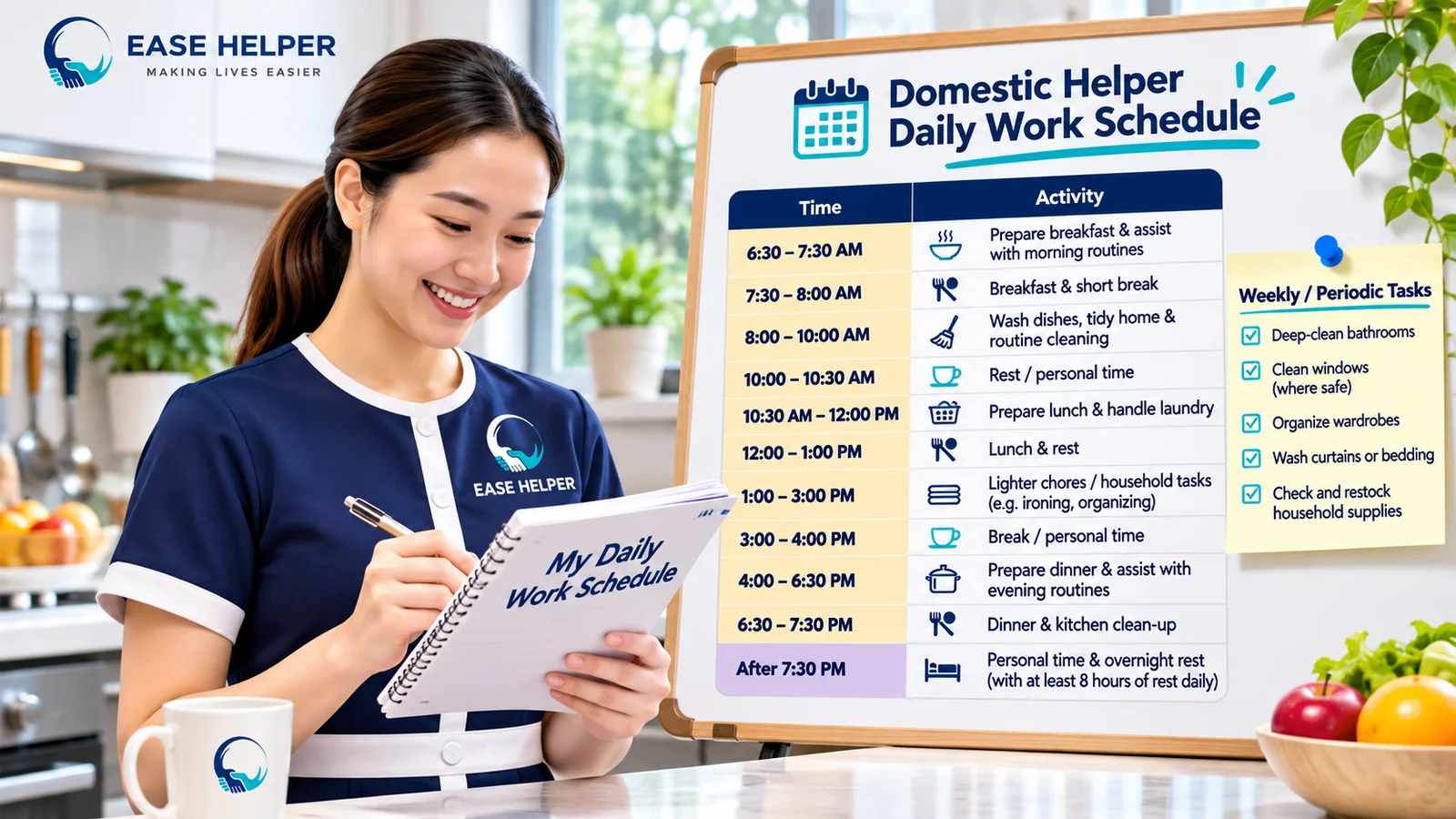
3. Sample Domestic Helper Daily Schedule in Singapore
The following timetable illustrates one possible routine for a household with school-going children. It is a planning example, not a mandatory schedule or MOM-prescribed working timetable.
| Time | Suggested Activity | Important Consideration |
|---|---|---|
| 6:30–7:30 AM | Prepare breakfast and assist with morning household routines. | Prioritise essential tasks. |
| 7:30–8:00 AM | Have breakfast and take a short break. | Allow an uninterrupted meal where practical. |
| 8:00–10:00 AM | Wash dishes, tidy common areas and complete routine cleaning. | Adjust tasks to the size of the home. |
| 10:00–10:30 AM | Rest or attend to personal needs. | Avoid continuous work without breaks. |
| 10:30 AM–12:00 PM | Prepare lunch and handle essential laundry. | Rotate larger chores across the week. |
| 12:00–1:00 PM | Lunch and rest. | Provide adequate time to eat and recover. |
| 1:00–3:00 PM | Complete lighter chores or planned household tasks. | Do not overload this period. |
| 3:00–4:00 PM | Break, personal time or adjusted household routine. | Allow flexibility according to the day’s needs. |
| 4:00–6:30 PM | Prepare dinner and assist with evening routines. | Give safety-sensitive work full attention. |
| 6:30–7:30 PM | Dinner and essential kitchen clean-up. | Allow time for the helper’s own meal. |
| After 7:30 PM | Personal time and overnight rest, except for genuinely agreed essential duties. | Ensure adequate daily rest. |
Important: This is only an illustrative schedule. Employers must adapt it to their household and ensure adequate rest. MOM advises employers to provide domestic helpers with sufficient rest, including at least eight hours of rest daily, with continuous rest at night where possible. A helper who starts earlier, works later or provides overnight care needs an appropriately adjusted routine.
4. Separate Daily Tasks From Weekly Tasks
One common scheduling mistake is expecting every household chore to be completed every day.
Instead, separate essential daily duties from larger tasks that can be rotated throughout the week.
| Daily Tasks | Weekly or Periodic Tasks |
|---|---|
| Prepare agreed meals. | Deep-clean kitchen cabinets. |
| Wash dishes and clean food preparation surfaces. | Clean windows where safe and appropriate. |
| Tidy frequently used areas. | Organise wardrobes and storage areas. |
| Complete essential laundry. | Wash curtains or bedding as needed. |
| Support agreed childcare or elderly care duties. | Deep-clean bathrooms and less-used spaces. |
| Dispose of household rubbish appropriately. | Review household supplies and organise storage. |
For example, employers might schedule wardrobe organisation on Tuesday and additional bathroom cleaning on Thursday.
As a result, the helper can focus on important daily responsibilities without rushing through unnecessary tasks.
5. How to Prioritise Household Duties
Not every task has the same urgency. Therefore, employers should help their helper understand what to do first when several duties compete for attention.
Priority One: Safety and Caregiving
Child safety, urgent elderly assistance and immediate household hazards should generally take priority over routine cleaning.
Priority Two: Essential Daily Needs
Meal preparation, hygiene and time-sensitive household activities usually come next.
Priority Three: Routine Housekeeping
Vacuuming, laundry and general tidying can often be arranged around essential caregiving responsibilities.
Priority Four: Non-Urgent Tasks
Wardrobe organisation, decorative cleaning and other non-essential chores can usually wait.
For instance, if an elderly family member needs help walking, your helper should not feel pressured to finish folding clothes first.
6. Creating a Schedule for Families With Young Children
Families with babies or young children often require more flexibility because caregiving needs can change unexpectedly.
For example, feeding times, naps and school activities may interrupt the normal housekeeping routine.
Therefore, avoid assigning several demanding cleaning tasks during periods when the helper must actively supervise a child.
Practical Scheduling Tips
- Identify the times when children need direct supervision.
- Keep meal preparation manageable during busy periods.
- Schedule non-urgent cleaning when another adult can supervise the child.
- Explain the family’s emergency procedures.
- Allow sufficient time for the helper’s meals and breaks.
Above all, childcare safety should not depend on a helper trying to complete multiple distracting tasks simultaneously.
7. Creating a Schedule for Elderly Care
Elderly care may involve meal preparation, mobility assistance, companionship and other agreed responsibilities.
However, some elderly family members require more support than one domestic helper can safely provide alone.
Therefore, employers should assess the person’s needs carefully and consider professional nursing or caregiving support where necessary.
Key Considerations
- Plan meals around the elderly person’s needs.
- Allow time for safe walking and mobility assistance.
- Provide clear instructions about medical appointments.
- Do not expect the helper to perform clinical procedures without appropriate training and authorisation.
- Arrange backup care so the helper can rest.
Additionally, families should review the schedule if the elderly person’s condition or level of dependence changes.
8. How Much Rest Should a Domestic Helper Receive?
Rest is an essential part of a sustainable household routine.
MOM advises employers to provide sufficient daily rest, including at least eight hours of rest per day. Continuous overnight rest is preferable where possible.
Furthermore, domestic helpers are entitled to weekly rest days under MOM’s rules. At least one rest day per month cannot be replaced by compensation.
Employers should distinguish between daily rest, meal breaks and weekly rest days when planning the household schedule.
For the latest requirements, consult MOM’s rest days and well-being guidance.
Employer reminder: A timetable should not require a helper to work continuously from early morning until late at night. Where overnight caregiving is necessary, arrange adequate daytime rest or additional support.
9. Should Employers Include Meal Breaks?
Yes. Domestic helpers need adequate meals and time to eat.
For example, if your helper prepares breakfast for the family, ensure she also has a reasonable opportunity to enjoy her own breakfast.
Similarly, do not assume that cooking and serving dinner automatically provides time for her to eat.
Discuss meal arrangements clearly, especially when family members follow different schedules.
Moreover, consider dietary needs and reasonable personal preferences when planning meals.
10. How to Manage Unexpected Changes
Even a carefully planned schedule may need adjustments.
For example, a child may become ill, a family member may return home late or an appliance may stop working.
In these situations, employers should identify the new priority and postpone non-urgent tasks.
A Simple Approach
- Identify the urgent situation.
- Decide which duties can wait.
- Explain the revised priority to your helper.
- Arrange additional support if the workload becomes excessive.
- Review the schedule after the situation is resolved.
As a result, the household can respond to changing needs without expecting the helper to complete every original task.
11. How to Introduce a New Schedule
Employers should explain the schedule clearly rather than simply handing over a long list of instructions.
First, walk through the routine together. Next, demonstrate unfamiliar tasks and explain important safety precautions.
Then, invite questions and confirm that the helper understands the priorities.
If language differences create difficulties, use simple English, photographs, demonstrations or suitable translation tools.
Five Questions to Ask Your Helper
- Do you understand which tasks are most important?
- Which duties would you like us to demonstrate?
- Do you have enough time to complete the routine safely?
- Are the meal and rest arrangements suitable?
- What changes would make the schedule more practical?
Finally, review the arrangement after the first week or two. Small adjustments can make the routine more effective for everyone.
12. Avoid Micromanaging Every Minute
A timetable should provide structure without creating unnecessary pressure.
For instance, employers do not need to assign an exact minute for every plate washed or every item of clothing folded.
Instead, set reasonable completion windows and explain the expected standard of work.
Additionally, remember that people complete tasks at different speeds. A new helper may need more time while learning the household routine.
Therefore, focus on safe, consistent results rather than unrealistic speed targets.
13. Common Daily Scheduling Mistakes
| Common Mistake | Better Approach |
|---|---|
| Assigning too many tasks every day. | Separate essential duties from weekly chores. |
| Expecting cleaning during active childcare. | Prioritise child supervision and postpone non-urgent work. |
| Leaving no time for meals or rest. | Build realistic breaks into the routine. |
| Changing instructions repeatedly. | Explain priorities and communicate changes clearly. |
| Expecting the same speed from every helper. | Allow suitable training and adjustment time. |
| Scheduling heavy work after overnight caregiving. | Adjust duties and arrange sufficient rest. |
| Using a rigid timetable during emergencies. | Reprioritise essential tasks and postpone others. |
14. Daily Schedule Checklist for Employers
Use this checklist when preparing or reviewing your domestic helper’s routine:
- ☐ Identify essential daily household duties.
- ☐ Separate weekly and periodic chores.
- ☐ Prioritise childcare, elderly care and safety.
- ☐ Allow realistic time for each task.
- ☐ Include adequate meal and rest periods.
- ☐ Ensure the helper receives sufficient daily rest.
- ☐ Respect MOM’s weekly rest-day requirements.
- ☐ Avoid overlapping demanding tasks.
- ☐ Explain the routine using clear instructions.
- ☐ Provide training for unfamiliar duties.
- ☐ Invite feedback from your helper.
- ☐ Review the timetable when household needs change.
15. Frequently Asked Questions
Does MOM provide a fixed daily work schedule for domestic helpers?
No. MOM does not prescribe one universal daily timetable for every household. Employers should organise reasonable duties while ensuring adequate rest and complying with applicable requirements.
How many hours should a domestic helper work each day?
Domestic helpers do not have one universal fixed daily working-hour schedule under MOM’s domestic helper framework. However, employers must provide adequate rest and avoid excessive workloads.
Should a domestic helper have meal breaks?
Yes. Employers should provide adequate meals and reasonable opportunities for the helper to eat and rest.
Can a helper manage childcare and cleaning at the same time?
That depends on the child’s age and supervision needs. Safety-sensitive childcare should take priority over non-urgent cleaning.
Should employers prepare a written timetable?
A written timetable can be useful, particularly for new helpers. However, employers should explain the schedule and allow reasonable flexibility.
Can employers change the daily schedule?
Yes. Household needs may change. Discuss significant adjustments clearly and ensure the revised workload remains reasonable.
What if the helper cannot complete every assigned task?
Review the workload, task priorities and training needs. Then, adjust the schedule rather than automatically assuming poor performance.
16. How EaseHelper Supports Employers
At EaseHelper, we understand that every Singapore household has different expectations and routines.
Our team helps employers consider candidate suitability, household responsibilities and practical training needs during the domestic helper hiring process.
Clear expectations can support better communication and a more stable working relationship.
However, employers remain responsible for organising reasonable duties, providing adequate rest and meeting MOM’s requirements.
Looking for a Domestic Helper in Singapore?
EaseHelper can help you explore suitable domestic helper options and prepare for your household’s daily needs.
Build a clearer routine and a more positive working relationship from the beginning.
Explore EaseHelper ServicesDisclaimer
This article provides general household management guidance and does not constitute legal or employment advice. The sample timetable is illustrative and should be adapted to individual circumstances. MOM requirements and guidance may change. Employers should consult the latest information from the Ministry of Manpower and seek official clarification where necessary.