Blog
How Long Does It Take to Hire a Domestic Helper in Singapore?

Executive Summary
How long does it take to hire a domestic helper in Singapore? The answer depends on whether you hire a helper already in Singapore or recruit someone from overseas. Candidate selection, Work Permit processing, travel arrangements, medical examinations and required training can all affect the schedule. As a practical planning estimate, employers may allow several weeks for an overseas placement, although individual cases can be faster or slower. This guide explains each stage, common causes of delays and how to prepare for a smoother hiring process.
How Long Does It Take to Hire a Domestic Helper in Singapore?
There is no single recruitment timeline that applies to every household. Some employers find a suitable transfer helper who is already in Singapore. Others recruit a new helper from Myanmar, Indonesia or another approved source country.
As a result, the overall timeline depends on several independent steps. These include candidate availability, document preparation, regulatory processing and the helper’s readiness to start work.
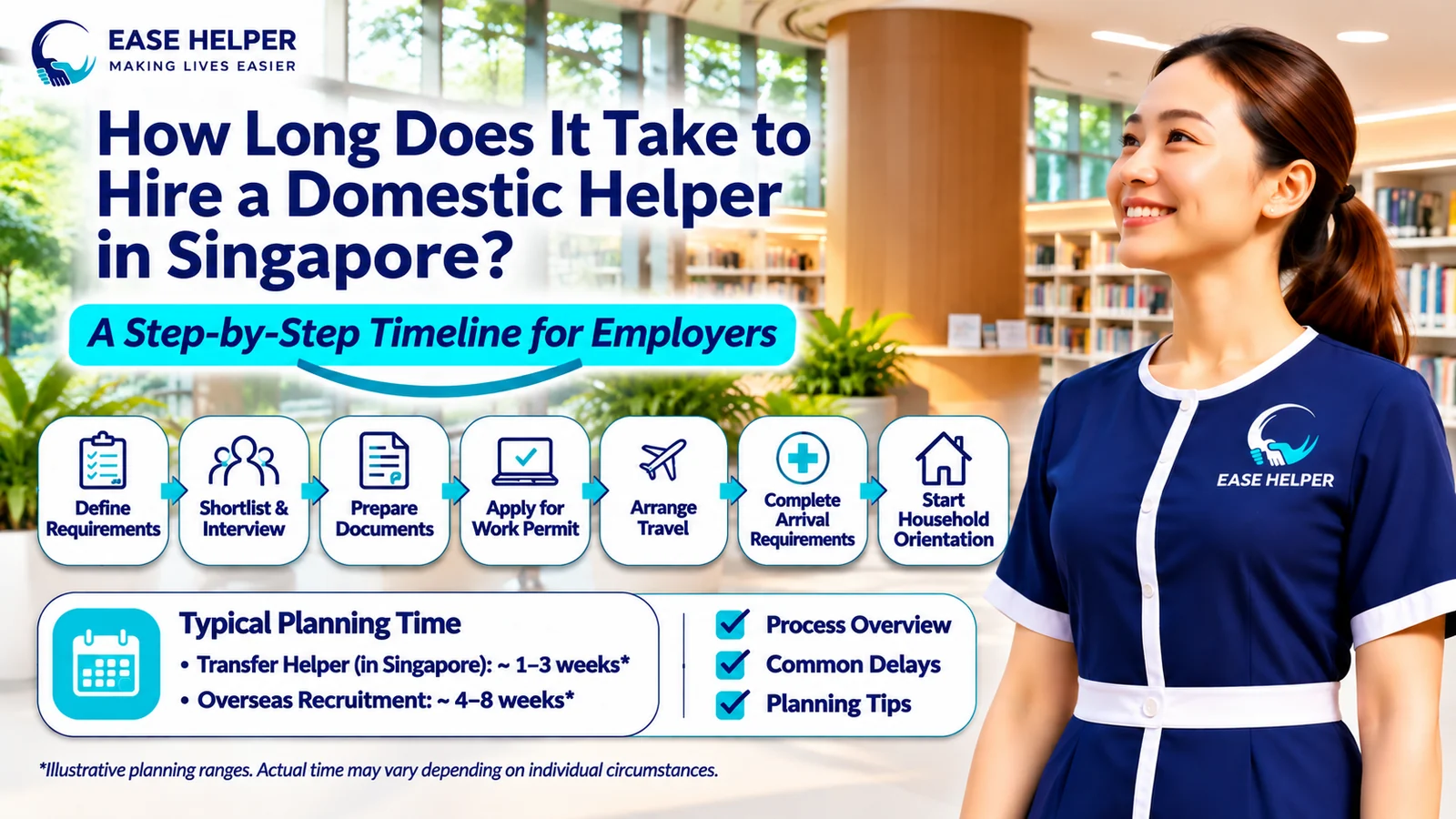
For initial planning, employers can use the following broad estimates. However, these are illustrative recruitment planning ranges, not official MOM guarantees.
| Recruitment Route | Illustrative Planning Range | Main Considerations |
|---|---|---|
| Transfer helper already in Singapore | Approximately 1–3 weeks in straightforward cases | Candidate availability, current employer’s consent, Work Permit procedures and agreed transfer date |
| New helper recruited from overseas | Approximately 4–8 weeks, sometimes longer | Recruitment, documents, source-country procedures, Work Permit approval, travel and arrival requirements |
| Specialised caregiving requirements | Variable; allow additional time | Candidate matching, interviews, experience checks and possible additional preparation |
These ranges should help households plan, rather than predict a confirmed arrival date. Always ask the agency for an updated estimate based on the selected candidate’s actual circumstances.
The Domestic Helper Hiring Process: Seven Main Stages
Stage 1: Identify Your Household Requirements
Before contacting an agency, decide which duties matter most. For example, your household may need help with general housekeeping, cooking, childcare or elderly care.
Next, identify any essential language abilities, relevant experience or training needs. Clear requirements make candidate matching more efficient.
Employers should also establish a realistic budget and understand their ongoing responsibilities.
Stage 2: Shortlist and Interview Candidates
The time required for shortlisting depends on candidate availability and the household’s expectations.
Some employers identify a suitable candidate quickly. However, others need several interviews before finding someone who meets their essential requirements.
During interviews, ask practical questions about experience, household routines and communication. Avoid making a decision based only on how quickly a candidate can arrive.
Stage 3: Prepare the Required Documents
Once you select a candidate, prepare the necessary information and documents for the application.
Depending on the circumstances, these may include employer details, the helper’s passport information and supporting documents required by MOM.
Additionally, first-time employers must complete the required Employers’ Orientation Programme unless an exemption applies.
Check the latest requirements through MOM’s migrant domestic worker Work Permit guidance.
Stage 4: Submit the Work Permit Application
The employer or appointed employment agency submits the Work Permit application through the relevant MOM system.
For many online applications, MOM indicates a processing time of around one week. However, applications requiring additional checks or supporting documents may take longer.
Therefore, do not treat the normal processing period as a guaranteed approval date.
Employers should wait for the required approval before confirming arrangements that depend on it.
Stage 5: Arrange Travel and Pre-Arrival Requirements
For overseas recruitment, the selected helper must complete any applicable source-country procedures and travel preparations.
These arrangements can involve passport validity, exit requirements, transport availability and other administrative steps.
Furthermore, employers must arrange the applicable insurance and security bond requirements before the helper’s arrival, where required.
Because these steps involve different parties, delays may occur even after MOM approves the Work Permit application.
Stage 6: Complete Arrival, Medical and Training Requirements
After arriving in Singapore, the helper must complete the applicable post-arrival procedures.
These may include the required medical examination, the Settling-in Programme for eligible first-time helpers and Work Permit issuance arrangements.
The exact sequence depends on the helper’s circumstances and current MOM requirements.
Consequently, an arrival date and a confirmed date for starting household duties are not always the same.
Stage 7: Begin Household Orientation
Once the helper can legally start work, introduce her to the household’s routines and expectations.
For example, explain appliance safety, cleaning priorities, meal preparation and emergency procedures.
Although the recruitment process may be complete, practical adjustment takes time. Therefore, allow a reasonable orientation period rather than expecting immediate familiarity with every task.
What Causes Delays When Hiring a Domestic Helper?
Several factors can affect the overall hiring schedule.
| Possible Delay | Why It Happens | What Employers Can Do |
|---|---|---|
| Limited candidate availability | Specific skills or experience may be harder to match | Separate essential requirements from preferences |
| Incomplete documents | Missing information may interrupt processing | Check the document list before submission |
| Additional MOM checks | Some applications need further assessment | Allow flexibility and respond promptly |
| Source-country procedures | Overseas requirements differ by location and candidate | Ask for realistic progress updates |
| Travel arrangements | Flight availability or administrative issues may change plans | Avoid relying on an unconfirmed arrival date |
| Transfer coordination | Current and prospective employers must coordinate relevant steps | Confirm consent and the proposed transfer date |
| Post-arrival requirements | Medical, training or issuance steps remain outstanding | Plan for the complete onboarding process |
Is Hiring a Transfer Helper Faster Than Recruiting From Overseas?
Hiring a transfer helper can be faster because the candidate is already in Singapore. In some cases, employers can arrange an interview and assess suitability without waiting for overseas travel.
However, the transfer still requires the appropriate Work Permit procedures and coordination with the current employer.
Moreover, a helper’s availability date may depend on existing employment arrangements.
Therefore, employers should compare both suitability and timing before choosing a transfer candidate.
Does Hiring Through an Agency Save Time?
An employment agency can help coordinate candidate selection, interviews, document preparation and application procedures.
For busy employers, this assistance may reduce the time spent managing different administrative tasks.
However, an agency cannot guarantee MOM approval or eliminate every delay. Processing decisions and certain overseas arrangements remain outside the agency’s control.
Before engaging an agency, ask which services it handles, what information you must provide and how it communicates progress updates.
How to Prepare for Hiring a Helper Within a Specific Timeframe
1. Start Before the Help Becomes Urgent
If you expect a new baby, an upcoming medical procedure or a change in caregiving needs, begin planning early.
This gives you more flexibility to interview suitable candidates and complete the required steps.
2. Prepare a Clear Job Description
List the household’s main duties, working routines and essential requirements.
As a result, the agency can focus on candidates who are more likely to suit your family.
3. Respond Promptly to Document Requests
Check that your information is accurate and complete. If the agency requests clarification, reply as soon as reasonably possible.
Nevertheless, avoid submitting inaccurate information merely to speed up the process.
4. Ask for Milestone Updates
Rather than relying on one estimated arrival date, request updates at important stages.
- Candidate selected and accepted.
- Required documents prepared.
- Work Permit application submitted.
- Application approved, where applicable.
- Travel arrangements confirmed.
- Post-arrival requirements completed.
- Helper ready to begin work.
5. Prepare Your Home in Advance
Arrange suitable accommodation, essential household supplies and a practical orientation checklist.
In addition, prepare a simple daily schedule. This helps the helper understand her responsibilities after she starts work.
Sample Recruitment Planning Timeline
The following example illustrates how an employer might organise an overseas recruitment process. It is not an official processing schedule.
| Planning Period | Possible Activities |
|---|---|
| Week 1 | Define requirements, review candidates and arrange interviews |
| Week 2 | Confirm candidate, prepare documents and submit application when ready |
| Weeks 3–4 | Monitor approval, complete applicable overseas procedures and coordinate arrangements |
| Weeks 5–6 | Arrange arrival when permitted and complete relevant post-arrival requirements |
| Following arrival | Complete onboarding and begin structured household orientation |
Some cases move more quickly, while others take considerably longer. Therefore, employers should avoid making non-refundable commitments based solely on this example.
Frequently Asked Questions
Can I hire a domestic helper in Singapore within one week?
It may be possible to complete certain stages quickly, particularly when a suitable transfer candidate is available. However, the full process depends on the required approvals, transfer arrangements and other conditions. One week should not be assumed.
How long does MOM take to approve a domestic helper Work Permit?
MOM commonly indicates around one week for online processing, although some applications require more time. Check the latest official processing guidance for your application type.
Is it faster to hire a Myanmar or Indonesian domestic helper?
Nationality alone does not determine the recruitment timeline. Candidate readiness, documents, source-country procedures and travel arrangements can all affect the schedule.
Can a domestic helper start work immediately after arriving?
Not necessarily. The helper must first meet the applicable Work Permit, medical, training and other post-arrival requirements. Employers should confirm when she may legally begin work.
What if the helper’s arrival is delayed?
Ask the agency to explain the reason and provide an updated estimate. Also review the service agreement for relevant arrangements and avoid assuming that every delay automatically creates a refund entitlement.
Should I choose the fastest available helper?
Not always. Skills, communication, experience and suitability for your household matter more than a small difference in arrival dates.
How EaseHelper Can Assist With Recruitment Planning
EaseHelper helps Singapore employers understand their household needs and explore suitable domestic helper recruitment options.
Our team can discuss candidate availability, recruitment procedures and practical scheduling considerations based on the circumstances of each placement.
We also encourage employers to prepare realistic expectations and allow time for household orientation after the helper begins work.
Planning to Hire a Domestic Helper?
Contact EaseHelper to discuss your household requirements, available recruitment options and expected hiring arrangements.
Explore EaseHelper ServicesDisclaimer: This article provides general information and illustrative recruitment planning estimates. It does not guarantee any hiring, approval or arrival timeline. Actual processing periods and requirements depend on the circumstances of each application and the latest MOM rules. Always verify current requirements through official government guidance and confirm candidate-specific arrangements before making commitments.