
Blog
Can a Domestic Helper Work at Another Address in Singapore? MOM Rules Explained

Executive Summary
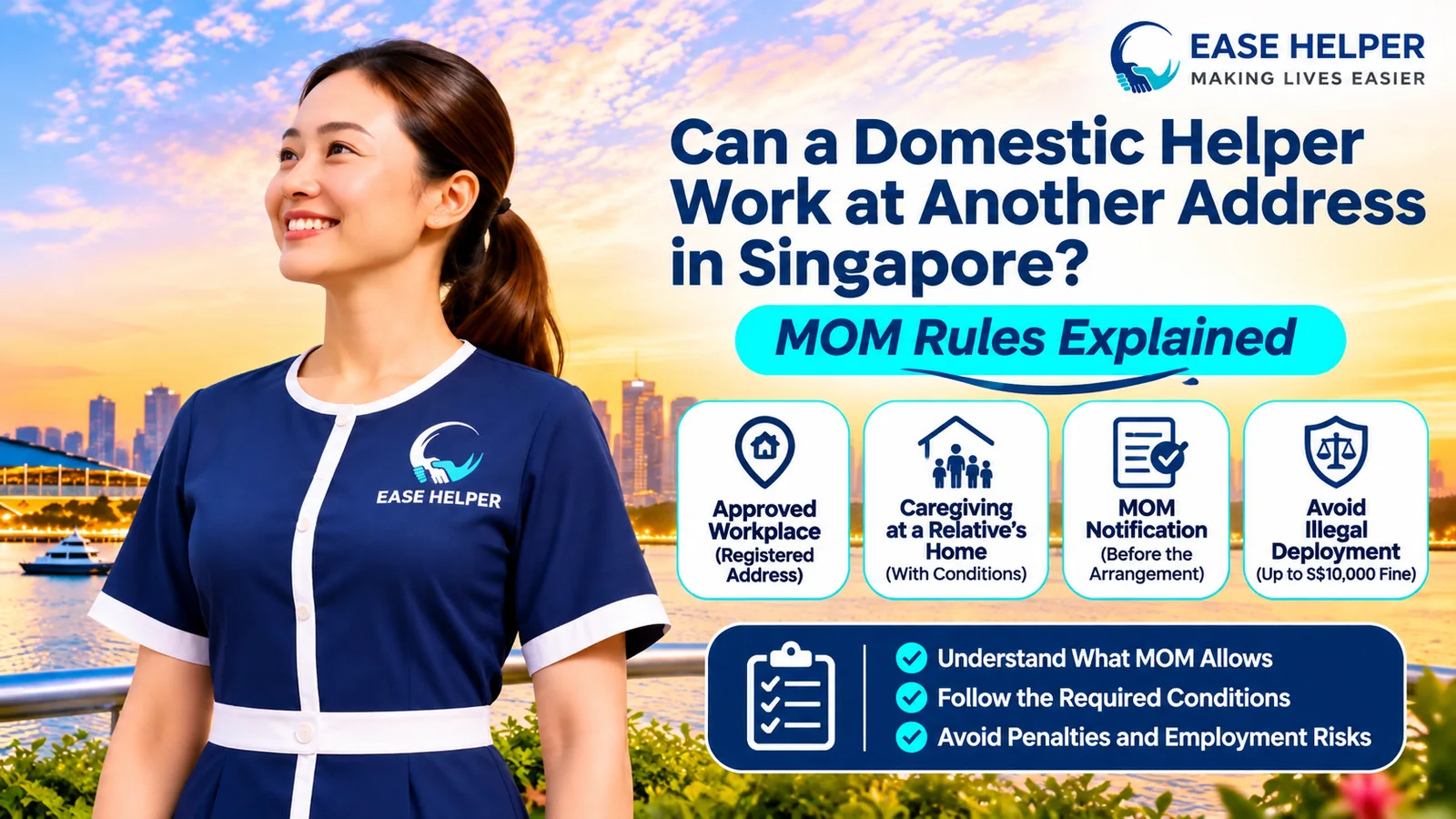
Can a domestic helper work at another address in Singapore? Generally, MOM requires migrant domestic workers to work only for their official employer at the registered residential address. However, employers may arrange caregiving at a relative’s home under specific conditions. They must obtain the helper’s written agreement, notify MOM before the arrangement begins and avoid assigning a full household workload at both homes. This guide explains permitted arrangements, prohibited work and the steps employers should follow.
Can a Domestic Helper Work at Another Address in Singapore?
Many Singapore families need help with childcare, elderly care and daily household responsibilities. Consequently, some employers wonder whether their domestic helper can work at another address.
For example, grandparents may care for young children while the parents work. Alternatively, an elderly parent may need support at a relative’s home during the day.
However, MOM’s Work Permit conditions generally restrict a domestic helper to domestic work for her official employer at the declared residential address.
Therefore, employers cannot freely send their helper to another household, even when the other household belongs to a relative.
Nevertheless, MOM allows certain caregiving arrangements when employers meet the required conditions and notify the ministry beforehand.
Read MOM’s employment rules for migrant domestic workers.
MOM Rules for Domestic Helpers Working at Another Address
Under MOM’s employment rules, a domestic helper must work for the employer named on her Work Permit. Furthermore, she may perform only permitted domestic duties.
Employers must not deploy helpers to another household for general housework or commercial activities.
Three Important Employment Restrictions
- Official employer: The helper may work only for the employer stated on her Work Permit.
- Registered workplace: Her normal workplace is the employer’s residential address declared to MOM.
- Domestic duties: Her responsibilities must remain within permitted household work.
However, a limited caregiving arrangement at a relative’s home may be possible. In that case, employers must meet MOM’s conditions before proceeding.
When Can a Domestic Helper Work at a Relative’s House?
MOM recognises that some employers need their helpers to care for their children or parents at a relative’s residential address.
For instance, a mother may bring her child to the grandparents’ home each morning. The domestic helper may accompany the child and provide childcare while the employer is working.
Similarly, a helper may assist with the employer’s elderly parent at a relative’s home under an eligible arrangement.
However, employers must fulfil several requirements.
Conditions for a Caregiving Arrangement
- Obtain the helper’s written agreement before the arrangement begins.
- Notify MOM before deploying the helper to the relative’s address.
- Ensure the arrangement concerns caregiving for the employer’s child or parent.
- Do not require the helper to perform the full household workload at both addresses.
- Provide suitable accommodation if the arrangement involves overnight stays.
- Continue meeting all employer responsibilities for salary, food, medical care and well-being.
Importantly, the helper’s consent alone does not remove the requirement to notify MOM.
For the official conditions, see MOM’s guidance on caregiving at a relative’s house.
Examples of Permitted and Prohibited Arrangements
Every household situation is different. Therefore, employers should assess the purpose of the work, the people receiving care and the relevant MOM conditions.
| Situation | General Position | Important Condition |
|---|---|---|
| Helper cares for employer’s child at grandparents’ home | May be permitted | Written agreement and prior MOM notification required |
| Helper cares for employer’s parent at a relative’s home | May be permitted | Must meet MOM caregiving conditions |
| Helper cleans a sibling’s home | Not permitted as ordinary cross-household deployment | Relative must not use another employer’s helper for general housework |
| Helper cleans an employer’s second property | Generally prohibited | Ownership of another property does not authorise deployment |
| Helper works at employer’s shop or office | Prohibited | Commercial and non-domestic work is not allowed |
| Helper prepares products for a home-based business | Prohibited | Business activities are not permitted domestic duties |
| Helper accompanies employer’s family on an outing | Different from deployment to another household | Duties must remain lawful and within the employment arrangement |
Important: A relative’s home is not automatically an approved workplace. Employers should confirm eligibility and complete MOM’s notification process before starting any secondary-address caregiving arrangement.
Can a Domestic Helper Clean Two Houses in Singapore?
Generally, no. Employers cannot use their domestic helper as a cleaner for multiple households or properties.
For example, an employer may own both an HDB flat and a condominium. However, owning two properties does not automatically allow the helper to clean both homes.
Likewise, employers should not send their helper to clean a relative’s apartment simply because the families know each other.
Even when MOM permits caregiving at a relative’s address, the helper must not carry out the full household workload at both homes.
Consequently, employers should separate genuine caregiving needs from unrelated cleaning or maintenance tasks.
Can a Domestic Helper Care for Children at Grandparents’ Home?
Yes, this may be possible under MOM’s specific caregiving arrangement.
For example, working parents may bring their toddler to the grandparents’ HDB flat during office hours. Their helper may accompany the child and assist with meals, supervision and the child’s daily routine.
However, the employer must first obtain the helper’s written agreement and notify MOM.
Additionally, the helper should not become responsible for the grandparents’ entire household.
Practical Childcare Arrangements
- Explain the child’s routine and caregiving needs.
- Identify the supervising family member.
- Clarify which duties relate directly to the child’s care.
- Agree on travel and working arrangements.
- Maintain reasonable workload and rest periods.
- Keep the required written agreement and MOM notification records.
As a result, the employer can organise childcare while respecting the helper’s employment conditions.
Can a Domestic Helper Care for Elderly Parents at Another Address?
MOM also recognises eligible arrangements involving care for the employer’s parent at a relative’s residential address.
For example, an elderly parent may spend weekdays at another family member’s home. The helper may assist with appropriate caregiving duties if the employer fulfils MOM’s requirements.
Nevertheless, employers should avoid assigning unrelated household work to the helper.
Caregiving Duties May Include
- Assisting with safe mobility and daily routines.
- Preparing meals for the person receiving care.
- Providing companionship and supervision.
- Helping with personal care within the helper’s training and abilities.
- Informing family members about changes in the elderly person’s condition.
However, tasks requiring professional medical qualifications should remain with appropriately trained healthcare providers.
Furthermore, employers should consider the helper’s experience, physical ability and workload before arranging elderly care.
How to Notify MOM Before a Helper Works at Another Address
Employers must notify MOM before starting an eligible caregiving arrangement at a relative’s home.
First, confirm that the proposed arrangement meets MOM’s conditions. Then, obtain the helper’s written agreement.
Next, use the notification process linked from MOM’s official guidance.
Employer Preparation Checklist
- Identify the reason for the secondary-address arrangement.
- Confirm that the care recipient qualifies under MOM’s rules.
- Discuss the arrangement with the helper.
- Obtain her written agreement.
- Confirm the duties and working schedule.
- Check accommodation requirements if overnight stays are necessary.
- Submit the required MOM notification before proceeding.
- Retain the relevant records for reference.
Moreover, employers should review the arrangement if household circumstances or caregiving needs change.
Visit MOM’s official secondary-address caregiving guidance for the current notification procedure.
What If the Employer Moves to a New Residential Address?
Moving house is different from sending a helper to work at a second household.
If an employer permanently changes residence, the employer must update the relevant residential address records.
According to MOM, employers should update their new residential address within two weeks of the change. The appropriate process depends on the employer’s immigration or residency status.
For example, Singapore citizens and permanent residents generally update their residential address through ICA’s service. Other pass holders may need to use the relevant MOM or ICA process.
Once the residential address update is processed, the helper’s workplace address is updated accordingly.
For details, refer to MOM’s notification and address-change guidance.
Can a Domestic Helper Stay With Relatives While the Employer Travels?
Sometimes, employers travel overseas without their helper. Consequently, they may arrange temporary accommodation with a friend, relative or employment agency.
However, temporary accommodation does not mean the helper can work for the person providing the accommodation.
MOM permits qualifying temporary accommodation arrangements for up to one month. Employers must notify MOM at least seven days before travelling.
Furthermore, the helper must not perform work at the temporary accommodation premises.
Employer Responsibilities During Temporary Accommodation
- Notify MOM within the required timeframe.
- Inform the helper about the arrangement.
- Ensure suitable accommodation.
- Continue paying salary and levy.
- Provide for food, medical care and maintenance.
- Remain contactable during the trip.
- Ensure the host does not assign work to the helper.
Therefore, employers should distinguish between temporary boarding and an approved caregiving arrangement.
Check MOM’s rules for leaving a helper in someone else’s care.
Can a Domestic Helper Work at an Employer’s Business?
No. A domestic helper cannot work at her employer’s shop, office, food stall or other business.
Moreover, this restriction also applies to commercial tasks performed inside the employer’s home.
For example, a helper must not prepare products for sale, pack commercial orders or perform administrative work for a home-based business.
Although these tasks may appear convenient, they fall outside permitted domestic employment.
Therefore, employers should engage appropriately authorised workers for business activities.
For further information, see MOM’s guidance on domestic helpers and business work.
What Are the Penalties for Illegal Deployment?
Illegal deployment can lead to serious consequences for employers.
According to MOM, employers who illegally deploy domestic helpers may face a financial penalty of up to S$10,000.
Additionally, MOM may ban errant employers from hiring domestic helpers in the future.
Therefore, employers should not rely on informal family arrangements or verbal permission when considering work at another address.
Instead, they should verify the rules and complete the required notification process before proceeding.
Common Mistakes Employers Should Avoid
| Common Mistake | Why It Is a Problem | Better Approach |
|---|---|---|
| Sending a helper to clean a relative’s home | May constitute illegal deployment | Keep work within the permitted employment arrangement |
| Assuming written consent is enough | MOM notification is also required for eligible secondary-address caregiving | Complete both steps before starting |
| Assigning full housework at two homes | Breaches the conditions for permitted caregiving arrangements | Limit duties to the approved caregiving purpose |
| Using the helper for a home business | Commercial work is prohibited | Use appropriately authorised workers |
| Leaving the helper with relatives without notifying MOM | Temporary accommodation has separate notification requirements | Follow MOM’s overseas-travel procedures |
| Failing to update a permanent residential address | Workplace records may become inaccurate | Update the address through the appropriate official service |
Frequently Asked Questions About Domestic Helpers Working at Another Address
1. Can a domestic helper work at two houses in Singapore?
Generally, no. A domestic helper must work for her official employer at the registered residential address. However, MOM allows certain caregiving arrangements at a relative’s home when employers meet the required conditions and notify MOM beforehand.
2. Can my helper clean my parents’ house?
Not simply because your parents are relatives. MOM’s limited secondary-address arrangement concerns eligible caregiving needs. It does not authorise a helper to perform the full household workload at another home.
3. Can my helper look after my child at my mother’s HDB flat?
Yes, this may be permitted. However, you must obtain your helper’s written agreement, notify MOM before starting and comply with the relevant caregiving and workload conditions.
4. Can my helper work at my condominium and HDB flat?
Owning two properties does not automatically permit work at both. Generally, the helper’s workplace is the residential address declared to MOM. Employers should verify any proposed arrangement before assigning duties elsewhere.
5. What happens if an employer sends a helper to work illegally at another address?
MOM may impose a financial penalty of up to S$10,000 for illegal deployment. Furthermore, employers may face restrictions on employing domestic helpers in the future.
How EaseHelper Supports Singapore Employers
Understanding whether a domestic helper can work at another address in Singapore helps families plan childcare and elderly care without breaching MOM requirements.
At EaseHelper, we support employers with domestic helper recruitment and practical employment guidance. Additionally, we encourage families to discuss household responsibilities clearly and verify regulatory requirements before changing work arrangements.
Whether your family needs help with children, elderly parents or general household duties, choosing an appropriate employment arrangement is essential.
Need a Domestic Helper for Your Family?
EaseHelper helps Singapore households explore domestic helper recruitment options and understand important employer responsibilities.
Explore EaseHelper ServicesDisclaimer: This article provides general information and does not constitute legal advice. Domestic helper deployment depends on the Employment of Foreign Manpower framework, Work Permit conditions and MOM requirements. Employers should verify the latest official rules and seek clarification from MOM before arranging work at another residential address.