
Blog
Domestic Helper Laundry Stain Removal in Singapore: A Practical Guide to Treating Common Clothing Stains

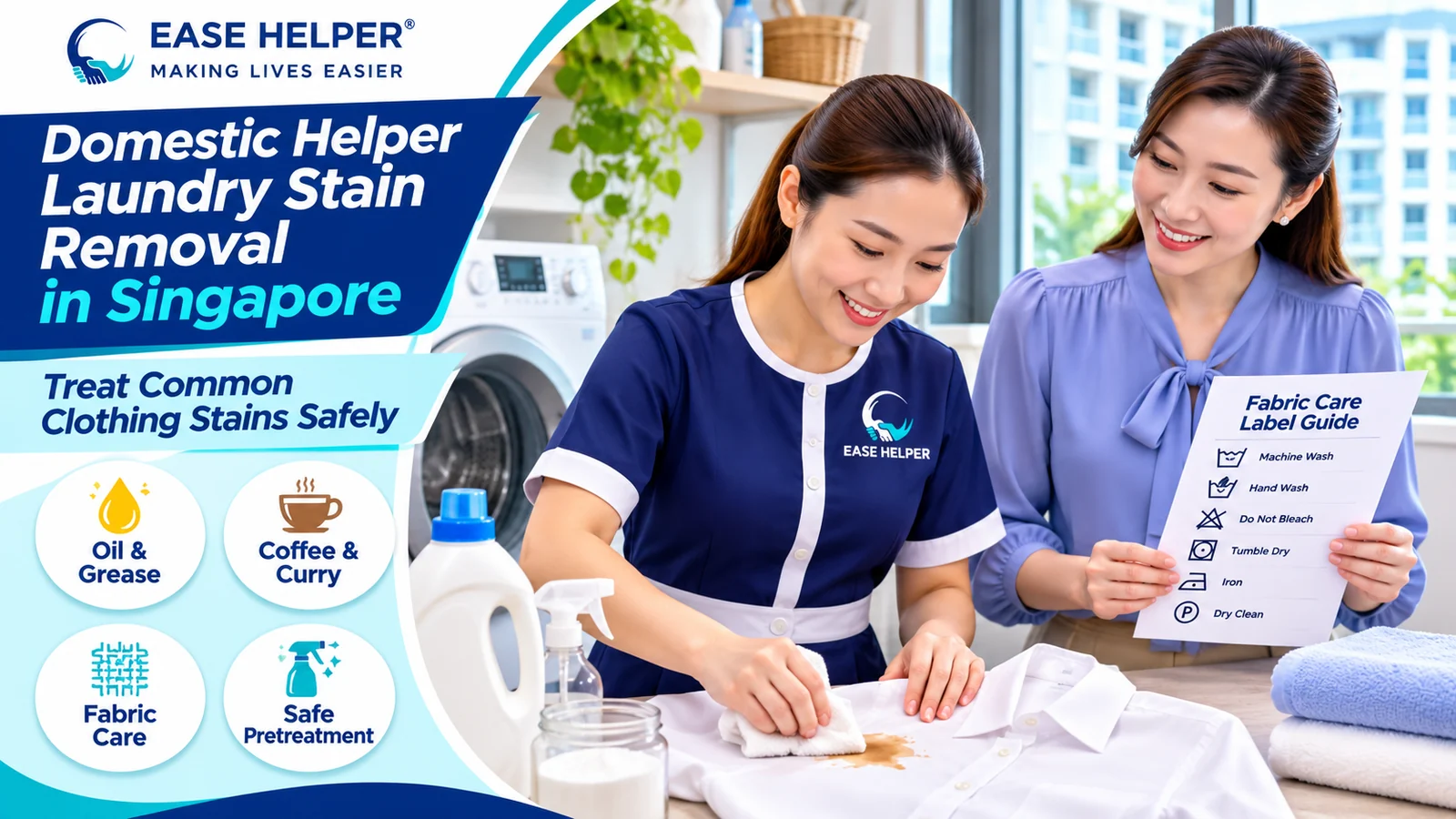
Domestic helper stain removal is an important laundry skill for Singapore households. Food spills, sweat, cooking oil, makeup and children’s clothing stains can be difficult to remove when treated incorrectly. However, the right technique can often improve results while protecting fabric quality.
Employers should explain how to identify stains, check garment care labels and choose suitable cleaning products. They should also demonstrate safe pretreatment methods before asking a helper to handle expensive or delicate clothing.
This guide covers common stain types, fabric-safe cleaning techniques, laundry product precautions and practical training tips for domestic helpers in Singapore.
Executive Summary
Effective domestic helper stain removal begins with identifying the stain and checking the fabric care label. Treat fresh stains promptly, blot rather than scrub aggressively and test suitable products on a hidden area before use.
Different stains require different approaches. For example, grease often needs a suitable detergent, while some protein-based stains should initially be treated with cool water.
Never mix laundry chemicals, apply bleach indiscriminately or tumble-dry a garment before checking whether the stain remains. For delicate or valuable clothing, professional cleaning may be safer.
1. Why Domestic Helper Stain Removal Training Matters
Clothing stains are common in busy households. Without clear instructions, helpers may use unsuitable cleaning products, wash garments at incorrect temperatures or scrub fabrics too aggressively.
These mistakes can lead to colour fading, damaged fibres or stains that become harder to remove.
Benefits of Proper Stain Removal Training
- Helps maintain clothing appearance and condition.
- Reduces unnecessary repeat washing.
- Protects delicate fabrics from avoidable damage.
- Encourages safe use of laundry products.
- Creates clear expectations for household laundry routines.
- Helps employers and helpers communicate about difficult stains.
Employers should remember that not every stain can be removed completely. The goal is to use appropriate methods rather than guarantee perfect results.
2. Identify the Stain Before Choosing a Cleaning Method
Different substances react differently to water, detergent and temperature. Therefore, the first step is to identify the likely source of the stain.
Common Household Stain Categories
- Oil-based stains: Cooking oil, butter and oily sauces.
- Protein-based stains: Blood, egg and some food residues.
- Coloured food stains: Curry, coffee, tea and fruit juice.
- Cosmetic stains: Foundation, lipstick and sunscreen.
- Outdoor stains: Mud, grass and dirt.
- Body-related stains: Sweat and deodorant residue.
- Ink stains: Pens and markers.
If the source is unknown, begin with the garment’s care instructions and a conservative treatment. Avoid applying several chemicals in succession.
3. Check Clothing Care Labels Before Stain Removal
Care labels provide important information about washing temperature, bleaching, drying and professional cleaning requirements.
Before treating a stain, helpers should check whether the garment is washable and whether special handling is necessary.
What to Check
- Fabric type and care label instructions.
- Maximum permitted washing temperature.
- Whether bleaching is allowed.
- Whether tumble drying is permitted.
- Whether professional dry cleaning is required.
- Whether the garment has delicate trims or embellishments.
Silk, wool, leather, embellished garments and certain structured clothing may require specialist care.
Important: Never assume that a product suitable for white cotton is also safe for coloured clothing, silk or wool. When uncertain, ask the employer before treating the garment.
4. The Basic Domestic Helper Stain Removal Method
A consistent pretreatment routine helps reduce mistakes.
Seven-Step Stain Removal Process
- Identify: Determine the likely stain source.
- Check: Read the garment care label.
- Remove excess: Gently lift away solids without spreading the stain.
- Blot: Absorb excess liquid with a clean cloth.
- Test: Check the chosen treatment on an inconspicuous area.
- Pretreat: Follow the cleaning product’s instructions.
- Inspect: Check the stain before machine drying or ironing.
Do not rub aggressively. Excessive friction can damage fibres or spread the stain across a larger area.
5. Remove Cooking Oil and Grease Stains
Cooking oil, butter and oily sauces frequently stain household clothing, aprons and kitchen towels.
Because grease does not dissolve easily in water alone, an appropriate laundry detergent or fabric-safe grease pretreatment may be helpful.
Suggested Method
- Blot excess oil without rubbing.
- Check the fabric care label.
- Apply a suitable laundry pretreatment product as directed.
- Allow the recommended contact time.
- Wash according to the garment instructions.
- Inspect before drying.
For delicate fabrics, avoid experimenting with strong degreasers or household solvents. Seek professional advice if necessary.
6. Treat Coffee and Tea Stains
Coffee and tea can leave visible discolouration, particularly on light-coloured fabrics.
Practical Treatment
- Blot fresh spills immediately.
- Rinse washable fabric with cool water where appropriate.
- Use a suitable laundry detergent or stain remover.
- Follow the product’s recommended treatment time.
- Wash according to the garment label.
- Repeat only when the fabric and product instructions permit.
Milk, sugar and other ingredients can affect treatment. Avoid using hot water without first checking the garment and stain-removal instructions.
7. Handle Curry and Turmeric Stains Carefully
Curry and turmeric can create persistent yellow or orange stains. Their pigments may remain visible even after ordinary washing.
Safer Approach
- Remove excess sauce gently.
- Blot the affected area.
- Check the garment’s care label.
- Use a fabric-compatible stain treatment.
- Wash according to the instructions.
- Inspect before applying heat.
Do not apply chlorine bleach to coloured garments unless both the care label and product instructions explicitly permit it.
Some stains may remain despite correct treatment. Employers should avoid blaming helpers when a stain cannot be safely removed.
8. Remove Sweat and Deodorant Marks
Shirts and uniforms may develop yellowish or whitish marks around the underarms.
These stains can involve sweat, body oils, deodorant ingredients and fabric residues.
Recommended Routine
- Check the garment label.
- Use a suitable laundry pretreatment product.
- Gently work the product into the affected area only if instructed.
- Allow the recommended treatment time.
- Wash using an appropriate programme.
- Check the result before drying.
Do not mix household acids, bleach or other chemicals in an attempt to remove stubborn marks.
9. Treat Makeup and Sunscreen Stains
Foundation, lipstick and sunscreen may contain oils, pigments or other ingredients that require careful treatment.
Practical Steps
- Remove excess product without spreading it.
- Blot gently with a clean cloth.
- Check the garment care label.
- Use an appropriate fabric-safe pretreatment product.
- Wash according to the manufacturer’s instructions.
- Inspect the garment before drying.
Avoid rubbing makeup deeper into fabric fibres. For delicate garments, professional cleaning may be preferable.
10. Handle Blood and Other Protein-Based Stains
Blood and certain food stains contain proteins that can become more difficult to remove when exposed to heat.
For washable fabrics, cool water is generally a safer initial approach, subject to the care label.
Safe Treatment Principles
- Wear appropriate gloves when handling blood-stained laundry.
- Avoid direct contact with bodily fluids.
- Follow household hygiene precautions.
- Use cool water initially when suitable.
- Apply a compatible laundry treatment.
- Wash and handle contaminated items according to appropriate hygiene guidance.
Do not handle visibly contaminated laundry with bare hands. For significant contamination, follow relevant infection-control advice.
11. Remove Mud and Grass Stains
Children’s school uniforms, sports clothing and outdoor garments may develop mud or grass stains.
Mud Stains
Allow ordinary mud to dry when appropriate, then gently remove loose dirt before washing. Avoid grinding wet mud into the fibres.
Grass Stains
Use a fabric-safe stain remover according to its instructions. Test coloured fabrics first, particularly when using products containing bleaching agents.
Always check the garment care label and avoid excessive brushing.
12. Handle Ink Stains Without Spreading Them
Ink stains can be difficult because different pens use different formulations.
Some inks require specialised products, while others may not be safely removable from certain fabrics.
Important Precautions
- Place a clean absorbent material beneath the stain when appropriate.
- Avoid rubbing the ink across the fabric.
- Check whether the garment is colourfast.
- Use only a suitable product recommended for the fabric and ink type.
- Keep flammable solvents away from heat and flames.
- Ask the employer before treating valuable clothing.
Do not use random household solvents or combine cleaning products. Professional cleaning may be the safest option.
13. Domestic Helper Stain Removal Reference Table
| Stain Type | Initial Treatment | Important Precaution |
|---|---|---|
| Cooking oil | Blot and use suitable laundry pretreatment. | Avoid excessive rubbing. |
| Coffee or tea | Blot, rinse where suitable and pretreat. | Check colourfastness. |
| Curry or turmeric | Remove excess and apply fabric-safe treatment. | Avoid unsuitable bleach. |
| Sweat or deodorant | Use appropriate laundry pretreatment. | Do not mix chemicals. |
| Makeup | Lift excess and blot carefully. | Check delicate fabrics. |
| Blood | Use protective gloves and cool water when suitable. | Follow hygiene precautions. |
| Mud | Remove loose dirt before washing. | Avoid grinding dirt into fibres. |
| Grass | Apply a compatible stain remover. | Test coloured fabrics. |
| Ink | Blot and assess suitable specialist treatment. | Avoid spreading or solvent damage. |
14. Use Laundry Detergents and Stain Removers Safely
Domestic helper stain removal training should include safe chemical handling, not just cleaning techniques.
Essential Product Safety Rules
- Read the product label before use.
- Use the recommended quantity.
- Follow contact-time and rinsing instructions.
- Never mix bleach with ammonia, acids or other incompatible products.
- Use protective gloves where recommended.
- Maintain suitable ventilation.
- Keep products in their original labelled containers.
- Store chemicals securely away from children.
For product-related safety information, follow the manufacturer’s instructions and any applicable local guidance.
Chemical safety warning: Mixing bleach with incompatible products can release dangerous gases. Never combine stain removers or household chemicals unless the manufacturer explicitly instructs you to do so.
15. Protect Delicate and Expensive Clothing
Some garments require more caution than ordinary cotton clothing.
Silk, wool, cashmere, lace, structured jackets and embellished fabrics may be damaged by water, heat, friction or unsuitable detergents.
When to Ask the Employer First
- The care label specifies professional cleaning.
- The fabric is silk, wool or another delicate material.
- The garment has decorative beads or embroidery.
- The stain is large, old or unidentified.
- The garment is expensive or sentimental.
- A previous treatment has caused discolouration.
When uncertain, stop treatment and ask for instructions. Preventing additional damage is more important than attempting repeated cleaning.
16. Avoid Common Laundry Stain Removal Mistakes
| Common Mistake | Safer Practice |
|---|---|
| Scrubbing a fresh stain aggressively | Blot gently and use appropriate pretreatment. |
| Using hot water on every stain | Check stain type and garment care instructions. |
| Applying bleach to coloured clothing | Confirm fabric compatibility and label instructions. |
| Mixing multiple stain removers | Use one appropriate product as directed. |
| Machine-drying stained clothing immediately | Inspect the garment before drying. |
| Ignoring the care label | Check instructions before washing or pretreatment. |
| Using strong products on delicate fabrics | Seek employer approval or professional cleaning. |
| Assuming every stain can be removed | Recognise limitations and avoid damaging the garment. |
17. Create a Simple Household Stain Removal Kit
A small, organised kit can help domestic helpers respond to common stains without searching for unsuitable products.
Suggested Supplies
- Clean white absorbent cloths.
- Suitable laundry detergent.
- Fabric-compatible stain remover.
- Soft cleaning brush where appropriate.
- Protective gloves.
- Measuring tools for laundry products.
- Clearly labelled storage containers for tools.
- A simple fabric-care instruction sheet.
Keep all cleaning chemicals in their original packaging and store them securely. Do not transfer products into unlabelled bottles.
18. How Employers Can Train Domestic Helpers in Stain Removal
Practical demonstrations are more useful than expecting helpers to memorise numerous stain-removal methods immediately.
Five-Step Training Method
- Explain: Show common stain types and garment labels.
- Demonstrate: Treat a small stain on a suitable washable fabric.
- Practise: Allow the helper to repeat the process under supervision.
- Review: Discuss which garments need special care.
- Confirm: Establish when the helper should ask before proceeding.
Employers should give clear, respectful feedback. A difficult stain does not necessarily indicate poor performance.
19. Build a Practical Laundry Stain Removal Routine
Households can reduce unnecessary garment damage by adopting a consistent process.
Suggested Daily Routine
- Check clothing for visible stains before washing.
- Separate delicate garments and special-care items.
- Identify stains that require pretreatment.
- Use suitable products according to labels.
- Wash garments using appropriate settings.
- Inspect treated areas before drying or ironing.
- Report stubborn stains or damage to the employer.
With consistent training, domestic helpers can handle routine laundry more confidently while knowing when to request guidance.
Frequently Asked Questions
1. What is the best way to train a domestic helper in stain removal?
Start with common stains, demonstrate safe pretreatment and explain garment care labels. Provide suitable products and clear instructions about when to ask for help.
2. Should domestic helpers use hot water to remove stains?
Not always. Some stains, particularly protein-based stains, can become more difficult to remove with heat. Always consider the stain type and garment care instructions.
3. Can domestic helpers use bleach on coloured clothes?
Only when the garment care label and the bleach product instructions permit it. Incompatible bleach can cause permanent discolouration or fabric damage.
4. What should a helper do if a stain remains after washing?
Check the garment before drying, review the care instructions and consider whether a compatible treatment can be repeated safely. Ask the employer before using stronger products or treating delicate garments.
5. When should stained clothing go to a professional cleaner?
Professional cleaning may be appropriate for dry-clean-only garments, delicate fabrics, valuable clothing, unidentified stains or items that have already reacted badly to home treatment.
Looking for a Domestic Helper in Singapore?
EaseHelper helps Singapore families explore domestic helper placement options suited to their household requirements. Clear instructions, practical training and respectful communication can help helpers manage everyday laundry and housekeeping tasks more confidently.
Explore EaseHelper ServicesDisclaimer: This article provides general laundry stain removal guidance. Results depend on fabric type, stain composition, product compatibility and garment condition. Always follow clothing care labels and cleaning product instructions. Seek professional advice for delicate or valuable items, and never mix incompatible cleaning chemicals.