
Blog
Domestic Helper Online Scam Awareness in Singapore: Protecting Helpers and Households From Digital Fraud

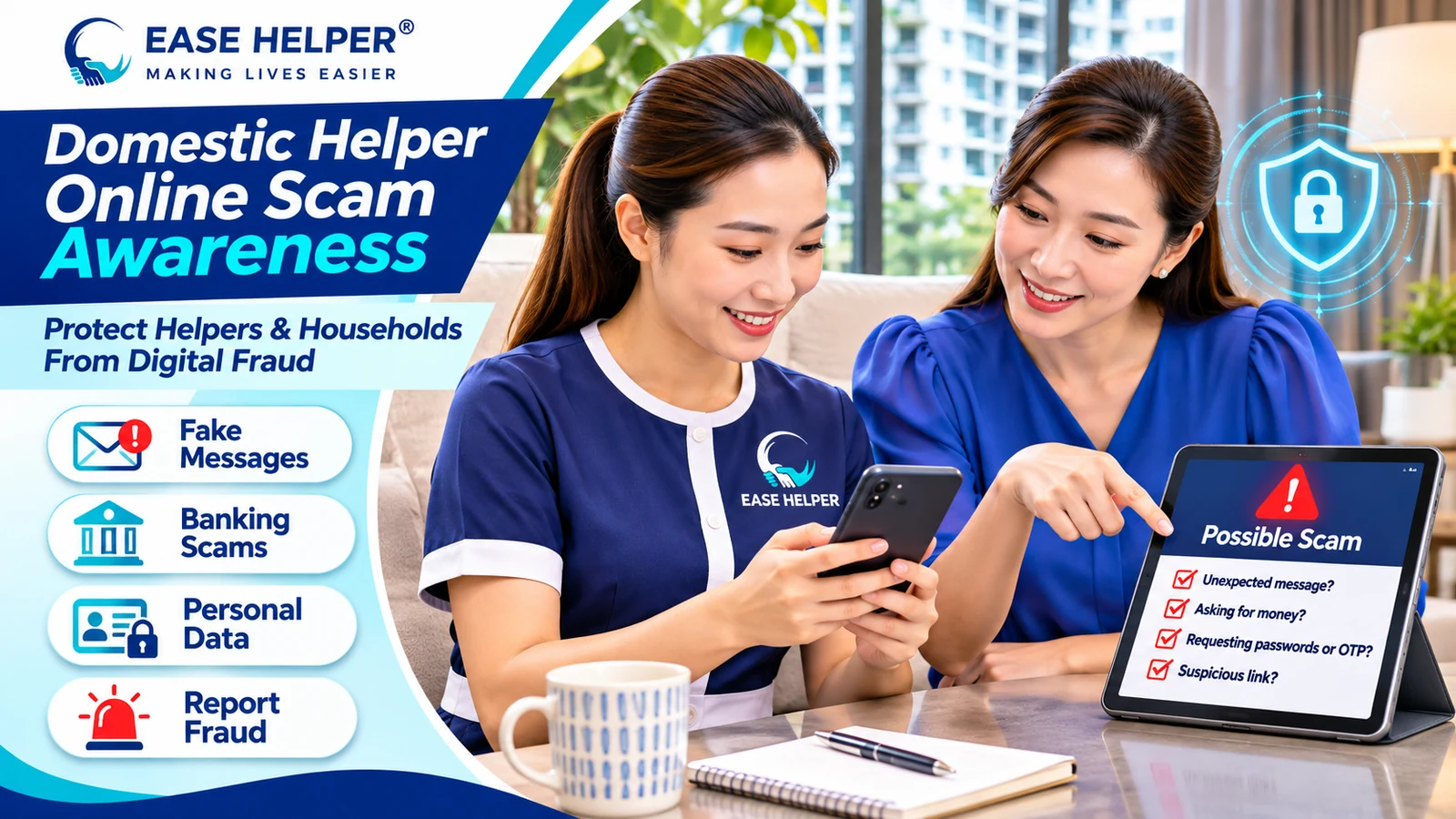
Domestic helper scam awareness is increasingly important for Singapore households. Fraudsters may contact domestic helpers through WhatsApp, Telegram, social media, shopping platforms or text messages. They may impersonate banks, delivery companies, government agencies, employers or even family members to obtain money or sensitive information.
Employers can help reduce these risks through simple digital safety training. Rather than restricting all online communication, families should teach helpers how to recognise suspicious requests, verify identities and seek assistance before taking action.
This guide explains common online scams, practical prevention measures and what domestic helpers and employers should do if fraud is suspected.
Executive Summary
Domestic helper scam awareness starts with three habits: stop, verify and report. Domestic helpers should never disclose banking passwords, one-time passwords, Singpass credentials or household security details in response to unexpected messages.
They should avoid suspicious links, verify requests through trusted channels and seek help promptly if they suspect a scam.
Employers can support safer online behaviour through practical demonstrations, respectful communication and clear household procedures. For current official advice, consult ScamShield and the Singapore Police Force.
1. Why Domestic Helper Scam Awareness Matters in Singapore
Many domestic helpers use smartphones to communicate with family members, manage personal finances, shop online and access digital services.
These activities are useful and legitimate. However, scammers may exploit unfamiliarity with local institutions, language barriers or urgent financial needs.
Potential Consequences of Online Fraud
- Loss of personal savings.
- Unauthorised bank transfers or account access.
- Theft of personal identity information.
- Exposure of private household details.
- Compromise of messaging or social media accounts.
- Stress, embarrassment and delayed reporting.
Employers should create an environment where helpers feel comfortable asking questions and reporting suspicious messages without fear of automatic blame.
2. Recognise Common Online Scams Targeting Domestic Helpers
Scammers frequently change their tactics. Nevertheless, many fraudulent approaches share common warning signs.
Fake Job and Recruitment Offers
A scammer may promise higher wages, overseas employment or guaranteed job placement in exchange for an advance payment.
Helpers should verify employment-related claims independently and avoid paying unfamiliar individuals who promise guaranteed work opportunities.
Parcel Delivery Scams
A message may claim that a parcel cannot be delivered until the recipient pays a small fee or updates an address through a link.
Instead of opening the link, check the delivery directly through the courier’s official application or website.
Bank and Government Impersonation
Fraudsters may pretend to represent a bank, Singpass, a government agency or a police officer.
They may demand passwords, verification codes, transfers or urgent action. Such requests should be treated as suspicious and verified through official channels.
Social Media and Online Shopping Scams
Unusually cheap products, fake sellers and requests to pay outside trusted platforms can indicate fraud.
Helpers should check seller credibility, use suitable payment protections and avoid transferring money to unknown accounts.
Friend or Family Impersonation
A scammer may take over a messaging account or impersonate someone familiar, then request emergency financial assistance.
Always verify unexpected requests through a separate trusted contact method.
3. Teach Domestic Helpers the Warning Signs of a Scam
Effective domestic helper scam awareness training should focus on behaviour rather than expecting helpers to recognise every scam variation.
Common Red Flags
- Messages demanding immediate action.
- Threats of arrest, account closure or financial penalties.
- Requests for passwords or one-time passwords.
- Unexpected requests to transfer money.
- Links that imitate official websites.
- Offers promising unusually high returns or guaranteed employment.
- Requests to install unfamiliar applications.
- Instructions to keep a transaction secret.
- Pressure to share identity documents or banking information.
A familiar name or profile picture does not prove that a message is genuine. Accounts and identities can be impersonated.
4. Never Share Passwords, OTPs or Singpass Credentials
Passwords and one-time passwords help protect digital accounts. Sharing them can allow another person to access sensitive information or authorise transactions.
Information That Must Remain Private
- Banking passwords and PINs.
- One-time passwords and verification codes.
- Singpass login credentials.
- Payment card security information.
- Account recovery codes.
- Personal identity documents requested by unverified parties.
Employers should also respect the helper’s own banking and personal account privacy. Scam prevention does not require employers to know or control a helper’s private passwords.
Simple rule: If someone unexpectedly asks for a password, OTP or money transfer, stop the interaction and verify the request independently.
5. Protect Household Information From Digital Fraud
Scammers may also seek information about the employer’s home, family members or daily routines.
Therefore, employers should explain which household information must remain confidential.
Examples of Sensitive Household Information
- Home access codes and security system details.
- Alarm or smart-lock credentials.
- Personal identity and financial information.
- Children’s school schedules and private records.
- Travel plans that the family has not authorised for sharing.
- Photographs of sensitive household documents.
- Private information received through employer messages.
Helpers should not send these details to strangers or upload them to unverified websites.
At the same time, employers should distinguish reasonable household confidentiality from a helper’s right to communicate privately with family and friends.
6. Be Careful With WhatsApp and Telegram Messages
Messaging applications are widely used for everyday communication. Fraudsters may exploit them through impersonation, malicious links and account takeover attempts.
Safe Messaging Habits
- Check unexpected requests carefully.
- Do not share verification codes.
- Verify unusual payment requests by calling the person through a known number.
- Avoid downloading unknown files or applications.
- Use available account security settings.
- Report suspicious contacts through the platform when appropriate.
If a friend suddenly requests money from an unfamiliar number, confirm the request through an existing trusted contact method.
7. Avoid Fake Online Shopping and Payment Requests
Online shopping scams can involve fake listings, counterfeit payment pages or sellers who disappear after receiving money.
Practical Shopping Safety Tips
- Compare prices and be cautious about unrealistic discounts.
- Review the seller’s history and platform protections.
- Avoid moving transactions to unfamiliar payment channels.
- Check website addresses before entering payment information.
- Do not share payment verification codes.
- Keep legitimate transaction records.
Employers can demonstrate these precautions using sample listings rather than asking helpers to reveal their private shopping accounts.
8. Recognise Fake Bank and Money Transfer Messages
Some scammers send messages claiming that a bank account has been frozen or that an urgent transaction requires verification.
They may provide a link that resembles a legitimate banking website.
What Helpers Should Do
- Do not click the message link.
- Open the bank’s official application independently.
- Use the bank’s published contact details.
- Do not disclose passwords or verification codes.
- Contact the bank immediately if account information may have been compromised.
If money has already been transferred to a suspected scammer, prompt contact with the bank is especially important.
9. Protect Against Fake Employment and Overseas Job Offers
Domestic helpers may receive messages advertising new employment opportunities, training programmes or overseas placements.
Not every offer is fraudulent. However, helpers should verify recruitment claims and avoid paying unknown intermediaries without checking their legitimacy.
Questions to Ask
- Is the recruiter or agency identifiable and legitimate?
- Can the offer be verified through an official source?
- Are the employment terms clear and realistic?
- Is someone demanding payment before providing basic information?
- Does the person pressure the helper to act immediately?
For Singapore employment-related matters, consult the Ministry of Manpower and its official resources.
10. What to Do When a Suspicious Link Is Received
A suspicious message does not always mean an account has been compromised. However, helpers should avoid interacting with unverified links or attachments.
Recommended Response
- Do not open the link or attachment.
- Do not enter personal or banking details.
- Verify the sender independently.
- Use official websites or applications instead.
- Block or report the sender when appropriate.
- Ask for assistance if the message remains unclear.
If a link was opened and sensitive information was entered, take immediate steps to secure the affected account.
11. What to Do If a Domestic Helper Has Been Scammed
Quick action can reduce further harm, although recovering stolen funds is not guaranteed.
Immediate Response Checklist
- Stop: End communication with the suspected scammer.
- Contact the bank: Report suspected unauthorised transactions immediately and ask about available account-protection measures.
- Secure accounts: Change compromised passwords through trusted channels and review account access.
- Preserve evidence: Keep relevant messages, transaction records and contact details.
- Report: Contact the Singapore Police Force and use official scam-reporting resources.
- Seek support: Ask a trusted person for help understanding the next steps.
For urgent police assistance in Singapore, call 999. For scam guidance, consult the official ScamShield website.
Important: Do not pay additional fees to someone claiming they can guarantee recovery of stolen money. Fraud victims may be targeted again by recovery scams.
12. Domestic Helper Scam Awareness Checklist
| Situation | Safe Response | What to Avoid |
|---|---|---|
| Unexpected banking message | Verify through the bank’s official app or published contact details. | Opening message links or sharing OTPs. |
| Friend requests urgent money | Call the person using a trusted number. | Transferring money without verification. |
| Parcel delivery payment request | Check the courier’s official tracking service. | Entering card details on unknown websites. |
| Overseas job offer | Verify the recruiter and employment terms. | Paying unverified intermediaries. |
| Suspicious shopping listing | Check seller credibility and platform protections. | Paying outside trusted channels. |
| Request for household access code | Decline and verify with the employer. | Sharing security credentials. |
| Unknown application download | Check its legitimacy before installing. | Installing software at a stranger’s request. |
| Possible scam transaction | Contact the bank and report promptly. | Waiting or sending more money. |
13. Teach Safe Smartphone and Account Settings
Digital security settings can provide additional protection, although no single setting prevents every scam.
Useful Protective Habits
- Keep the phone operating system and applications updated.
- Use a strong device screen lock.
- Enable available multi-factor authentication.
- Review application permissions.
- Install applications from trusted sources.
- Avoid sharing account recovery information.
- Review unusual login alerts promptly.
Employers can demonstrate general security settings without demanding access to a helper’s personal device or private messages.
14. How Employers Can Conduct Scam Awareness Training
Domestic helper scam awareness training works best when employers use realistic examples and simple instructions.
Five-Step Training Method
- Explain: Introduce common scam types.
- Demonstrate: Show examples of suspicious messages without opening malicious links.
- Practise: Ask the helper to identify warning signs in sample messages.
- Confirm: Agree on whom to contact when uncertain.
- Review: Repeat the training when new scam tactics become common.
Language differences may affect understanding. Use translated instructions or visual examples when helpful.
15. Establish a Respectful Household Digital Safety Policy
Employers should distinguish digital safety training from unnecessary surveillance.
A reasonable policy can explain household confidentiality, safe online behaviour and procedures for reporting suspicious requests.
Recommended Household Rules
- Do not share home access credentials with outsiders.
- Do not disclose private employer information.
- Verify unexpected instructions involving household money or purchases.
- Report suspicious messages involving household security.
- Protect personal passwords and banking information.
- Ask questions when an online request seems unusual.
Domestic helpers should retain appropriate privacy and access to personal communication. Employers should avoid monitoring private accounts or demanding personal passwords.
16. Build a Simple Scam Response Plan
When fraud is suspected, confusion can delay protective action. A short response plan helps everyone know what to do.
Household Scam Response Plan
- Identify a trusted person who can help interpret suspicious messages.
- Keep official bank support details accessible.
- Know how to access ScamShield resources.
- Understand when to make a police report.
- Preserve evidence without forwarding malicious links unnecessarily.
- Review affected account security promptly.
Employers should reassure helpers that early reporting is more important than embarrassment or fear of criticism.
17. Common Mistakes to Avoid
| Common Mistake | Better Approach |
|---|---|
| Trusting a familiar profile picture | Verify unexpected requests independently. |
| Sharing an OTP to resolve an alleged problem | Keep verification codes private. |
| Clicking links in urgent bank messages | Use the official banking app directly. |
| Paying an unknown recruiter in advance | Verify the recruitment arrangement first. |
| Installing an app requested by a stranger | Check the application’s legitimacy. |
| Hiding a suspected scam out of embarrassment | Seek help and report promptly. |
| Sharing household access details online | Keep security information confidential. |
| Paying a supposed fund-recovery agent | Use official reporting and banking channels. |
18. Make Online Safety a Shared Household Responsibility
Scam awareness should apply to everyone in the household, not only domestic helpers.
Employers, children, elderly family members and helpers may all encounter fraudulent messages. Families can therefore benefit from discussing suspicious requests and practising independent verification.
With clear communication and accessible support, domestic helpers can use digital services more confidently while protecting themselves and the household.
Frequently Asked Questions
1. What online scams should domestic helpers in Singapore watch out for?
Common examples include fake job offers, parcel delivery scams, bank impersonation, shopping scams, malicious links and messages from people impersonating friends or relatives.
2. What should a domestic helper do after receiving a suspicious WhatsApp message?
Avoid opening links or sharing information. Verify the request through a separate trusted contact method and report or block the suspicious sender when appropriate.
3. Should employers ask domestic helpers for their banking passwords?
No. Helpers should keep personal banking passwords, PINs and verification codes private. Employers can provide safety guidance without accessing private financial accounts.
4. What should a helper do if money has been transferred to a scammer?
Contact the bank immediately, secure affected accounts, preserve transaction evidence and report the incident through official police and scam-reporting channels. Recovery is not guaranteed.
5. How can employers teach domestic helper scam awareness effectively?
Use simple examples of fraudulent messages, explain common warning signs and practise the stop-verify-report approach. Encourage helpers to ask for help promptly without fear of blame.
Looking for a Domestic Helper in Singapore?
EaseHelper helps Singapore families explore domestic helper placement options suited to their household requirements. Practical training, clear household expectations and respectful communication can support a safer home environment.
Explore EaseHelper ServicesDisclaimer: This article provides general digital scam awareness information and does not constitute legal, financial or cybersecurity advice. Scam methods and official reporting procedures may change. For current guidance, consult ScamShield, the Singapore Police Force and the relevant financial institution. If immediate danger is involved, contact emergency services.