
Blog
Domestic Helper Food Safety in Singapore: Hygiene, Storage and Kitchen Practices

Executive Summary
Domestic helper food safety in Singapore starts with clean hands, safe ingredient storage and careful food preparation. Employers should teach their helpers to separate raw and cooked food, refrigerate perishables promptly, cook food thoroughly and handle leftovers safely. In Singapore’s warm climate, these habits are especially important. This guide explains practical kitchen hygiene, food storage, cross-contamination prevention and a daily checklist that families can use to build safer cooking routines.
Why Domestic Helper Food Safety in Singapore Matters
Domestic helper food safety in Singapore is an important part of everyday household management. Many families rely on their domestic helpers to prepare meals, organise groceries and store leftovers.
However, unsafe food handling can expose household members to foodborne illness. Young children, older adults, pregnant women and people with weakened immune systems may face greater risks from certain infections.
Furthermore, Singapore’s warm and humid climate makes careful food storage particularly important. Therefore, employers should explain food safety expectations before assigning independent kitchen duties.
The Singapore Food Agency (SFA) provides official guidance on safe food practices. Employers can use this guidance when establishing household routines.
1. Teach Proper Handwashing and Personal Hygiene
Clean hands help prevent germs from spreading to food, kitchen equipment and household surfaces.
First, demonstrate how to wash hands thoroughly with soap and running water. Next, explain when handwashing is necessary.
When Should a Domestic Helper Wash Her Hands?
- Before preparing or serving food.
- Before handling ready-to-eat ingredients.
- After touching raw meat, poultry, seafood or eggs.
- After using the toilet.
- After handling rubbish or cleaning chemicals.
- After coughing, sneezing or blowing her nose.
- After touching pets or pet-related items.
- Whenever hands become dirty during cooking.
Additionally, remind your helper to keep fingernails clean and secure long hair before food preparation.
If she has a wound on her hand, she should cover it appropriately and use suitable protection when handling food.
Important: A person experiencing vomiting or diarrhoea should not prepare food for others while unwell. Employers should arrange appropriate medical attention and alternative meal preparation when necessary.
2. Prevent Cross-Contamination Between Raw and Cooked Food
Cross-contamination happens when harmful microorganisms transfer from one food, surface or utensil to another.
For example, a chopping board used for raw chicken can contaminate salad ingredients if someone reuses it without proper cleaning.
Therefore, teach your domestic helper to keep raw ingredients separate from cooked and ready-to-eat food.
Practical Cross-Contamination Prevention
- Use separate chopping boards for raw meat and ready-to-eat ingredients.
- Clean knives and utensils thoroughly between different food tasks.
- Keep raw meat and seafood in sealed containers.
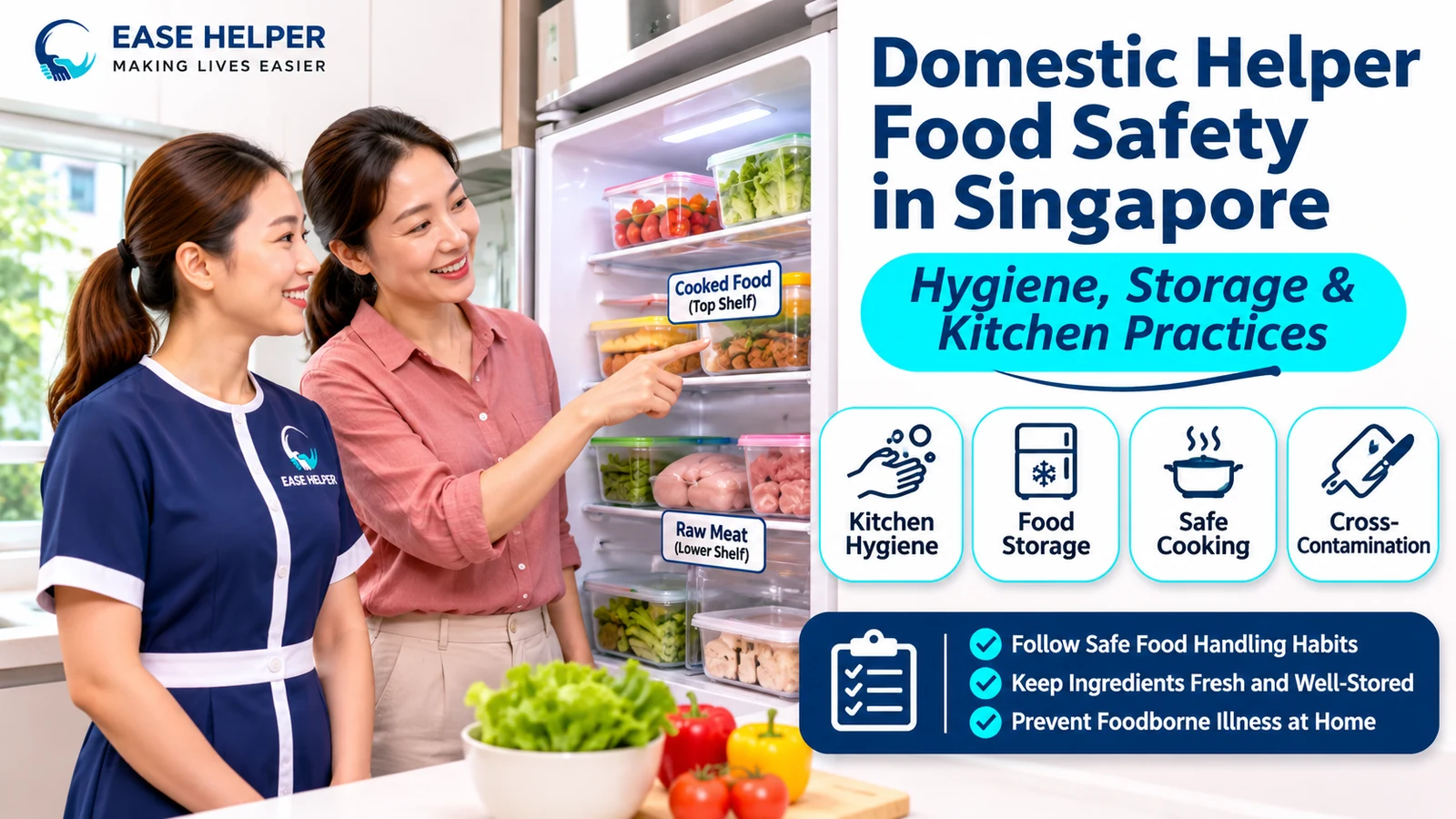
- Store raw meat below cooked and ready-to-eat food in the refrigerator.
- Wash hands after handling raw ingredients.
- Clean preparation surfaces before switching to another task.
- Never place cooked food on an unwashed plate that held raw meat.
Moreover, explain that rinsing raw poultry can spread contaminated water around the sink. Cooking poultry thoroughly is safer than washing it.
3. Store Food Safely in the Refrigerator and Freezer
Correct refrigeration helps slow bacterial growth and preserve food quality.
As a practical household target, keep the refrigerator at 4°C or below and the freezer at approximately -18°C. Use a thermometer to check actual temperatures.
Additionally, avoid overcrowding shelves because cold air needs space to circulate.
Refrigerator Storage Guide
| Food Category | Recommended Storage | Key Precaution |
|---|---|---|
| Raw meat and poultry | Sealed containers on lower shelves | Prevent juices from dripping onto other foods |
| Raw seafood | Covered and refrigerated promptly | Keep separate from ready-to-eat food |
| Cooked leftovers | Shallow, covered containers | Cool and refrigerate promptly |
| Vegetables and fruit | Suitable produce compartments | Separate from leaking raw meat packages |
| Milk and dairy products | Refrigerator shelves | Follow package storage instructions |
| Frozen food | Freezer at approximately -18°C | Keep packaging sealed and label when needed |
Furthermore, teach your helper to check packaging instructions and use-by dates. A refrigerator does not make food safe indefinitely.
4. Handle Groceries Safely After Shopping
Food safety begins before cooking. In fact, the way groceries travel from the supermarket or wet market to the kitchen can affect their condition.
Therefore, encourage your helper to purchase chilled and frozen items towards the end of a shopping trip.
Safe Grocery Handling Steps
- Check packaging for damage or leakage.
- Separate raw meat and seafood from ready-to-eat products.
- Use suitable insulated bags when transporting perishables.
- Return home promptly after buying chilled or frozen food.
- Place perishables in the refrigerator or freezer without unnecessary delay.
- Check expiry dates and follow storage instructions.
Additionally, teach your helper to report suspicious smells, damaged packaging or unexpected changes in food condition.
However, remember that harmful bacteria do not always cause visible spoilage or unpleasant smells. Proper storage and handling remain essential even when food looks normal.
5. Cook Meat, Poultry, Seafood and Eggs Thoroughly
Proper cooking reduces the risk of foodborne illness. Therefore, employers should teach their helpers to check that food reaches a safe internal temperature.
For example, poultry should reach at least 74°C internally. A food thermometer provides a more reliable check than appearance alone.
Different foods may require different temperatures. Consequently, follow relevant SFA guidance and product instructions rather than assuming that every dish has the same cooking requirements.
Cooking Safety Reminders
- Cook poultry thoroughly, including thicker portions.
- Use a clean food thermometer where appropriate.
- Follow suitable cooking guidance for fish, meat and eggs.
- Keep raw and cooked utensils separate.
- Avoid partially cooking meat and leaving it unrefrigerated for later.
- Serve prepared meals promptly or maintain safe holding temperatures.
For households with young children or elderly family members, take additional care with foods that may contain raw or undercooked animal products.
6. Follow Safe Food Cooling and Reheating Practices
Leftovers require careful handling, particularly when meals contain rice, meat, seafood or dairy ingredients.
After cooking, divide large quantities into shallow containers so they can cool more quickly. Then, refrigerate them promptly.
Do not leave perishable cooked food at room temperature for long periods. As a general rule, refrigerate it within two hours, and sooner in very hot conditions.
How to Handle Leftovers
- Use clean utensils to transfer leftovers.
- Divide large portions into smaller, shallow containers.
- Refrigerate promptly rather than leaving food on the counter.
- Label containers with preparation dates when useful.
- Reheat leftovers thoroughly before serving.
- Discard food when its safety is uncertain.
Moreover, teach your helper to avoid repeatedly reheating and cooling the same batch of food. Instead, reheat only the portion needed for the meal.
7. Pay Special Attention to Cooked Rice and Noodles
Cooked rice and noodles need careful storage because certain bacteria can survive cooking and multiply when food remains at unsafe temperatures.
Therefore, serve rice promptly after cooking or keep it appropriately hot. Otherwise, cool it quickly and refrigerate it without delay.
For example, if your family prepares rice for lunch and dinner, explain how to store the remaining portion safely instead of leaving it in a switched-off rice cooker for several hours.
Furthermore, reheating does not reliably eliminate every toxin that bacteria may produce. Consequently, safe cooling and storage are essential.
8. Clean Kitchen Surfaces and Equipment Properly
Clean equipment supports safe cooking. However, kitchen hygiene involves more than wiping visible dirt away.
Teach your domestic helper to clean food-contact surfaces after preparation, especially after handling raw ingredients.
Daily Kitchen Cleaning Tasks
- Wash chopping boards after use.
- Clean knives, utensils and preparation bowls.
- Wipe countertops with suitable cleaning products.
- Clean spills promptly.
- Wash reusable cleaning cloths regularly.
- Keep sinks and drain areas clean.
- Empty rubbish bins as needed.
- Store cleaning chemicals away from food.
Additionally, explain the difference between cleaning and sanitising. Cleaning removes dirt and food residue, while appropriate sanitising helps reduce microorganisms on suitable surfaces.
Always follow product labels. Never mix household cleaning chemicals, particularly bleach with acids or ammonia-based products.
9. Teach Safe Food Preparation for Children and Elderly Family Members
Some household members may need additional food safety precautions.
For instance, babies, young children and elderly people can be more vulnerable to certain foodborne infections.
Therefore, teach your helper to follow the family’s specific dietary instructions and appropriate professional advice.
Additional Precautions
- Prepare infant food with clean hands and utensils.
- Follow safe formula preparation and storage instructions when applicable.
- Cook high-risk ingredients thoroughly.
- Keep children’s food separate from raw ingredients.
- Check allergies and dietary restrictions before serving meals.
- Follow medical guidance for swallowing difficulties or special diets.
- Discard food when storage conditions are uncertain.
Moreover, do not expect a domestic helper to make independent medical or nutritional decisions. Employers should provide clear instructions and seek professional guidance where needed.
10. Create a Daily Domestic Helper Food Safety Checklist
A short checklist can help your helper develop consistent habits.
Rather than relying on memory alone, place the checklist in a convenient kitchen location.
| Stage | Food Safety Check | Completed |
|---|---|---|
| Before cooking | Wash hands and clean preparation surfaces | □ |
| Before cooking | Check ingredients and storage condition | □ |
| Food preparation | Separate raw and ready-to-eat ingredients | □ |
| Food preparation | Use clean knives and chopping boards | □ |
| Cooking | Cook food thoroughly | □ |
| After cooking | Serve promptly or store safely | □ |
| After cooking | Refrigerate leftovers without unnecessary delay | □ |
| After cooking | Clean utensils, surfaces and equipment | □ |
| End of day | Check refrigerator doors and food storage | □ |
Review the checklist together during initial training. Afterwards, your helper can use it independently once she understands each step.
11. Use a Simple Seven-Day Food Safety Training Plan
Employers can introduce food safety gradually instead of explaining every rule in one session.
| Day | Training Topic | Practical Exercise |
|---|---|---|
| 1 | Personal hygiene | Demonstrate proper handwashing |
| 2 | Cross-contamination | Separate raw and cooked food equipment |
| 3 | Refrigeration | Organise refrigerator shelves safely |
| 4 | Grocery handling | Store a typical household grocery purchase |
| 5 | Thorough cooking | Practise checking food temperatures |
| 6 | Leftovers | Cool, label and refrigerate cooked food |
| 7 | Review | Complete the daily food safety checklist |
Importantly, this schedule is only a suggested training tool. Adjust it according to your helper’s experience, language needs and normal workload.
12. Communicate Food Safety Instructions Clearly
Food safety rules work best when everyone understands them.
For example, telling a helper to “store the chicken properly” may be less effective than demonstrating the correct shelf, container and storage procedure.
Therefore, use simple instructions and practical demonstrations.
Helpful Training Methods
- Show correct and incorrect examples.
- Use pictures to explain refrigerator organisation.
- Label food containers clearly.
- Demonstrate safe chopping-board practices.
- Explain why each safety rule matters.
- Encourage questions and clarification.
- Review routines periodically without blaming mistakes.
Additionally, employers should provide the equipment, cleaning supplies and reasonable time needed to follow these practices.
For broader household cooking instruction, read our guide to teaching domestic helpers Singapore cooking. Confirm that this article’s published permalink matches before using the link.
Frequently Asked Questions About Domestic Helper Food Safety in Singapore
1. What are the most important domestic helper food safety rules in Singapore?
Start with handwashing, separating raw and cooked food, safe refrigeration, thorough cooking and prompt storage of leftovers. These basic practices help reduce common food safety risks in household kitchens.
2. What temperature should a household refrigerator be set to?
A practical target is 4°C or below for the refrigerator and approximately -18°C for the freezer. Use a thermometer to verify actual temperatures and follow food packaging instructions.
3. Can my domestic helper leave cooked rice outside until dinner?
Leaving cooked rice at room temperature for extended periods is unsafe. Serve it promptly, keep it appropriately hot or cool and refrigerate it quickly. Reheating cannot reliably correct every storage-related safety problem.
4. How can I prevent cross-contamination in my kitchen?
Use separate equipment for raw and ready-to-eat food, wash hands after handling raw ingredients, clean preparation surfaces and store raw meat in sealed containers below cooked food.
5. How should I train a new domestic helper in food hygiene?
Demonstrate each practice, provide a short checklist and let your helper repeat the steps under supervision. Use photographs and simple instructions where helpful. Review the routine regularly and provide constructive feedback.
How EaseHelper Supports Practical Household Training
Domestic helper food safety in Singapore requires clear expectations, practical instruction and consistent household routines.
At EaseHelper, we recognise the value of preparing domestic helpers for everyday household responsibilities. Our recruitment and in-house training approach supports employers who want to establish practical cooking, cleaning and communication expectations.
Nevertheless, each household has different equipment and routines. Therefore, employers should demonstrate their own kitchen procedures and provide ongoing guidance.
With the right training and support, families can build safer and more organised food preparation habits.
Looking for a Domestic Helper in Singapore?
EaseHelper helps Singapore families explore domestic helper recruitment options and prepare for everyday household responsibilities.
Explore EaseHelper ServicesDisclaimer: This article provides general household food safety information and does not replace current Singapore Food Agency guidance, product instructions or professional medical advice. Recommended storage and cooking practices may vary by food type. Always follow applicable official guidance and seek professional advice when needed.