Blog
How to Communicate Effectively With Your Domestic Helper in Singapore: A Guide for Employers


Executive Summary
Effective communication with your domestic helper in Singapore begins with clear instructions, patience and mutual respect. Employers can reduce misunderstandings by using simple language, demonstrating household tasks and encouraging questions. Regular feedback also helps both parties understand expectations and resolve concerns early. This guide explains practical communication methods, language barriers, cultural differences, respectful feedback and common employer-helper challenges. It also includes examples, checklists and frequently asked questions for Singapore households.
Why Effective Communication With Your Domestic Helper Matters
Learning how to communicate effectively with your domestic helper in Singapore can improve household routines and working relationships. Clear communication helps employers explain expectations, while domestic helpers gain confidence in carrying out their responsibilities.
However, misunderstandings can arise even when both parties have good intentions. For example, an employer may ask the helper to clean the kitchen without explaining which surfaces or appliances need attention.
As a result, the helper may complete the task differently from what the employer expects. Instead of assuming carelessness, the employer should clarify the instructions and demonstrate the preferred method.
Moreover, respectful communication helps create an environment where helpers feel comfortable reporting problems, asking questions and discussing safety concerns.
1. Use Clear and Simple Instructions
Clear instructions are especially helpful when a domestic helper is still learning English or becoming familiar with a Singapore household.
Therefore, employers should use straightforward sentences and avoid giving too many instructions at once.
Examples of Clear Household Instructions
| Unclear Instruction | Clearer Instruction |
|---|---|
| Clean everything properly. | Please wipe the dining table, sweep the kitchen floor and wash the dishes. |
| Prepare dinner early. | Please begin preparing the vegetables at 5 pm so dinner can be ready around 7 pm. |
| Do the laundry carefully. | Please separate white clothes from coloured clothes and check the care labels. |
| Take care of the groceries. | Please check the shopping list, buy the agreed items and keep the receipts. |
| Watch the child. | Please stay with the child in the living room and contact me if you need to leave. |
Additionally, avoid using unfamiliar abbreviations or complicated expressions during the first few weeks.
2. Demonstrate Household Tasks Instead of Only Explaining Them
Some household instructions are easier to understand through practical demonstrations. For example, explaining how to operate a washing machine may be difficult if the helper has never used that model.
Use a Simple Training Method
- Explain the task in simple language.
- Demonstrate the correct method.
- Allow the helper to practise.
- Check whether she understands the steps.
- Provide constructive feedback when necessary.
For instance, an employer can demonstrate how to sort laundry, measure detergent and select the correct washing programme.
Afterwards, the helper can repeat the task while the employer observes. This approach helps identify misunderstandings before they become repeated mistakes.
3. Encourage Your Domestic Helper to Ask Questions
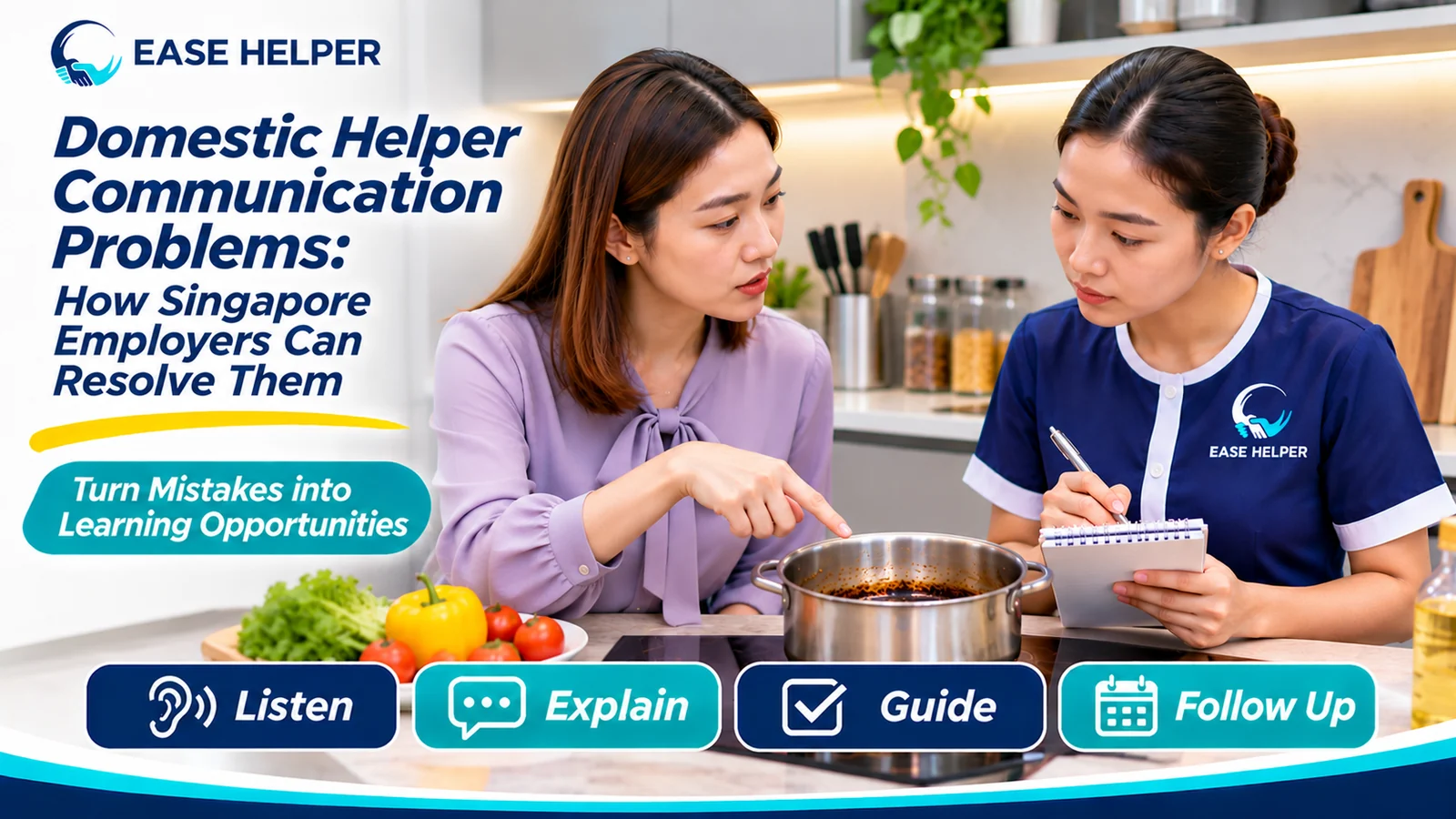
Effective communication should work in both directions. Therefore, employers should encourage domestic helpers to seek clarification whenever instructions are unclear.
Some helpers may hesitate to ask questions because they worry about appearing inexperienced. Consequently, employers should explain that asking questions is better than guessing.
Useful Questions Helpers Can Ask
- Which task should I do first?
- Would you like me to use this cleaning product?
- Is this the correct ingredient?
- What should I do if the item is unavailable?
- Should I contact you if the child feels unwell?
- Can you show me how to use this appliance?
Likewise, employers should respond calmly when a helper asks for clarification. Over time, this can reduce mistakes and improve confidence.
4. Understand Language Barriers
Singapore households may employ domestic helpers from Myanmar, Indonesia or other approved source countries. As a result, English proficiency and familiarity with local expressions can vary considerably.
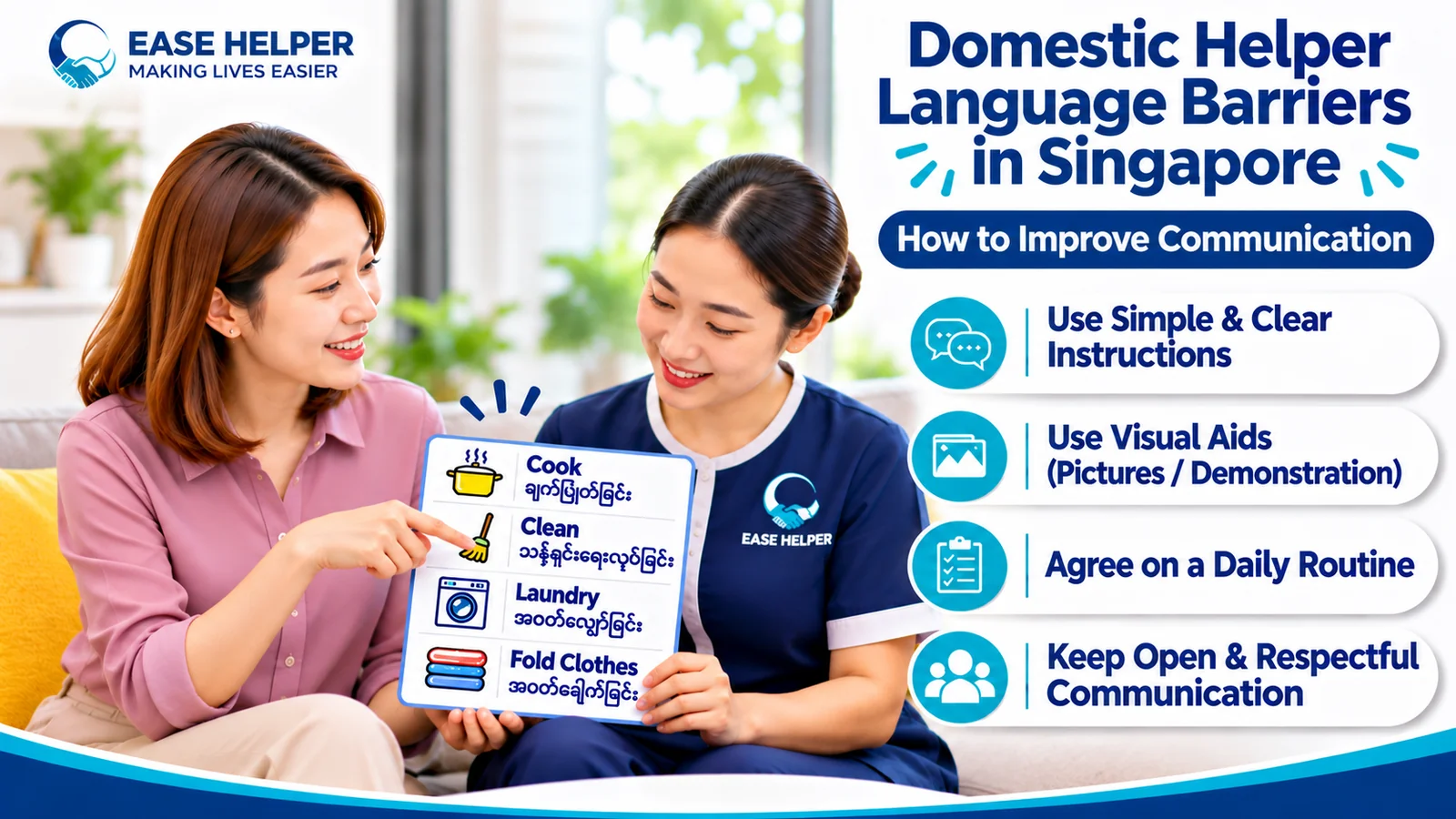
However, limited English proficiency does not necessarily indicate poor work ability. Instead, it may mean the helper needs additional language support and practical training.
Ways to Reduce Language Barriers
- Use short sentences and familiar vocabulary.
- Speak at a natural, moderate pace.
- Show photographs of household items.
- Use written checklists where helpful.
- Demonstrate unfamiliar activities.
- Confirm understanding through practical examples.
For example, photographs of preferred grocery products may be more effective than describing their packaging verbally.
Furthermore, employers can explain common Singapore expressions gradually rather than expecting immediate familiarity with Singlish.
5. Explain Household Expectations Early
Many misunderstandings arise because employers and helpers have different assumptions about household routines.
Therefore, employers should explain their expectations during the first few days and review them when necessary.
Important Topics to Discuss
- Daily and weekly household responsibilities.
- Meal preparation and dietary preferences.
- Cleaning standards and product usage.
- Laundry and clothing care.
- Childcare or elderly care arrangements.
- Household safety procedures.
- Communication and emergency contact arrangements.
- Meals, rest, privacy and personal time.
However, expectations should remain reasonable and consistent with applicable employment requirements.
6. Give Constructive Feedback Without Blaming
Every domestic helper may make mistakes while learning a new household routine. Consequently, employers should focus on correcting the task rather than criticising the person.
A Practical Feedback Method
- Describe the specific issue.
- Explain why it matters.
- Demonstrate the preferred method.
- Allow the helper to ask questions.
- Review improvement at a suitable time.
For example, if a delicate shirt is washed incorrectly, the employer can explain the garment’s care label and demonstrate the correct washing method.
In contrast, shouting or humiliating the helper may discourage her from reporting future mistakes.
Employer reminder: Respectful feedback does not mean ignoring serious safety concerns. Address urgent risks promptly, then provide clear instructions and appropriate support without threats, intimidation or humiliation.
7. Learn to Recognise Cultural Differences
Domestic helpers may come from different cultural and social backgrounds. Therefore, employers should avoid assuming that everyone interprets instructions, gestures or communication styles in the same way.
For instance, some individuals may speak softly or avoid direct disagreement out of politeness. However, these behaviours vary between people and should not be treated as fixed cultural characteristics.
Practical Ways to Build Understanding
- Explain household routines without making assumptions.
- Ask whether instructions are clear.
- Respect reasonable personal and cultural differences.
- Discuss concerns privately.
- Avoid stereotypes or comparisons with previous helpers.
Most importantly, treat your domestic helper as an individual with her own experience, communication preferences and learning needs.
8. Use Written Checklists for Repeated Instructions
Written instructions can help when tasks involve several steps. Additionally, checklists reduce the need to repeat the same directions every day.
Sample Household Communication Checklist
| Topic | Information to Confirm | Suggested Method |
|---|---|---|
| Cleaning | Which rooms and surfaces need attention | Demonstration and checklist |
| Cooking | Menu, ingredients and meal times | Recipe notes and photographs |
| Laundry | Fabric separation and washing settings | Care labels and demonstration |
| Shopping | Products, quantities and budget | Shopping list |
| Childcare | Care routines and emergency contacts | Written care instructions |
| Safety | What to do during household emergencies | Practice and contact list |
Nevertheless, written instructions should remain manageable. A short, clear checklist is often more useful than a lengthy document.
9. Hold Short Household Check-In Discussions
Regular conversations help employers identify problems before they become serious.
For example, a short weekly discussion can cover completed tasks, difficulties, upcoming appointments and changes in household routines.
Questions Employers Can Ask
- Are any household instructions unclear?
- Do you need help learning a particular task?
- Are there any safety concerns?
- Is the daily schedule manageable?
- Do you have the equipment needed for your duties?
- Is there anything you would like to discuss?
Importantly, these discussions should allow the helper to express concerns without fear of punishment.
10. Communicate Clearly During Emergencies
Emergency communication requires special attention. Therefore, employers should explain what the helper should do during fires, accidents, medical emergencies or other urgent situations.
Essential Emergency Communication Instructions
- Know the household address.
- Understand when to contact emergency services.
- Know how to contact the employer or another trusted person.
- Report accidents and injuries promptly.
- Follow household evacuation instructions.
- Avoid attempting dangerous tasks without appropriate training.
In Singapore, call 995 for emergency ambulance and fire services, and 999 for police emergencies.
Furthermore, employers should make sure the helper understands that urgent medical or safety concerns must not be concealed.
11. Respect Privacy and Personal Boundaries
Good communication also involves respecting personal boundaries. For example, employers should discuss household privacy rules clearly rather than assuming the helper already understands them.
At the same time, domestic helpers need reasonable personal privacy and opportunities to communicate with family members.
Topics Worth Discussing
- Appropriate phone use during household duties.
- Confidentiality of household information.
- Respect for personal belongings.
- Personal time and rest arrangements.
- How to raise sensitive concerns privately.
However, household rules must remain reasonable and consistent with applicable employment requirements.
12. Handle Disagreements Calmly and Fairly
Disagreements may occur even when employers and helpers communicate regularly. Nevertheless, both parties should have an opportunity to explain their understanding of the situation.
Steps for Resolving Misunderstandings
- Choose a suitable time to discuss the issue.
- Describe the concern without personal accusations.
- Listen to the helper’s explanation.
- Clarify expectations and responsibilities.
- Agree on practical next steps.
- Review whether the issue has improved.
For example, if an employer believes the helper is ignoring instructions, first check whether she understands the language, task sequence and expected result.
Where serious disputes, suspected abuse or employment concerns arise, the parties may need assistance from the employment agency, the Ministry of Manpower or another appropriate support organisation.
13. Common Communication Mistakes to Avoid
| Communication Mistake | Possible Result | Better Approach |
|---|---|---|
| Giving several instructions at once | Confusion and forgotten tasks | Explain priorities step by step |
| Using unfamiliar expressions | Language misunderstandings | Use clear and simple English |
| Assuming the helper understands | Repeated mistakes | Ask for a practical demonstration |
| Criticising without explanation | Reduced confidence | Provide specific constructive feedback |
| Changing instructions frequently | Inconsistent results | Explain changes clearly |
| Ignoring the helper’s concerns | Unresolved problems | Encourage respectful two-way discussion |
Ultimately, effective communication depends on clarity, consistency and mutual respect.
Frequently Asked Questions About Communicating With Domestic Helpers
1. How can I communicate better with my domestic helper in Singapore?
Use simple instructions, demonstrate unfamiliar tasks and encourage questions. Additionally, provide respectful feedback and hold regular discussions about household routines.
2. What should I do if my domestic helper does not understand English well?
Use photographs, demonstrations and short written instructions. Speak clearly and check understanding through practical examples. Allow reasonable time for language improvement.
3. How should I correct my domestic helper’s mistakes?
Explain the specific problem calmly, demonstrate the preferred method and allow the helper to practise. Avoid shouting, humiliation or personal criticism.
4. Should I prepare written instructions for my domestic helper?
Written instructions can help with repeated tasks, safety procedures and household routines. However, keep them simple and review them together to confirm understanding.
5. What if communication problems continue despite training?
Review whether expectations are clear and reasonable. Discuss the problem privately and consider assistance from your employment agency. For serious employment concerns, consult the Ministry of Manpower or an appropriate support service.
How EaseHelper Can Support Your Household
Effective communication with your domestic helper in Singapore helps create clearer expectations and more positive household relationships.
EaseHelper assists Singapore employers with domestic helper recruitment and household matching. During the selection process, families can discuss language abilities, previous work experience, training needs and household expectations.
Looking for a Domestic Helper in Singapore?
Explore EaseHelper’s recruitment services and find out how we can assist your family in selecting a domestic helper suited to your household needs.
Explore EaseHelper ServicesDisclaimer: This article provides general communication and household management guidance. It does not replace legal advice or official employment requirements. Employers must comply with applicable Ministry of Manpower rules and maintain safe, respectful working arrangements. For current requirements or serious employment disputes, consult the Ministry of Manpower.