Blog
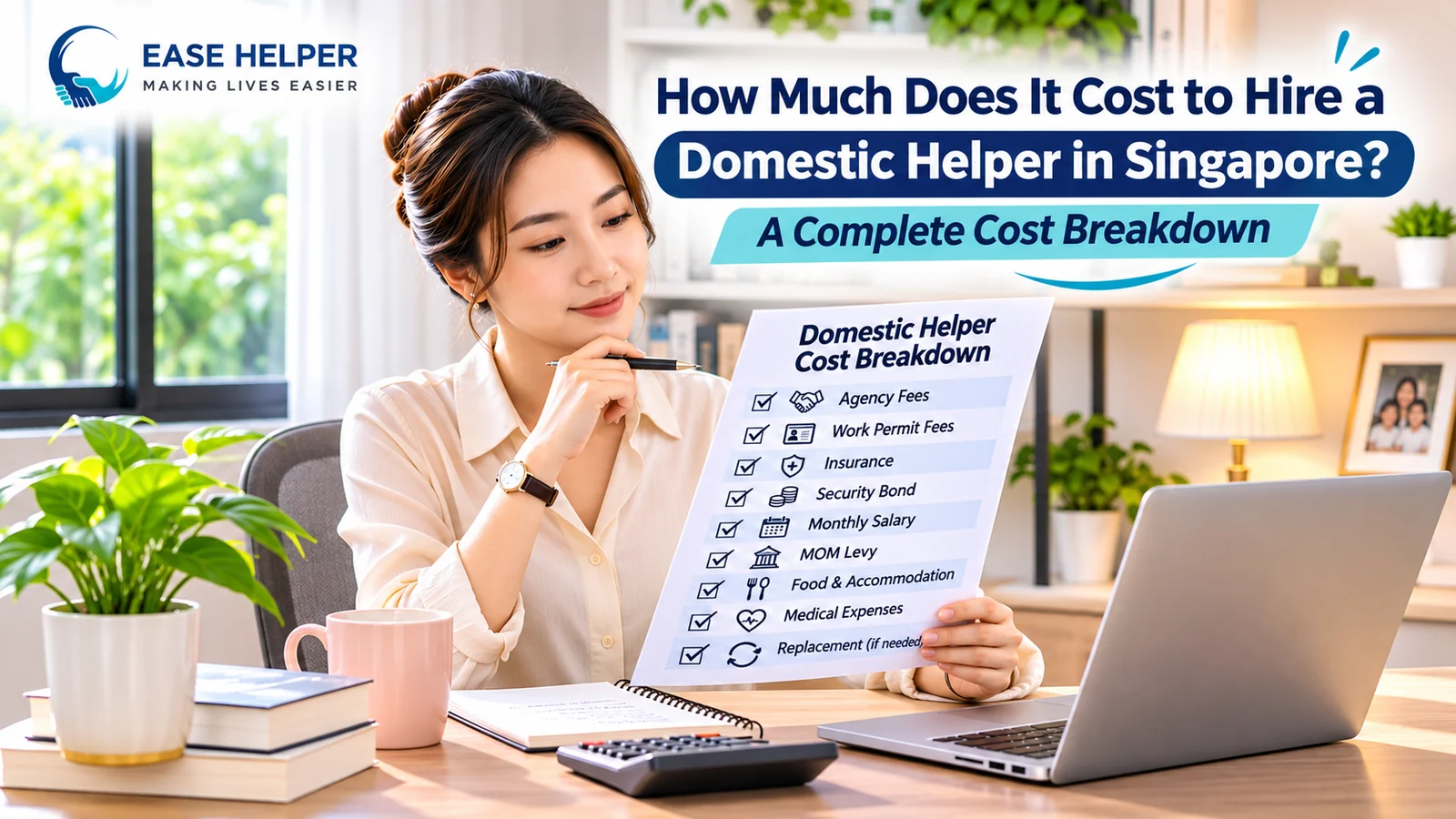
How Much Does It Cost to Hire a Domestic Helper in Singapore? Complete Cost Breakdown

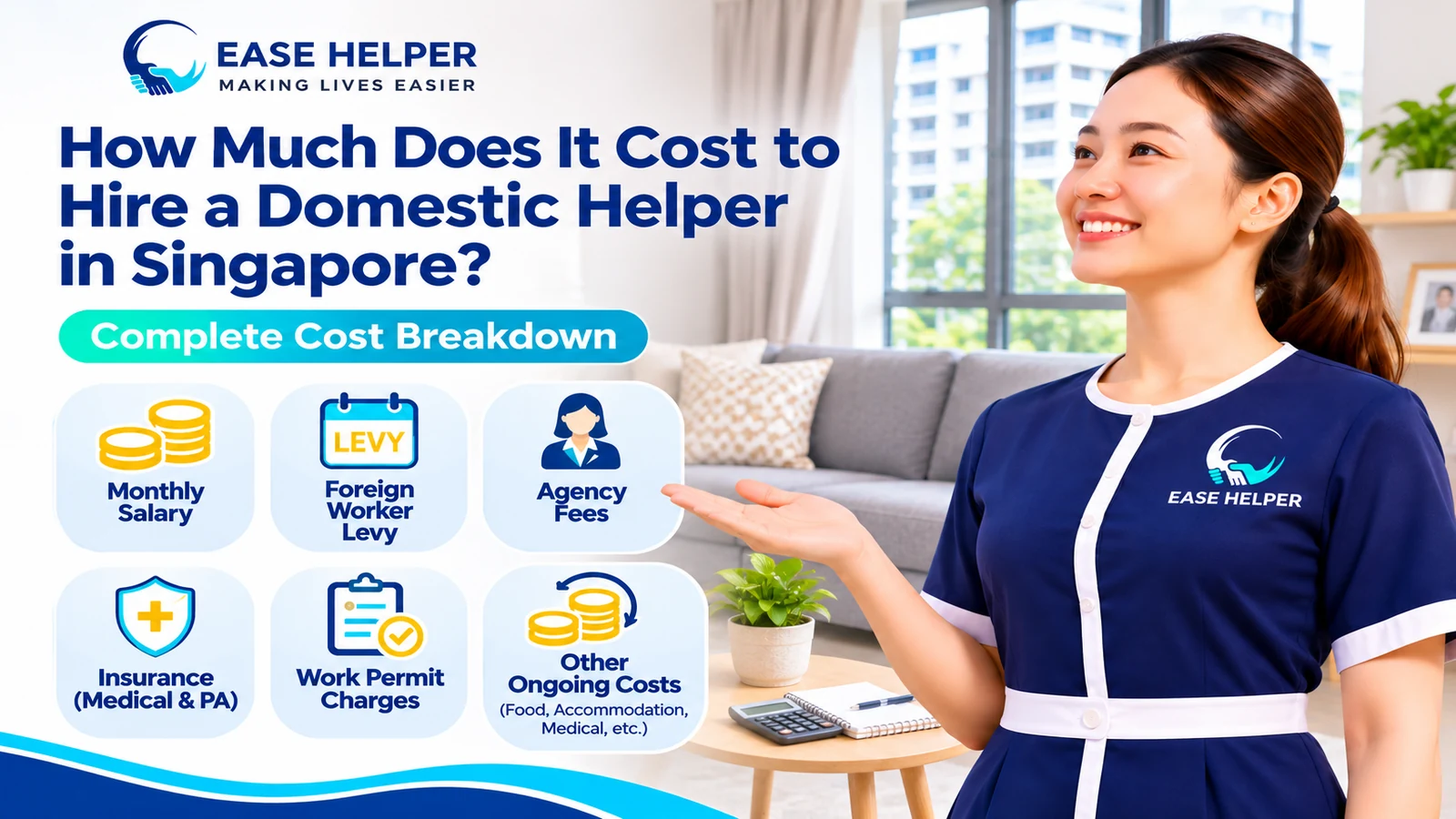
Understanding the domestic helper cost in Singapore is an important step before hiring household support. Employers need to consider more than the helper’s monthly salary. The overall budget may include agency fees, government charges, insurance, medical examinations, travel arrangements, food and accommodation.
Some expenses arise before employment begins. Others continue every month or occur periodically throughout the employment period. Consequently, preparing a realistic budget helps families avoid unexpected financial pressure.
This guide explains the main costs, distinguishes official government fees from variable expenses, and provides practical examples for Singapore households.
Executive Summary
The total cost of hiring a domestic helper in Singapore depends on the helper’s agreed salary, applicable levy, recruitment arrangements, insurance and household expenses.
- Work Permit charges: S$35 for application and S$35 for issuance.
- Monthly levy: S$300 for the first helper, S$450 for subsequent helpers, or S$60 where a concession applies.
- Salary: Negotiated between employer and helper; no universal MOM-prescribed minimum monthly salary.
- Insurance: Employers must purchase qualifying medical and personal accident insurance.
- Security bond: A S$5,000 guarantee is generally required for non-Malaysian helpers.
- Other expenses: Agency services, medical examinations, travel, meals, accommodation and ongoing healthcare.
Employers should calculate both their initial cash requirements and their recurring monthly household budget.
1. What Is the Total Cost of Hiring a Domestic Helper in Singapore?
The total expense has three components: initial hiring costs, monthly employment costs and occasional or periodic expenses.
| Cost category | Typical components | Payment timing |
|---|---|---|
| Initial hiring costs | Agency services, Work Permit fees, insurance, travel and initial medical examination | Before or around commencement |
| Monthly employment costs | Salary, levy, meals, accommodation and household necessities | Monthly |
| Periodic expenses | Insurance renewal, medical examinations, training and travel | As required |
| Unexpected expenses | Uninsured medical bills, changes in employment arrangements and other contingencies | When incurred |
Because agency packages and employment arrangements differ, there is no single total price that applies to every employer.
2. Domestic Helper Monthly Salary in Singapore
The helper’s monthly salary is usually the largest recurring employment expense.
Singapore does not impose a universal statutory minimum monthly salary specifically for migrant domestic workers. However, employers must comply with the agreed salary and applicable employment requirements. Some source countries may impose additional conditions.
Salary expectations may vary according to:
- Previous employment experience in Singapore or overseas.
- Household duties and caregiving responsibilities.
- Language and communication abilities.
- Relevant training and practical skills.
- Agreed employment terms.
Illustrative salary examples
| Monthly salary assumption | Annual salary cost |
|---|---|
| S$600 | S$7,200 |
| S$700 | S$8,400 |
| S$800 | S$9,600 |
| S$900 | S$10,800 |
These figures are arithmetic budgeting examples, not verified market salary averages or recommended salary levels. The actual amount must follow the agreed employment terms and any applicable requirements.
3. Domestic Helper Levy in Singapore
Employers must pay the monthly foreign worker levy to the Ministry of Manpower (MOM). The applicable rate depends on the household’s circumstances and the number of helpers employed.
| Levy category | Monthly amount | Annual amount |
|---|---|---|
| Normal levy — first helper | S$300 | S$3,600 |
| Normal levy — subsequent helpers | S$450 | S$5,400 |
| Concessionary levy | S$60 | S$720 |
Eligible households may qualify for the S$60 concessionary rate if they meet MOM’s conditions relating to young Singaporean children, qualifying elderly household members or persons with disabilities.
Eligibility is not automatic in every situation. Employers should verify the applicable criteria and ensure the required household information is accurate.
Official reference: MOM — Paying levy for a migrant domestic worker.
4. Domestic Helper Agency Fees
Agency fees are an important component of the upfront hiring budget. However, the amount varies according to the services provided and the employment arrangement.
An agency package may include some or all of the following:
- Understanding the employer’s household requirements.
- Candidate sourcing and shortlisting.
- Interview coordination.
- Employment documentation and administrative assistance.
- Work Permit application support.
- Arrival coordination and orientation.
- Training arrangements and post-placement support.
Employers should request a written fee breakdown before confirming the placement.
Questions to ask about agency fees
- What services are included in the quoted amount?
- Which government fees are charged separately?
- Are insurance and travel arrangements included?
- What are the replacement and refund conditions?
- Are there additional charges for a transfer helper?
- Which payments are refundable if the placement does not proceed?
Comparing packages based only on the headline agency fee may be misleading. Instead, compare the full amount payable and the services included.
5. Work Permit Application and Issuance Fees
MOM charges two separate fees for a new domestic helper Work Permit application.
| Government charge | Amount |
|---|---|
| Work Permit application | S$35 |
| Work Permit issuance | S$35 |
| Total | S$70 |
These charges are distinct from agency service fees. Employers should check whether the agency quotation already includes them.
Official reference: MOM — Apply for a Work Permit.
6. Domestic Helper Insurance Costs
Employers must purchase qualifying medical insurance and personal accident insurance for their domestic helper.
MOM requires medical insurance with an annual claim limit of at least S$60,000 for inpatient care and day surgery. Personal accident insurance must provide a sum assured of at least S$60,000.
These amounts describe the required insurance coverage. They do not represent the price of an insurance policy.
The actual premium depends on the coverage, policy terms and optional benefits selected. Employers should also review exclusions, deductibles and applicable co-payment arrangements.
Official reference: MOM — Insurance requirements for domestic helpers.
7. Is the S$5,000 Security Bond a Hiring Fee?
For most non-Malaysian domestic helpers, employers must arrange a S$5,000 security bond.
However, the bond is generally provided through a bank or insurer guarantee. It should not automatically be treated as a S$5,000 cash expense in the household’s hiring budget.
Employers may need to pay a fee or premium for the guarantee arrangement. They also remain responsible for complying with the bond conditions.
The bond may be forfeited under specified circumstances, including certain breaches of Work Permit or security bond conditions.
Important distinction: A S$5,000 bond liability is different from the amount an employer pays to arrange the bond. Employers should understand both the arrangement cost and the potential financial exposure.
Official reference: MOM — Security bond requirements.
8. Travel and Arrival Expenses
Hiring a helper from overseas may involve additional travel and arrival expenses.
Depending on the recruitment arrangement, these may include:
- Air tickets to Singapore.
- Arrival transportation.
- Required documentation and travel arrangements.
- Initial medical examination.
- Settling-In Programme arrangements for first-time helpers.
- Other applicable arrival-related expenses.
Some agency packages include selected arrival expenses. Others charge them separately. Therefore, employers should confirm the scope of the quotation in writing.
9. Medical Examinations and Healthcare Expenses
Employers are responsible for their domestic helper’s medical obligations under the applicable employment rules.
These may include an initial medical examination, required periodic examinations and medical treatment during employment.
Although mandatory insurance helps reduce financial exposure, it may not cover every medical expense. For this reason, employers should review policy terms and maintain an emergency healthcare budget.
Medical costs should not be deducted from the helper’s salary in a manner that breaches employment requirements.
10. Food and Accommodation Costs
Employers must provide suitable accommodation and adequate food for their domestic helper.
The household should consider:
- Regular meals and groceries.
- Suitable sleeping arrangements and privacy.
- Basic toiletries and household necessities.
- Utilities and other additional household consumption.
These costs vary significantly by household. A family that already prepares meals for several people may experience a different incremental food cost from a smaller household.
Rather than applying an arbitrary fixed amount, employers should estimate the actual additional household expenditure.
11. Rest Days and Additional Compensation
Domestic helpers are entitled to rest-day arrangements under MOM requirements.
Where a helper agrees to work on an eligible rest day that may be compensated, employers must follow the applicable compensation rules. At least one rest day each month cannot be compensated away.
Employers should agree on the arrangements clearly, maintain appropriate records and account for any additional compensation in the monthly budget.
The exact amount depends on the agreed salary and applicable rules. Therefore, employers should not assume that a fixed monthly salary automatically covers every possible rest-day arrangement.
12. Monthly Domestic Helper Cost: Budget Examples
The following scenarios illustrate how salary and levy affect the household’s monthly expenditure.
| Monthly expense | Scenario A: Normal levy | Scenario B: Concessionary levy |
|---|---|---|
| Illustrative salary | S$700 | S$700 |
| Monthly levy | S$300 | S$60 |
| Salary + levy | S$1,000 | S$760 |
| Meals and accommodation | Additional | Additional |
| Insurance and medical expenses | Additional | Additional |
| Other employment expenses | Additional | Additional |
The S$700 salary is an illustrative assumption, not a verified market rate. These examples do not represent the complete cost of employment.
13. How Much Does a Domestic Helper Cost Per Year?
Annual budgeting provides a clearer picture of the long-term financial commitment.
Using an illustrative monthly salary of S$700:
| Annual expense | Normal first-helper levy | Concessionary levy |
|---|---|---|
| Salary | S$8,400 | S$8,400 |
| Levy | S$3,600 | S$720 |
| Annual salary + levy | S$12,000 | S$9,120 |
These figures exclude recruitment, insurance, healthcare, food, accommodation, travel and other expenses.
They assume 12 full months of employment at unchanged salary and levy rates.
14. First-Year Costs Versus Subsequent-Year Costs
The first year may involve higher expenditure because employers incur initial recruitment and placement expenses.
Subsequent years may not require the same initial hiring expenses. Nevertheless, employers must continue to budget for salary, levy, insurance, medical obligations and other ongoing costs.
Additional expenses may arise if employment ends, a replacement is needed or travel arrangements change.
Therefore, comparing only the first month’s expenditure with later monthly expenses can produce a misleading estimate.
15. Fresh Helper Versus Transfer Helper: Cost Considerations
Hiring a new helper from overseas and hiring a transfer helper already in Singapore may involve different cost structures.
Fresh helper
Potential expenses may include overseas recruitment arrangements, travel, arrival procedures and initial training requirements.
Transfer helper
The employer may face different agency charges, transfer-related arrangements and other applicable expenses.
However, a transfer helper is not automatically cheaper. The total amount depends on the individual placement, agreed terms and services included.
Employers should compare the full written quotation rather than relying on assumptions about either hiring route.
16. Common Budgeting Mistakes Employers Should Avoid
- Budgeting only for salary. Monthly levy and household upkeep also matter.
- Confusing insurance coverage with premiums. Coverage limits are not the amount paid for the policy.
- Assuming the security bond is a cash fee. The guarantee arrangement and potential liability must be understood separately.
- Overlooking medical expenses. Insurance may not cover every situation.
- Ignoring agency fee exclusions. Different packages may include different services.
- Forgetting periodic expenses. Renewals, examinations and travel can affect the annual budget.
- Failing to plan for changes. Employment transfers, termination or replacement may create additional costs.
17. How to Compare Domestic Helper Hiring Quotations
Before confirming a placement, employers should request a clear quotation that separates government fees, agency charges and other expenses.
A useful quotation should explain:
- The total upfront amount payable.
- Services included in the agency fee.
- Any excluded government charges.
- Insurance and security bond arrangements.
- Travel and medical examination costs.
- Refund and replacement terms.
- Any possible additional charges.
Clear written information makes it easier to compare hiring arrangements and prepare a realistic household budget.
18. How EaseHelper Can Help You Plan Your Hiring Budget
EaseHelper helps Singapore households understand the practical considerations involved in hiring a domestic helper.
Our team can discuss household needs, explain the recruitment process and provide information about the applicable placement arrangements.
Employers can also clarify the services included in their quotation and consider the ongoing financial responsibilities associated with employing a helper.
Frequently Asked Questions
1. How much does a domestic helper cost per month in Singapore?
The monthly cost includes the agreed salary, applicable levy, food, accommodation and other employment expenses. The levy is generally S$300 for the first helper, S$450 for subsequent helpers, or S$60 for qualifying households.
2. What is the minimum salary for a domestic helper in Singapore?
Singapore does not impose a universal MOM-prescribed minimum monthly salary specifically for migrant domestic workers. However, employers must comply with agreed employment terms and any applicable requirements, including those imposed by the helper’s source country.
3. Is the S$5,000 security bond an upfront cash payment?
Not usually. The bond is generally arranged through a bank or insurer guarantee. Employers may pay an arrangement fee or premium and remain responsible for the applicable bond conditions.
4. Can I qualify for the S$60 domestic helper levy?
Qualifying households may receive the concessionary levy when they meet MOM’s criteria involving eligible children, elderly household members or persons with disabilities. Employers should verify their eligibility directly with MOM.
5. Are agency fees included in the monthly domestic helper salary?
No. Agency service fees and the helper’s agreed monthly salary are separate items. Employers should review the written agency quotation to understand what is included and when each payment is due.
Planning to Hire a Domestic Helper in Singapore?
Understanding the full cost of hiring helps your family make an informed decision. EaseHelper can guide you through the hiring process, household requirements and placement arrangements.
Explore EaseHelper’s services and contact our team to discuss your household needs.
Explore EaseHelperDisclaimer: This article provides general information for Singapore employers and is not legal, financial or immigration advice. Government fees, levy rates, insurance requirements and employment rules may change. Illustrative salary figures are budgeting assumptions, not market quotations. Always refer to the Ministry of Manpower for current requirements and confirm actual hiring costs with the relevant service provider before making a commitment.