
Blog
Your Domestic Helper’s First Day in Singapore: A Step-by-Step Guide for Employers

Executive Summary
Your domestic helper’s first day in Singapore is an important opportunity to establish a positive working relationship. A welcoming introduction, clear household instructions and appropriate rest can help her understand her new environment.
Employers should prepare accommodation, explain essential safety procedures, introduce family members and discuss daily routines without overwhelming a newly arrived domestic helper.
This guide provides a practical first-day orientation checklist, communication tips and advice for helping your domestic helper settle into your household.
1. Why Your Domestic Helper’s First Day Matters
Starting work in a new household can be challenging, especially for a domestic helper arriving in Singapore for the first time.
She may need time to become familiar with the home, understand the family’s expectations and adapt to different routines, food preferences and communication styles.
A structured introduction can help reduce misunderstandings and build confidence.
What Employers Should Aim to Achieve
- Make the domestic helper feel welcomed and respected.
- Introduce household members and essential routines.
- Explain important safety rules.
- Clarify the most urgent responsibilities.
- Provide opportunities to ask questions.
- Allow appropriate time to rest and settle in.
For families still preparing to recruit, our guide to hiring a domestic helper in Singapore explains the wider recruitment process.
2. Prepare Your Home Before Your Domestic Helper Arrives
Employers should make essential preparations before the domestic helper’s arrival rather than leaving everything until the first day.
Prepare Her Accommodation
Ensure the sleeping arrangements are appropriate, safe and consistent with applicable Ministry of Manpower requirements.
Provide suitable space for personal belongings and explain which household facilities she may use.
Prepare Essential Household Information
- Employer and emergency contact numbers.
- Home address and important nearby landmarks.
- Wi-Fi and communication arrangements.
- Basic household rules.
- Information about food, meals and drinking water.
- Instructions for safely using household appliances.
Prepare a Simple Daily Schedule
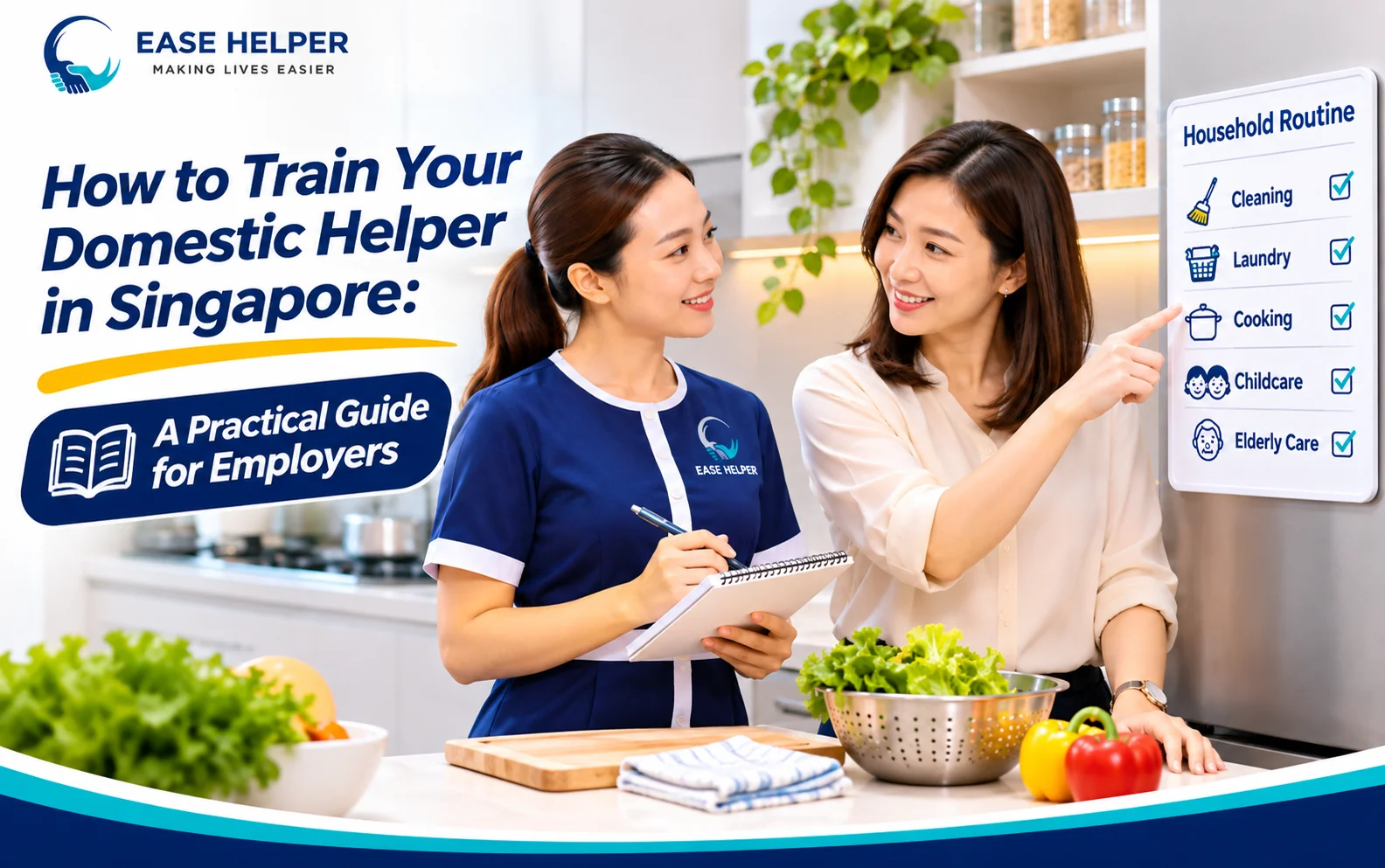
Write down the main household routines in clear language. A short checklist is often more useful than several pages of complicated instructions.
3. Welcome Your Domestic Helper and Introduce the Family
Begin with a friendly introduction. Explain who lives in the household and how family members prefer to be addressed.
Introduce children, elderly family members and other household members where appropriate.
Give the domestic helper time to become familiar with the home before expecting her to remember every detail.
Practical tip: Avoid giving too many instructions immediately after arrival. Start with essential information and introduce more detailed routines gradually.
4. Give a Basic Tour of the Home
A household tour helps the domestic helper understand where important items are kept and which areas require special attention.
Kitchen
- Show where food and cooking equipment are stored.
- Explain refrigerator and food storage arrangements.
- Demonstrate safe use of the stove and appliances.
- Identify cleaning products and their proper uses.
Bathroom and Laundry Area
- Explain bathroom cleaning routines.
- Show how to operate the washing machine.
- Explain laundry sorting and drying arrangements.
- Identify potential slip hazards.
Bedrooms and Living Areas
Explain cleaning expectations, privacy boundaries and which belongings require special care.
5. Explain Essential Household Safety Rules
Safety instructions should be a priority during first-day orientation.
Fire and Gas Safety
Explain how to respond to smoke, fire or a suspected gas leak. Identify safe exits and emergency contact procedures.
Window and High-Rise Safety
Explain safe window-cleaning practices and ensure the domestic helper understands the restrictions applicable to high-rise work.
Electrical and Cleaning Product Safety
Show how to use appliances safely. Explain that cleaning chemicals must be used according to their instructions and that incompatible products must not be mixed.
Childcare and Elderly Care Safety
If the household includes children or elderly family members, explain the most important supervision requirements and emergency procedures.
Do not assume that a newly arrived domestic helper is ready to perform specialised caregiving independently without assessment and appropriate guidance.
6. Explain Household Routines and Priorities
Introduce the family’s usual schedule, including meals, cleaning, laundry and other responsibilities.
Clarify which tasks are essential and which can be completed later.
Start With a Few Important Tasks
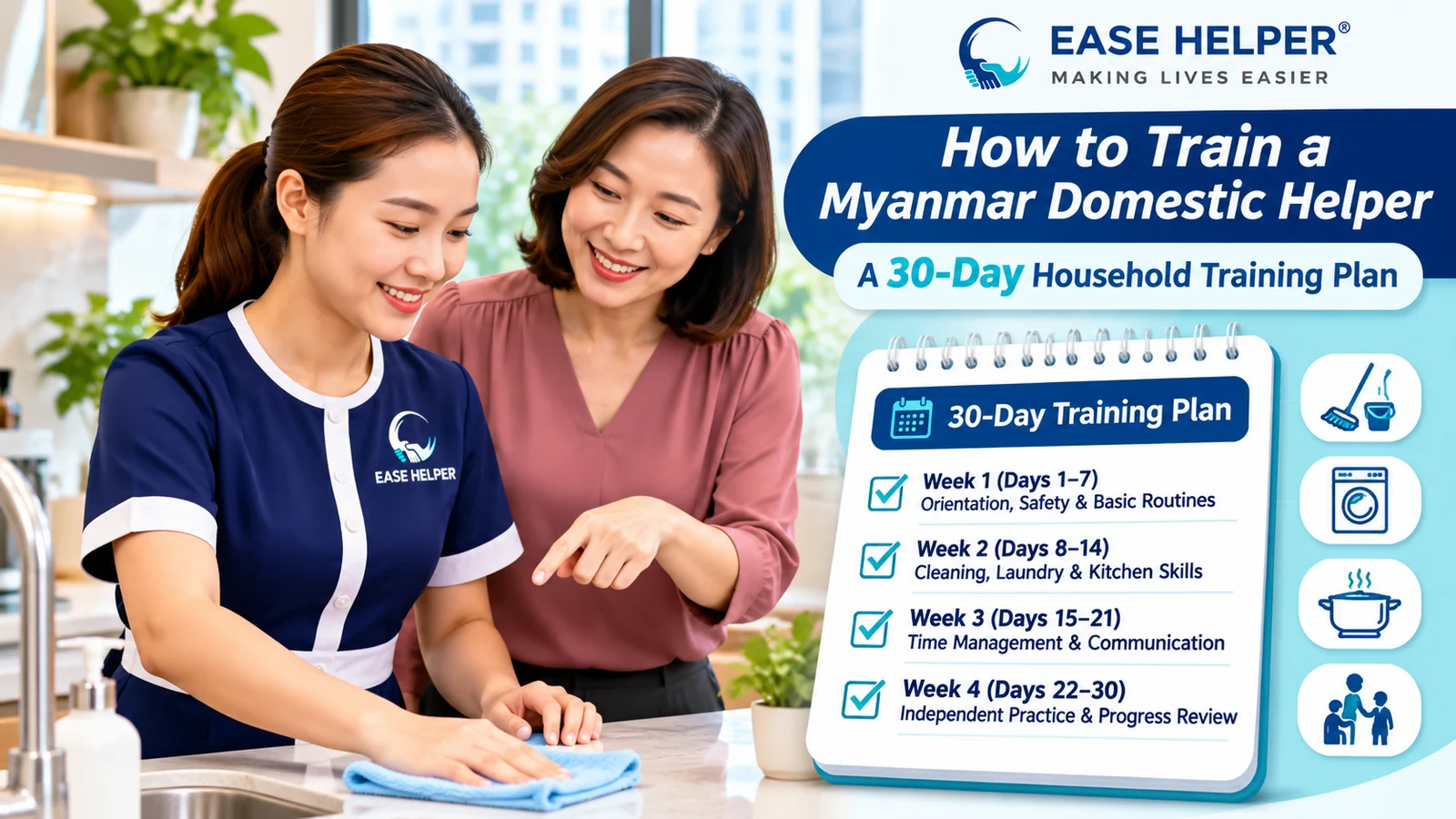
During the initial orientation, demonstrate key tasks and ask the domestic helper to explain the instructions back in her own words where appropriate.
Gradually introduce more responsibilities as she becomes familiar with the household.
7. First-Day Orientation Checklist
Employers can use this checklist to organise the introduction.
| Orientation Item | What to Explain | When |
|---|---|---|
| Welcome and introduction | Family members and basic expectations | On arrival |
| Accommodation | Sleeping arrangements and personal space | On arrival |
| Meals and drinking water | Food arrangements and kitchen access | First day |
| Emergency contacts | Who to contact and when | First day |
| Household safety | Fire, gas, electrical and window safety | First day |
| Daily schedule | Main routines and task priorities | First day and following days |
| Appliance training | Safe operation of household equipment | Gradually |
| Communication | How to ask questions or report problems | First day |
| Rest arrangements | Rest days, breaks and sleep expectations | First day |
8. Establish Clear Communication From the Beginning
Good communication is essential for a successful working relationship.
Use Simple Instructions
Explain tasks one at a time, especially if the domestic helper is still developing her English communication skills.
Demonstrate Important Tasks
Practical demonstrations can help clarify household expectations more effectively than verbal explanations alone.
Encourage Questions
Let the domestic helper know that she should ask whenever she does not understand an instruction.
For additional hiring-related questions, see our domestic helper interview guide.
9. Set Realistic Expectations for the First Week
Employers should not expect a newly arrived domestic helper to memorise every household routine immediately.
Even experienced domestic helpers may need time to learn new equipment, family preferences and different ways of organising work.
During the First Few Days
- Focus on safety and essential tasks.
- Provide clear demonstrations.
- Check whether instructions are understood.
- Offer constructive feedback.
- Allow time to adapt to the new environment.
During the First Week
- Review the daily schedule together.
- Identify tasks requiring additional training.
- Discuss any communication difficulties.
- Adjust instructions where necessary.
- Recognise improvements and good work.
10. Respect Rest, Privacy and Personal Wellbeing
A positive working relationship depends on mutual respect and clear employment arrangements.
Employers should explain rest days, daily rest arrangements, communication expectations and other applicable employment conditions.
A domestic helper should also know whom to approach if she is unwell, has a concern or needs clarification about her responsibilities.
Follow current MOM requirements on accommodation, rest days, medical care and other employer obligations.
11. Common First-Day Mistakes Employers Should Avoid
Giving Too Many Instructions
Long lists of tasks can be difficult to remember. Prioritise important information and provide written reminders.
Assuming Previous Experience Means No Training Is Needed
Every household has different routines. Even experienced candidates benefit from a proper introduction.
Failing to Explain Safety Procedures
Never assume that a domestic helper already understands the risks associated with unfamiliar appliances, cleaning products or caregiving tasks.
Not Encouraging Questions
Employers should make it clear that asking for clarification is preferable to guessing.
Expecting Immediate Full Productivity
Allow reasonable time for rest, orientation and adjustment, particularly after travel.
12. MOM Requirements for Employers in Singapore
Employers must comply with applicable Ministry of Manpower requirements when employing a migrant domestic worker.
These include relevant Work Permit conditions, accommodation, medical obligations, rest days and other employer responsibilities.
For current requirements, refer to:
Employers should also ensure any required arrival, medical examination, orientation or administrative procedures are completed according to current regulations.
13. How EaseHelper Supports Employers
EaseHelper assists Singapore families in selecting suitable Myanmar and Indonesian domestic helpers according to their household requirements.
Our approach considers relevant experience, communication skills, practical abilities and training needs.
We encourage employers to communicate expectations clearly and provide appropriate guidance as domestic helpers settle into their new working environments.
For employers comparing candidates, our fresh vs experienced domestic helper guide provides additional considerations.
Frequently Asked Questions
What should I do on my domestic helper’s first day?
Welcome her, introduce the household, explain accommodation and meals, provide emergency contacts, cover essential safety rules and introduce basic routines without overwhelming her.
Should my domestic helper start working immediately after arrival?
Employers should consider travel fatigue, necessary arrival procedures and appropriate rest before introducing work responsibilities. Essential orientation can begin once she is ready.
How long does a new domestic helper need to adjust?
Adjustment periods vary. Familiarity with household routines, language, previous experience and the complexity of duties can all affect how quickly a domestic helper settles in.
Should I prepare a written schedule?
Yes. A simple daily schedule can help communicate expectations and reduce misunderstandings, especially during the initial weeks.
What if my domestic helper does not understand my instructions?
Use simpler language, demonstrate the task, provide written reminders or ask for clarification. Check understanding without assuming that silence means agreement.
Can EaseHelper help employers prepare for a new domestic helper?
EaseHelper can provide guidance during the hiring process and help employers consider candidate experience, training needs and household expectations.
Conclusion: A Positive Start Builds a Stronger Working Relationship
Your domestic helper’s first day in Singapore should focus on welcoming her, introducing the household and explaining essential safety procedures.
Clear instructions, realistic expectations, appropriate rest and respectful communication can help reduce misunderstandings during the adjustment period.
By taking time to prepare and guide a newly arrived domestic helper, employers can establish a stronger foundation for a positive and productive working relationship.
Looking for a Suitable Domestic Helper in Singapore?
EaseHelper helps Singapore employers explore Myanmar and Indonesian domestic helper candidates based on their household requirements.
Whether you need assistance with childcare, elderly care, cooking or general housekeeping, our team can support you through the hiring process.
Contact EaseHelperDisclaimer
This article is provided for general information only and does not constitute legal or employment advice. Ministry of Manpower requirements and employment conditions may change. Employers should verify current Work Permit conditions, arrival procedures, accommodation requirements and other obligations through official government sources before making employment decisions.