
Blog
Domestic Helper Language Training in Singapore: Essential English and Mandarin for Daily Household Tasks

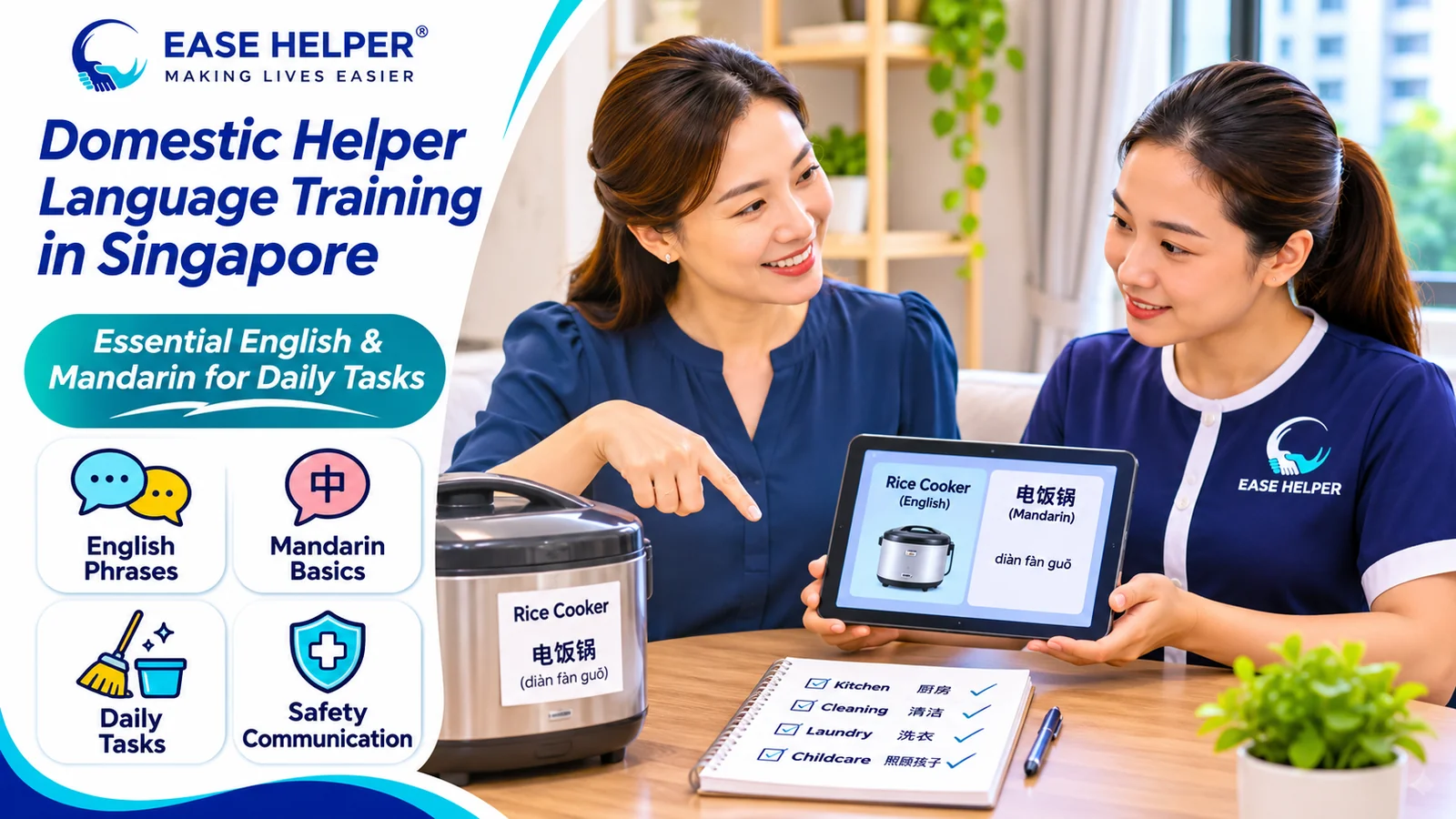
Domestic helper language training can make everyday household communication easier for Singapore employers and their helpers. Simple English and Mandarin expressions are especially useful when discussing cooking, cleaning, childcare, elderly care and household safety.
However, learning a new language takes time. Employers should use clear instructions, practical demonstrations and encouraging feedback rather than expecting immediate fluency.
This guide provides essential English and Mandarin vocabulary, everyday conversation examples and a practical four-week domestic helper language training plan for Singapore households.
Executive Summary
Domestic helper language training should focus on useful household communication rather than perfect grammar. Start with essential safety words, daily instructions and common household objects.
Teach short English phrases first, then introduce Mandarin where it is relevant to the family. Use photographs, labels, demonstrations and repetition to reinforce understanding.
Employers should also encourage helpers to ask questions and confirm instructions. A simple, consistent training routine can reduce misunderstandings and support greater confidence.
1. Why Domestic Helper Language Training Matters in Singapore
Singapore is a multilingual society. Many families communicate in English, Mandarin or a combination of languages and dialects.
Meanwhile, domestic helpers from Myanmar and Indonesia may arrive with different levels of English or Mandarin proficiency.
Consequently, a helper may understand familiar household tasks but struggle with new instructions, unfamiliar accents or technical vocabulary.
Practical language training helps with:
- Understanding daily household instructions.
- Following safety warnings and emergency procedures.
- Communicating with children and elderly family members.
- Shopping and identifying household products.
- Reporting problems and asking for clarification.
- Building confidence during everyday conversations.
Importantly, employers share responsibility for clear communication. Language training should not place the entire burden of understanding on the helper.
2. Assess Your Helper’s Current Language Ability
Before beginning domestic helper language training, identify what your helper already understands.
For example, someone may understand spoken English but have difficulty reading written instructions. Another helper may recognise Mandarin household terms without speaking complete sentences.
Simple Language Assessment
- Ask the helper to identify common kitchen items.
- Give one simple instruction at a time.
- Check whether she understands basic safety words.
- Ask her to explain a familiar household routine.
- Determine whether pictures or written words are more helpful.
- Identify which language the family uses most frequently.
Keep the assessment informal and supportive. Its purpose is to select suitable training methods, not to embarrass the helper.
3. Essential English Phrases for Daily Household Tasks
Start with short English sentences that the helper will hear regularly.
| English Phrase | Meaning or Situation | Training Method |
|---|---|---|
| Please clean the table. | Wipe the dining or work surface. | Demonstrate with a cloth. |
| Please sweep the floor. | Remove dust and debris. | Show the broom and area. |
| Please fold the clothes. | Fold clean laundry. | Demonstrate one item. |
| Please wash the vegetables. | Rinse vegetables appropriately. | Demonstrate at the sink. |
| Please switch off the stove. | Turn off the cooking appliance. | Identify the correct control. |
| Please check the door. | Check whether the door is properly secured. | Show the lock. |
| Please call me immediately. | Contact the employer without delay. | Practise using the phone. |
| Do you understand? | Check understanding. | Encourage an honest response. |
Employers should demonstrate each phrase in context. For instance, saying “fold the clothes” while showing a shirt helps connect the words with the action.
4. Essential Mandarin Words for Domestic Helpers
Some Singapore households use Mandarin regularly, especially when communicating with elderly family members.
In these homes, basic Mandarin vocabulary can be helpful. However, employers should introduce only the words that are relevant to their household.
| English | Mandarin | Pinyin |
|---|---|---|
| Water | 水 | shuǐ |
| Eat | 吃 | chī |
| Drink | 喝 | hē |
| Rice / cooked rice | 饭 | fàn |
| Vegetables | 菜 | cài |
| Clean | 打扫 | dǎsǎo |
| Wash | 洗 | xǐ |
| Wait a moment | 等一下 | děng yíxià |
| Be careful | 小心 | xiǎoxīn |
| Slowly | 慢慢来 | mànmàn lái |
| Thank you | 谢谢 | xièxie |
| I don’t understand | 我不明白 | wǒ bù míngbai |
Mandarin pronunciation depends on tones. Therefore, employers should provide spoken examples or reliable audio recordings rather than expecting helpers to learn pronunciation from pinyin alone.
Training tip: Mandarin words may differ from the expressions used in Singaporean dialects. Ask elderly family members which language and terms they actually use before preparing a vocabulary list.
5. Teach English and Mandarin for Kitchen Tasks
Kitchen communication should prioritise safety, hygiene and clarity.
For example, the helper needs to distinguish between washing vegetables, cutting raw meat and cleaning a chopping board.
Useful Kitchen Vocabulary
| English | Mandarin | Pinyin |
|---|---|---|
| Knife | 刀 | dāo |
| Plate | 盘子 | pánzi |
| Bowl | 碗 | wǎn |
| Refrigerator | 冰箱 | bīngxiāng |
| Hot | 烫 | tàng |
| Turn off the fire / stove | 关火 | guān huǒ |
| Wash your hands | 洗手 | xǐ shǒu |
| Don’t touch | 不要碰 | bú yào pèng |
When teaching safety-related instructions, demonstrate the correct action and ask the helper to show what she understood.
Never rely on unfamiliar vocabulary alone when explaining dangerous equipment or cleaning chemicals.
6. Language Training for Cleaning and Laundry
Cleaning instructions often contain unfamiliar product names, fabric descriptions and household-specific preferences.
Therefore, labels and photographs can make training easier.
Useful Cleaning Vocabulary
- Detergent: A cleaning product used for washing.
- Disinfectant: A product used according to its label to reduce harmful microorganisms.
- Rinse: Remove soap or cleaning residue with water.
- Dry: Remove moisture or allow an item to become dry.
- Delicate: A fabric requiring gentle handling.
- Separate: Keep certain items apart, such as white and coloured laundry.
For Mandarin-speaking households, introduce words such as 洗衣服 (xǐ yīfu, wash clothes) and 晾衣服 (liàng yīfu, hang clothes to dry).
However, written labels should supplement, not replace, demonstrations of safe cleaning procedures.
7. Language Training for Childcare Communication
When a helper assists with childcare, clear communication is particularly important.
Employers should teach the words needed to describe meals, school routines, injuries and urgent situations.
Essential Childcare Phrases
| English | Mandarin | Pinyin |
|---|---|---|
| Are you hungry? | 你饿了吗? | nǐ è le ma? |
| Drink some water. | 喝点水。 | hē diǎn shuǐ. |
| Be careful. | 小心。 | xiǎoxīn. |
| Don’t run. | 不要跑。 | bú yào pǎo. |
| Are you feeling unwell? | 你不舒服吗? | nǐ bù shūfu ma? |
| Call your mother. | 打电话给妈妈。 | dǎ diànhuà gěi māma. |
Employers should also explain how to report an injury or unexpected incident. For example, a helper should know how to say, “The child fell down” and “Please come home.”
Most importantly, parents should establish clear emergency contact procedures instead of relying only on memorised phrases.
8. Language Training for Elderly Care
Some elderly family members may prefer Mandarin or a Chinese dialect. Consequently, helpers may need additional support understanding everyday requests.
Useful Elderly Care Phrases
| English | Mandarin | Pinyin |
|---|---|---|
| Please sit down. | 请坐下。 | qǐng zuò xià. |
| Walk slowly. | 慢慢走。 | mànmàn zǒu. |
| Do you need help? | 你需要帮忙吗? | nǐ xūyào bāngmáng ma? |
| Are you in pain? | 你哪里痛? | nǐ nǎlǐ tòng? |
| Wait for me. | 等我一下。 | děng wǒ yíxià. |
Where elderly care involves medication, mobility assistance or medical symptoms, employers should provide specific instructions and suitable training.
Do not rely on language exercises as a substitute for medical guidance or practical care training.
9. Teach Emergency and Safety Communication First
Domestic helper language training should always prioritise essential emergency communication.
A helper should understand how to describe an urgent problem and contact the appropriate person or emergency service.
Important Emergency English Phrases
- “There is a fire.”
- “Someone has fallen.”
- “The child is injured.”
- “I smell gas.”
- “Please call an ambulance.”
- “I need help.”
- “What is the address?”
In Singapore, call 995 for an emergency ambulance or fire emergency and 999 for urgent police assistance.
Employers should write down the home address and emergency contact details in an accessible place. Then practise explaining the address clearly.
For official emergency information, visit the Singapore Civil Defence Force.
10. Use Visual Learning Instead of Long Explanations
Visual learning can be especially useful when a helper is unfamiliar with English or Mandarin.
For example, a photograph of the washing machine can accompany a short instruction explaining which setting to use.
Practical Visual Training Methods
- Attach labels to appropriate household storage areas.
- Use photographs of commonly used appliances.
- Demonstrate one task at a time.
- Create picture-based shopping lists.
- Use short audio examples for pronunciation.
- Prepare simple illustrated safety instructions.
However, avoid placing labels where they could damage appliances or obscure safety warnings.
11. Encourage Helpers to Ask Questions
Some helpers may hesitate to admit that they do not understand an instruction.
Employers should make it clear that asking questions is encouraged, particularly when safety is involved.
Useful Clarification Phrases
- “Could you please repeat that?”
- “Please speak more slowly.”
- “Can you show me?”
- “Do you mean this one?”
- “I don’t understand yet.”
- “Should I do this first?”
Instead of asking only “Do you understand?”, employers can invite the helper to explain the instruction in her own words or demonstrate the next step.
This method helps confirm understanding without turning the conversation into a test.
12. Four-Week Domestic Helper Language Training Plan
A short, consistent training programme can help domestic helpers learn useful vocabulary without creating unnecessary pressure.
| Week | Learning Focus | Practical Activities |
|---|---|---|
| Week 1 | Basic English and household objects | Learn common instructions, identify rooms and practise asking questions. |
| Week 2 | Kitchen, cleaning and laundry vocabulary | Use labels, demonstrations and short daily conversations. |
| Week 3 | Childcare, elderly care and useful Mandarin | Practise relevant family phrases and safe communication. |
| Week 4 | Emergency communication and revision | Review safety phrases, contact numbers and realistic household scenarios. |
Consider five to ten minutes of voluntary, supportive practice during appropriate training time rather than lengthy memorisation sessions.
Adjust the pace to the helper’s existing skills and the family’s actual communication needs.
13. Daily Ten-Minute Language Practice Routine
Short practice sessions can be easier to maintain than occasional intensive lessons.
- Two minutes: Review three familiar words.
- Three minutes: Introduce two new words or one useful phrase.
- Three minutes: Demonstrate the words during a real household task.
- Two minutes: Encourage questions and review understanding.
For example, during laundry training, practise the words “detergent”, “rinse” and “dry” while demonstrating the correct procedure.
Employers should focus on practical understanding rather than perfect pronunciation.
14. Common Language Training Mistakes to Avoid
| Common Mistake | Better Approach |
|---|---|
| Speaking too quickly | Use clear, natural speech and short sentences. |
| Teaching too many words at once | Introduce a few useful terms at a time. |
| Giving several instructions together | Explain tasks in a logical sequence. |
| Criticising pronunciation harshly | Model the correct pronunciation patiently. |
| Assuming a nod means understanding | Ask for a demonstration or explanation. |
| Using unfamiliar slang and dialects immediately | Start with standard, practical expressions. |
| Relying entirely on translation apps | Verify important instructions through demonstration. |
15. Should Employers Use Translation Apps?
Translation applications can help clarify unfamiliar vocabulary, especially during the early adjustment period.
However, automatic translations may misunderstand context, household terminology or spoken accents.
Good Practices for Translation Tools
- Use short, complete sentences.
- Avoid complicated idioms and slang.
- Confirm important instructions with demonstrations.
- Check translations involving medication or safety.
- Respect personal privacy when using shared devices.
- Do not depend on machine translation during emergencies.
For complex medical or legal matters, seek qualified language assistance when necessary.
16. Build Confidence Through Positive Communication
Successful domestic helper language training depends on patience, repetition and a supportive learning environment.
Employers should acknowledge progress and recognise that mistakes are a normal part of learning.
Five Habits That Help
- Use consistent words for recurring tasks.
- Demonstrate unfamiliar instructions.
- Encourage clarification without embarrassment.
- Practise useful vocabulary in everyday situations.
- Review progress and adjust the training plan.
Ultimately, language training works best when both employer and helper communicate respectfully and share responsibility for understanding.
Frequently Asked Questions
1. How can employers teach English to a domestic helper in Singapore?
Start with common household words, short instructions and practical demonstrations. Use pictures, repetition and brief daily practice. Encourage the helper to ask questions and confirm understanding.
2. Should a domestic helper learn Mandarin in Singapore?
Mandarin can be useful when household members speak it regularly. However, it is not necessary for every family. Employers should prioritise the languages and vocabulary most relevant to their household.
3. What English words should domestic helpers learn first?
Start with safety expressions, common household objects, simple instructions and clarification phrases. Emergency communication should receive particular attention.
4. How long does domestic helper language training take?
Progress varies according to previous experience, language exposure and training methods. A four-week introductory programme can establish useful routines, but language development usually requires continued practice.
5. Can translation apps replace language training?
Translation apps can support communication, but they may produce inaccurate or unclear translations. Practical demonstrations and direct confirmation remain important, especially for safety-related tasks.
Looking for a Domestic Helper in Singapore?
EaseHelper helps Singapore families explore domestic helper placement options based on their household needs. Clear communication, appropriate training and realistic expectations can support a smoother adjustment for both employers and helpers.
Explore EaseHelper ServicesDisclaimer: This article provides general language training guidance for Singapore households. Mandarin translations and pinyin are intended as introductory learning examples; pronunciation and everyday usage may vary. Employers should verify safety-critical instructions and consult relevant professionals when necessary. This article does not replace official employment, medical or safety guidance.