Blog
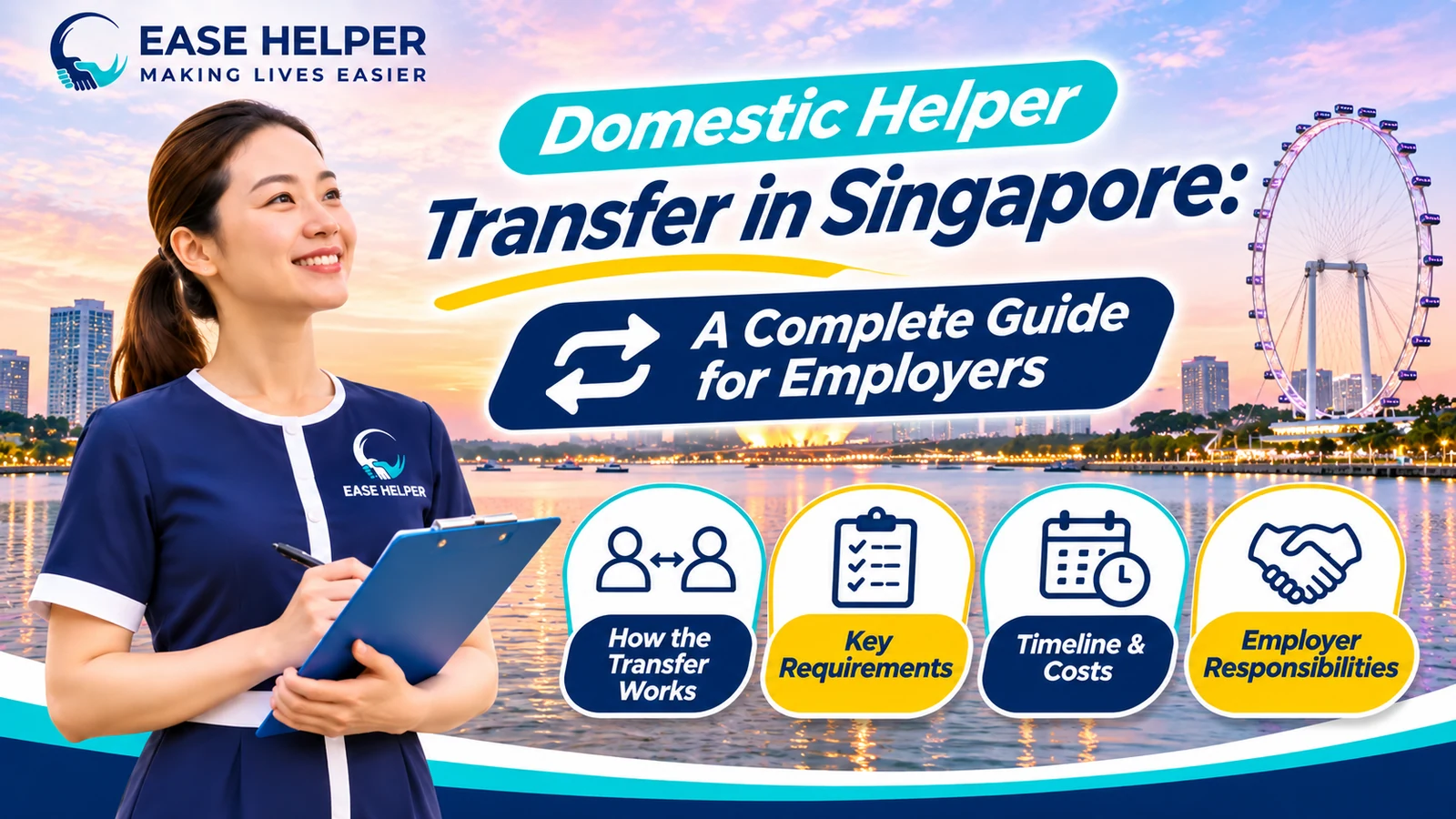
Domestic Helper Transfer in Singapore: A Complete Guide for Employers

Executive Summary
Hiring a transfer domestic helper in Singapore means employing a migrant domestic worker who is already in Singapore and moving from an existing employer to a new household.
Transfer helpers may offer practical Singapore household experience and the opportunity for an in-person interview. However, employers must understand the transfer procedure, current employer consent, Work Permit requirements, employment responsibilities and appropriate timing.
This guide explains how domestic helper transfers work, what employers should check before hiring, and how to prepare for a smooth transition.
1. What Is a Transfer Domestic Helper in Singapore?
A transfer domestic helper is a migrant domestic worker who is already in Singapore and is changing from one employer to another.
Unlike hiring a domestic helper who is arriving from overseas, a transfer involves a worker who has an existing employment arrangement in Singapore.
The transfer must be completed through the appropriate Ministry of Manpower (MOM) procedures before the domestic helper can legally begin working for the new employer.
Why do domestic helpers transfer?
There are several possible reasons:
- The current employer no longer requires domestic assistance.
- The employer is relocating overseas.
- The household’s childcare or elderly care needs have changed.
- The helper and employer are not a suitable long-term match.
- The helper is seeking a different employment arrangement.
A transfer does not automatically indicate poor performance or a problem with the domestic helper.
Employers should assess the candidate individually and understand the circumstances before making a hiring decision.
2. Transfer Helper vs New Helper: What Is the Difference?
Both transfer and overseas-recruited domestic helpers can be suitable for Singapore households. The better choice depends on the family’s needs, expectations and preferred hiring timeline.
| Factor | Transfer Domestic Helper | Helper Recruited from Overseas |
|---|---|---|
| Current location | Already in Singapore | Usually outside Singapore |
| Interview arrangements | In-person interviews may be possible | Often interviewed by video call |
| Singapore experience | Has worked in Singapore | May or may not have Singapore experience |
| Hiring timeline | Depends on transfer approval and agreed date | Depends on application, travel and entry arrangements |
| Work Permit process | Transfer and new Work Permit issuance | Work Permit application and arrival procedures |
| Suitability | Depends on individual skills and experience | Depends on individual skills and experience |
Employers who are still considering different hiring arrangements can read our complete guide to hiring a domestic helper in Singapore.
3. Advantages of Hiring a Transfer Domestic Helper
Opportunity for an in-person interview
Depending on the arrangements, employers may be able to meet a transfer helper in person before deciding whether to proceed.
This can help employers assess communication, expectations and general compatibility.
Existing Singapore household experience
A transfer helper may already be familiar with Singapore household routines, local living conditions and employer expectations.
However, experience should be verified rather than assumed.
Potentially shorter deployment time
Some transfer arrangements may be completed more quickly than overseas recruitment, particularly when all parties are ready and the required approvals are obtained.
Nevertheless, there is no guaranteed transfer timeline. Processing, employer consent and Work Permit validity can affect the schedule.
Opportunity to review previous work experience
Employers can discuss the candidate’s Singapore work history, responsibilities and reasons for seeking a transfer.
Any information obtained should be handled respectfully and assessed fairly.
4. How Does the Domestic Helper Transfer Process Work?
MOM sets out the procedures for transferring a migrant domestic worker directly to another employer.
Step 1: Confirm the helper’s willingness to transfer
Ensure that the domestic helper is agreeable to the proposed change of employer and understands the intended employment arrangement.
Step 2: Discuss the transfer with the current employer
The current employer must provide the necessary consent for a direct transfer.
The parties should also discuss the proposed transfer date and any practical handover arrangements.
Step 3: Check the existing Work Permit and medical examination
For a direct transfer, MOM requires the helper’s six-monthly medical examination to be completed where due.
The first two application steps generally need to be completed at least 30 days before the current Work Permit expires. If the permit is approaching expiry, the current employer may need to request an extension.
Step 4: Submit the new Work Permit application
The prospective employer requests the current employer’s consent through MOM’s FDW eService and proceeds with the application once consent is given.
If the application is approved, MOM issues an In-Principle Approval (IPA).
Step 5: Prepare the required documents and coverage
The new employer must complete the relevant IPA requirements, which include arranging the applicable security bond, medical insurance and personal accident insurance.
The employer and helper must also sign the required declaration form.
Step 6: Issue the new Work Permit on the agreed transfer date
On the agreed transfer date, the new employer issues the Work Permit through MOM’s FDW eService and completes the required document submission.
Once the new permit is issued, the previous Work Permit is automatically cancelled.
Important: The domestic helper must not begin working for the new employer before the new Work Permit has been issued. Check MOM’s official direct transfer procedure for the latest instructions and deadlines.
5. How Long Does a Domestic Helper Transfer Take?
The time required depends on the circumstances of the transfer.
Factors include:
- How quickly the current employer provides consent
- The remaining validity of the helper’s Work Permit
- Completion of any required medical examination
- Work Permit application processing
- Insurance and security bond arrangements
- The agreed transfer date
MOM indicates that a direct transfer Work Permit application generally receives an outcome within one week, although this should not be treated as a guarantee for every case.
The new permit must be issued within the applicable deadline, generally the earlier of 21 days after approval or the expiry date of the existing Work Permit.
Employers should avoid making firm deployment arrangements before the relevant approval and transfer date have been confirmed.
6. What Should Employers Check Before Hiring a Transfer Helper?
Employment history
Ask about previous household responsibilities, employment duration and the type of assistance provided.
Reason for transfer
Discuss why the helper is seeking a new employer. Consider the explanation fairly and avoid making assumptions based on the transfer alone.
Communication skills
Assess whether the helper can understand instructions, ask questions and communicate important household matters.
Practical household experience
Ask about cooking, cleaning, laundry, childcare or elderly care, depending on the family’s needs.
Employment expectations
Discuss salary, rest days, duties, household routines, privacy and communication expectations before confirming the arrangement.
Willingness to learn
Even an experienced helper may need time to adapt to a new household.
Employers can use our domestic helper interview questions guide to structure their assessment.
7. What Questions Should You Ask a Transfer Domestic Helper?
A structured interview can help employers compare candidates consistently.
- How long have you worked in Singapore?
- What were your main responsibilities in your previous household?
- Why are you looking for a transfer?
- What household tasks are you most confident performing?
- Do you have experience caring for children or elderly family members?
- What meals are you comfortable preparing?
- How do you manage several tasks when priorities change?
- How do you respond when you do not understand an instruction?
- What are your expectations regarding salary and rest days?
- What would help you settle into a new household successfully?
Employers should avoid discriminatory or unnecessarily intrusive questions and focus on the candidate’s ability to meet legitimate household requirements.
8. Domestic Helper Transfer Costs in Singapore
The cost of hiring a transfer domestic helper varies depending on the arrangement and the services involved.
Potential expenses may include:
- Work Permit application and issuance fees
- Employment agency service fees, where applicable
- Medical and personal accident insurance
- Security bond arrangements
- Any required medical examination
- Monthly salary and government levy
- Other applicable employment expenses
Employers should request a clear breakdown of fees and confirm what is included before agreeing to an agency’s services.
For ongoing employment costs, see our domestic helper salary guide.
Employers should also consider the monthly levy and whether their household qualifies for a concession.
9. Responsibilities of the Current and New Employers
A domestic helper transfer involves responsibilities for both employers.
| Current Employer | New Employer |
|---|---|
| Confirm the helper’s willingness to transfer | Assess the helper’s suitability |
| Provide transfer consent through the required procedure | Submit the new Work Permit application |
| Complete required medical examination arrangements | Arrange required insurance and security bond |
| Continue applicable employment responsibilities until transfer | Agree on the transfer date and prepare the household |
| Pay levy through the applicable transfer date | Issue the new Work Permit before employment begins |
Once the new Work Permit is issued, the previous permit is automatically cancelled under MOM’s direct transfer process.
Employers should document agreed arrangements clearly and follow the latest MOM instructions.
10. Can a Domestic Helper Transfer Through an Employment Agency?
Yes. MOM permits employment agencies to facilitate transfers under the applicable procedures.
In certain arrangements, an employment agency may agree to take over responsibility for a domestic helper while seeking a new employer.
When an agency formally assumes responsibility under the relevant transfer procedure, it must meet MOM’s requirements concerning accommodation, food, medical care and other obligations.
This arrangement differs from a direct transfer between two employers.
Employers should understand which process applies and obtain clear written information about the agency’s role and responsibilities.
For further information, refer to MOM’s employment agency transfer guidance.
11. Common Mistakes to Avoid When Hiring a Transfer Helper
Mistake 1: Assuming a transfer helper can start immediately
The helper must have the new Work Permit issued before working for the new employer.
Mistake 2: Failing to confirm employer consent
A direct transfer requires the current employer’s consent through the applicable process.
Mistake 3: Ignoring the Work Permit expiry date
Late planning may complicate the transfer or require additional action.
Mistake 4: Choosing a helper based only on Singapore experience
Relevant experience is useful, but compatibility, communication and actual skills remain important.
Mistake 5: Not discussing employment expectations
Salary, duties, rest days and household expectations should be clearly discussed before employment begins.
Mistake 6: Overlooking the adjustment period
Even an experienced domestic helper needs time to understand a new family’s routines and preferences.
Our first-day guide for employers offers practical onboarding suggestions.
12. How EaseHelper Supports Domestic Helper Hiring
EaseHelper supports Singapore families looking for suitable domestic helpers based on their household requirements.
Our services include:
- Understanding employer requirements
- Exploring suitable Myanmar and Indonesian domestic helper options
- Arranging candidate interviews
- Providing guidance on relevant hiring procedures
- Helping employers understand practical employment considerations
- Supporting communication and placement arrangements
Where a transfer arrangement is available and appropriate, employers should confirm the candidate’s status and applicable process with our team.
Families comparing placement agencies can also read our guide to choosing a reliable domestic helper agency in Singapore.
13. Frequently Asked Questions About Domestic Helper Transfers
Can I hire a transfer domestic helper directly in Singapore?
Yes. A direct transfer is possible when the required conditions are met, including current employer consent, the new Work Permit application and issuance of the permit.
Does a transfer helper need a new Work Permit?
Yes. The new employer must obtain the required Work Permit approval and issue the new permit before the helper starts work.
Can I interview a transfer helper in person?
An in-person interview may be possible, subject to appropriate arrangements and the helper’s current employment obligations.
Is a transfer helper always more experienced?
Not necessarily. A transfer helper has Singapore employment experience, but the relevance and depth of that experience vary by individual.
How quickly can a transfer helper start work?
The timing depends on employer consent, application approval, the agreed transfer date and issuance of the new Work Permit.
Who pays the levy before the transfer?
For a direct transfer, the current employer remains responsible for levy payments up to the date the new employer issues the Work Permit.
Can an employment agency arrange the transfer?
Yes. Licensed employment agencies may assist with transfer arrangements, subject to MOM’s requirements and the relevant authorisations.
Conclusion
Hiring a transfer domestic helper in Singapore can be a practical option for families seeking someone who already has local household experience.
However, a successful transfer requires more than finding an available candidate. Employers should assess suitability carefully, understand the reason for transfer, clarify expectations and follow MOM’s Work Permit procedures.
Clear communication and proper planning can help both the employer and domestic helper begin the new working relationship with confidence.
Looking for a Suitable Domestic Helper in Singapore?
EaseHelper helps Singapore families explore Myanmar and Indonesian domestic helper options based on their household needs.
Contact our team to discuss candidate availability, interview arrangements and the appropriate hiring process for your family.
Contact EaseHelperDisclaimer
This article is provided for general information only and does not constitute legal or employment advice. Domestic helper transfer requirements, Work Permit procedures, processing times, fees and employer obligations may change. Employers should verify the latest information directly with Singapore’s Ministry of Manpower before making hiring or transfer decisions.