Blog
Domestic Helper Temporary Accommodation in Singapore: When Employers May Need a Helper Hostel

Executive Summary
Domestic helper temporary accommodation in Singapore may be necessary during an employment transfer, before placement, while awaiting repatriation, or when a temporary housing problem arises. However, a helper hostel is not automatically suitable or permitted for every situation. Employers and employment agencies must follow the relevant Ministry of Manpower (MOM) requirements, provide acceptable accommodation and clarify who remains responsible for the helper’s well-being. This guide explains common situations, accommodation standards, costs, Work Permit considerations and practical steps for arranging a safe temporary stay.
1. What Is Domestic Helper Temporary Accommodation?
Temporary accommodation refers to a short-term place where a domestic helper stays when her usual living arrangement is unavailable or inappropriate. For example, she may need somewhere to stay while an employment agency manages an approved transfer.
Some people use the term “helper hostel” to describe accommodation arranged for domestic helpers between placements. However, the term does not establish that a particular facility meets MOM’s requirements.
Therefore, employers should assess the purpose of the stay, the helper’s Work Permit status and the applicable accommodation rules before making arrangements.
Most importantly, temporary accommodation does not automatically transfer legal responsibility from the employer to a hostel operator or another person.
2. When Might a Domestic Helper Need Temporary Accommodation?
Several situations may create a genuine need for short-term accommodation. Nevertheless, each situation has different rules and responsibilities.
| Situation | Why Accommodation May Be Needed | Important Consideration |
|---|---|---|
| Before first placement | The helper has arrived but has not yet started work with an employer | The responsible employment agency must meet its pre-placement obligations |
| Employment agency-managed transfer | The helper is between employers under the applicable transfer process | The agency must formally take over responsibility under MOM’s requirements |
| Awaiting repatriation | The helper cannot depart immediately after employment ends | The responsible party must maintain lawful stay and suitable accommodation |
| Employer travelling overseas | The helper cannot remain in the usual home during the employer’s absence | Specific MOM notification rules apply to qualifying arrangements |
| Unexpected housing problem | The usual home becomes temporarily unsuitable | Check with MOM before adopting an arrangement that affects permit conditions |
| Employment dispute or safety concern | The helper may need a safe place while the matter is addressed | Seek appropriate help from MOM or the relevant authorities |
Consequently, families should avoid treating every temporary stay as an ordinary accommodation booking.
3. Who Is Responsible for a Domestic Helper’s Accommodation?
Responsibility depends on the helper’s employment and transfer status. As a general rule, employers must provide acceptable accommodation, adequate food and medical treatment while they remain responsible for their domestic helper.
For example, an employer cannot simply send a helper to temporary accommodation and assume that all legal obligations have ended.
However, MOM provides a specific process through which an employment agency may take over responsibilities while arranging a transfer to a new employer.
Accordingly, both parties should document any formal transfer of responsibility and follow the relevant MOM procedures.
Read MOM’s guidance on transferring a domestic helper through an employment agency.
4. Temporary Accommodation Before First Placement
Some domestic helpers arrive in Singapore before their first employment placement begins. During this period, the employment agency that brought the helper into Singapore has specific obligations.
According to MOM, the agency must provide upkeep and maintenance, including accommodation, from the helper’s arrival until successful placement or repatriation if placement is unsuccessful.
In addition, the agency must arrange repatriation and bear the relevant cost if it cannot successfully place the helper.
Therefore, employers should not assume that a newly arrived helper must independently pay for accommodation before placement.
For official details, see MOM’s explanation of employment agency responsibilities.
5. Temporary Accommodation During a Helper Transfer
An employment transfer may involve a short period between the helper’s previous employment and her next placement. However, employers should distinguish a direct transfer from a transfer managed through an employment agency.
Direct Transfer to Another Employer
In a direct transfer, the existing and prospective employers must follow MOM’s transfer procedures. Until responsibility changes under the applicable process, the current employer should continue fulfilling her obligations.
Therefore, neither employer should assume that an informal agreement automatically changes the helper’s legal status.
Transfer Through an Employment Agency
Alternatively, an employment agency may agree to take over responsibility for a helper while seeking a new employer.
Under MOM’s agency-managed transfer process, the agency can cancel the Work Permit for the transfer after obtaining the required authorisation. The agency then becomes responsible for the helper until she starts with a new employer or leaves Singapore.
These responsibilities include acceptable accommodation, adequate food, medical treatment and the required medical insurance. Furthermore, the agency must arrange and pay for repatriation if the transfer is unsuccessful under the applicable rules.
Because the transfer involves legal responsibilities, employers and agencies should keep written records of their agreement.
6. What Happens If a Helper Cannot Find a New Employer?
Not every employment transfer succeeds. Consequently, employers and agencies should understand the next steps before the transfer begins.
Under MOM’s agency-managed transfer process, the helper may receive a Special Pass with up to 30 days of validity while the agency seeks another employer.
If no suitable placement occurs before the permitted stay ends, the agency must fulfil its repatriation obligations.
However, a Special Pass is not a Work Permit. Therefore, the helper must not start working for another household unless the necessary authorisation is in place.
Employers should also avoid assuming that the full maximum validity period applies in every case. Instead, check the actual pass and its expiry date.
7. Temporary Accommodation While Awaiting Repatriation
Sometimes a helper cannot leave Singapore immediately after employment ends. For example, travel arrangements may require several additional days.
During this period, the responsible party must ensure that the helper has lawful permission to remain in Singapore and receives suitable accommodation and upkeep.
When the employer remains responsible, she must continue fulfilling her obligations until the helper departs or responsibility changes through an approved process.
Additionally, employers should settle outstanding salary and make appropriate repatriation arrangements.
For current cancellation procedures, consult MOM’s Work Permit cancellation guidance.
8. Can Employers Arrange a Helper Hostel While Travelling Overseas?
Yes, MOM permits certain temporary accommodation arrangements when employers travel overseas. However, specific conditions apply.
An employer may arrange for her helper to stay with a friend, relative or employment agency while she is overseas, provided the temporary accommodation period does not exceed one month.
Importantly, the employer must notify MOM at least seven days before the trip.
Before departure, the employer should:
- Check that the accommodation meets the relevant requirements.
- Inform the helper about the arrangements.
- Notify MOM within the required timeframe.
- Confirm who will oversee the helper’s well-being.
- Provide clear emergency contact information.
While overseas, the employer must continue paying the helper’s salary and levy. In addition, she remains responsible for accommodation, food, medical treatment and upkeep.
The helper must not perform work at the temporary premises. Furthermore, the employer must remain contactable and notify MOM before changing the arrangement.
See MOM’s official notification requirements.
9. Can a Helper Work While Staying in Temporary Accommodation?
Temporary accommodation does not give a domestic helper permission to work for another household.
Under MOM’s employment rules, a helper may work only for her employer at the residential address declared to MOM, subject to applicable approved arrangements.
Therefore, a helper staying with a friend, relative or employment agency should not perform household chores for the people providing accommodation.
Similarly, a helper awaiting a new placement must not begin working for a prospective employer before the necessary Work Permit arrangements take effect.
Employers can review MOM’s domestic helper employment rules.
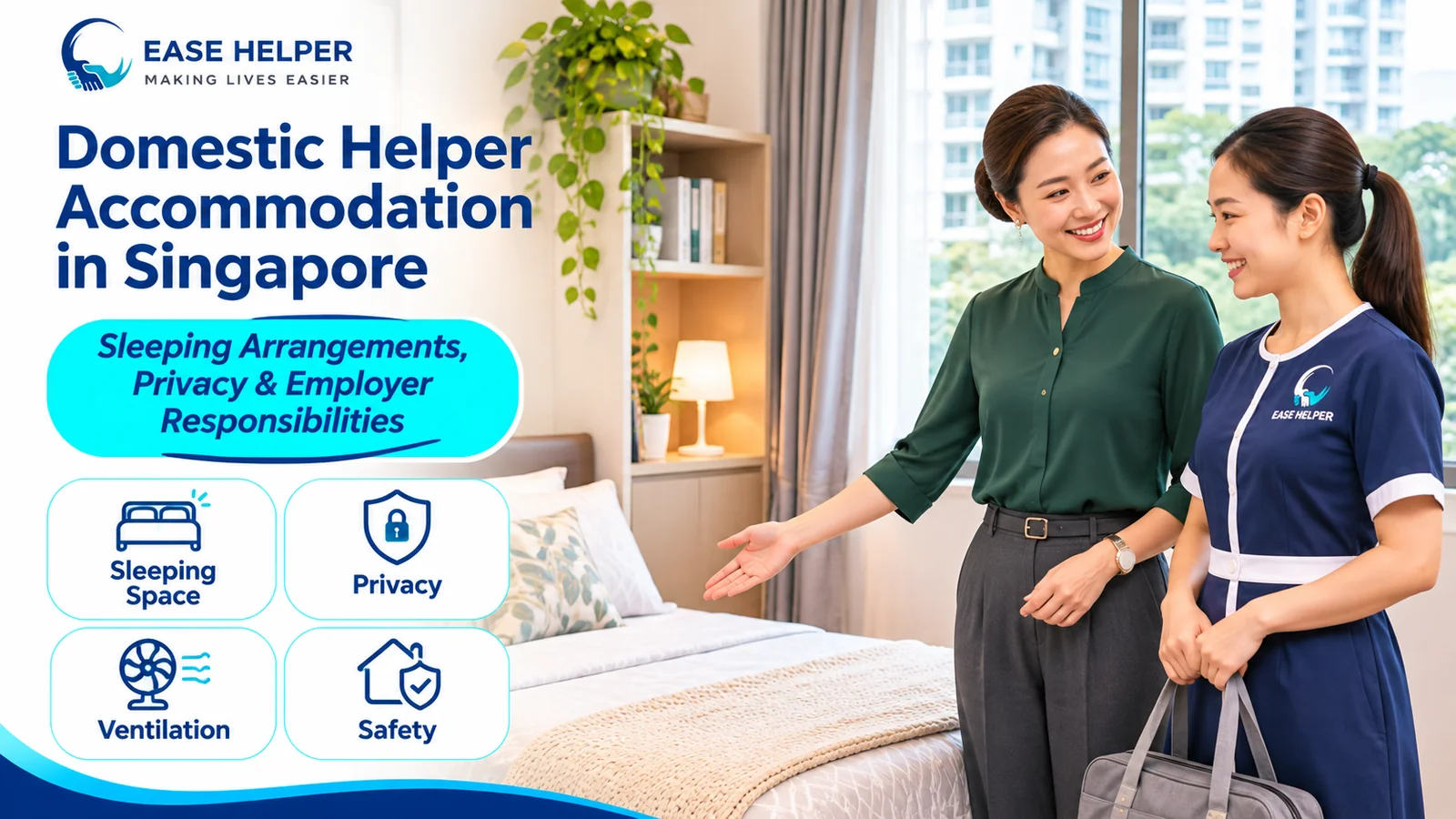
10. What Makes Temporary Accommodation Suitable?
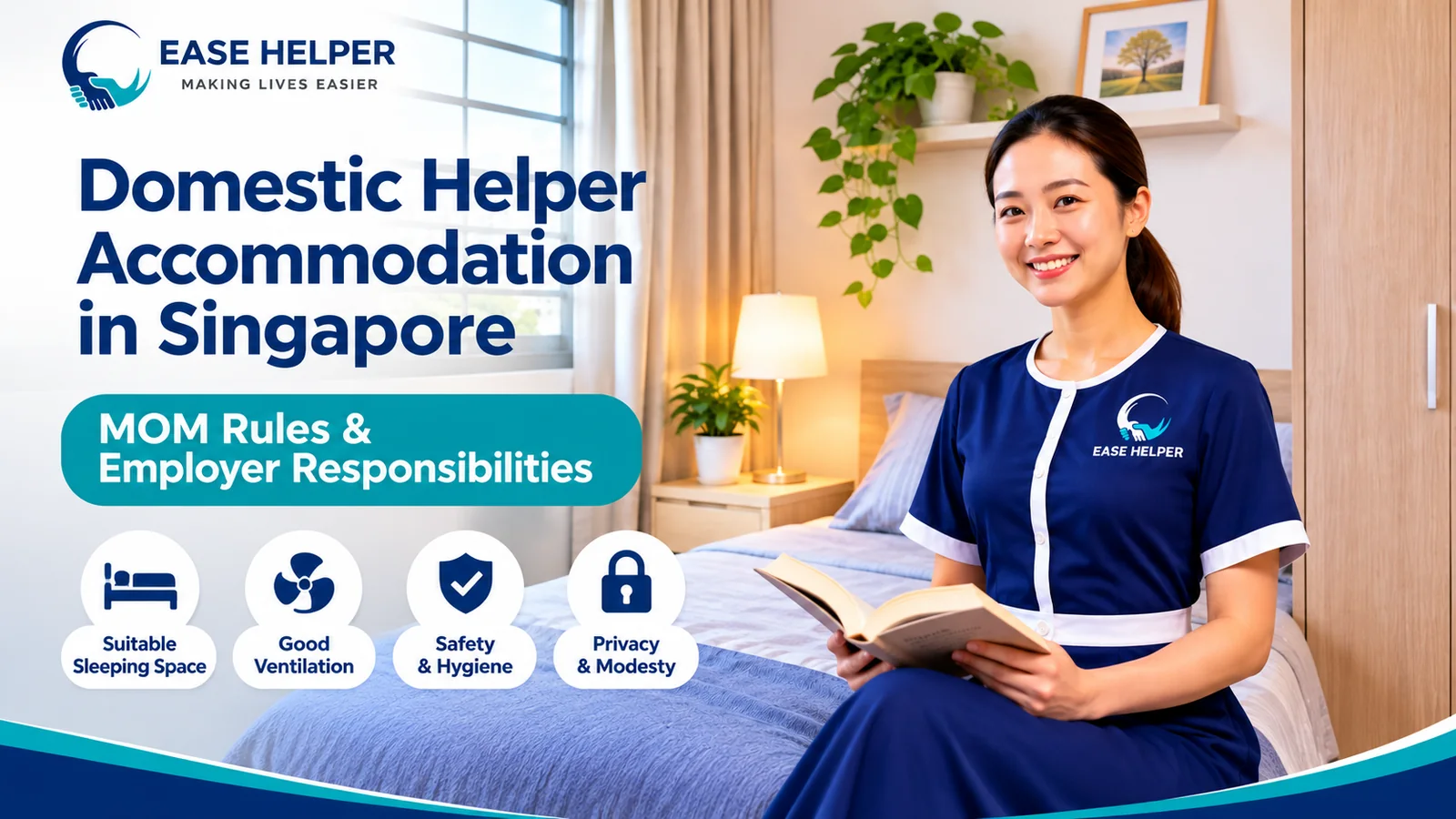
Acceptable accommodation should provide a safe, clean and suitable environment. Moreover, the arrangements should respect the helper’s privacy, dignity and basic needs.
Before confirming accommodation, consider the following checklist:
| Accommodation Factor | What to Check |
|---|---|
| Sleeping arrangements | A suitable bed or sleeping space with adequate privacy |
| Cleanliness | Clean rooms, bedding, toilets and shared areas |
| Ventilation | Appropriate airflow and a comfortable environment |
| Bathroom access | Safe and hygienic toilet and washing facilities |
| Food and water | Reliable access to adequate meals and drinking water |
| Security | Reasonable protection from unauthorised access and unsafe conditions |
| Emergency arrangements | Clear contact details and procedures for urgent assistance |
| Personal belongings | Reasonable arrangements for safeguarding personal property |
| Compliance | Accommodation that meets the applicable MOM and public-agency requirements |
Nevertheless, a general checklist does not replace the formal requirements that apply to employment agency boarding facilities or other regulated accommodation.
11. Employment Agency Boarding Facilities and MOM Requirements
Employment agencies that provide boarding facilities for domestic helpers must comply with the relevant licensing conditions.
For example, MOM requires agency boarding facilities used under the employer-overseas arrangement to meet the applicable Employment Agencies Licence Conditions, including Annex D.
Therefore, an employment agency should verify that its accommodation arrangements satisfy the current rules before accepting a helper.
Employers should also ask the agency to explain who is responsible for food, medical care, accommodation costs and emergency support.
For official requirements, refer to MOM’s Employment Agencies Licence Conditions.
12. How Much Does Temporary Helper Accommodation Cost?
Temporary accommodation costs vary according to the arrangement, duration and included services. However, there is no single government-set price that applies to every situation.
Possible cost components include:
- Accommodation charges.
- Meals and drinking water.
- Transport to the accommodation.
- Medical treatment or related care arrangements.
- Administrative services, where applicable.
- Additional nights caused by travel or transfer delays.
Importantly, the party legally responsible for the helper must meet the relevant upkeep and accommodation obligations.
For example, an agency that brought a helper into Singapore before placement cannot simply pass its required pre-placement upkeep costs to the helper.
Similarly, an agency that formally takes over responsibility under MOM’s transfer process must fulfil the obligations attached to that arrangement.
Therefore, employers should request a written breakdown of charges and clarify who must pay before proceeding.
13. Documents and Information to Prepare
Clear records help prevent confusion during a temporary stay. Consequently, employers and agencies should prepare the information relevant to their arrangement.
Useful details may include:
- The helper’s name and contact details.
- Current Work Permit or Special Pass status.
- Accommodation address and contact person.
- Expected check-in and departure dates.
- Employer or agency emergency contact details.
- Written confirmation of the responsible party.
- Travel details, where repatriation is planned.
- Relevant medical information shared with appropriate consent.
However, organisations should collect only the personal information necessary for the arrangement and handle it securely.
Furthermore, the helper should know where she will stay, whom she can contact and what arrangements apply during the temporary period.
14. How to Arrange Temporary Accommodation Step by Step
Employers can use the following process to reduce mistakes.
- Identify the reason. Confirm whether the stay relates to placement, transfer, travel, repatriation or another situation.
- Check the helper’s status. Review her Work Permit, transfer arrangements and permitted stay.
- Confirm responsibility. Establish whether the employer or employment agency must provide accommodation and upkeep.
- Review MOM requirements. Check whether notification, authorisation or another formal step is necessary.
- Assess the accommodation. Confirm that the proposed location meets the applicable standards.
- Explain the arrangements. Inform the helper about the location, duration, contacts and daily arrangements.
- Document costs and dates. Keep written confirmation of the expected stay and responsibilities.
- Monitor the arrangement. Remain contactable and respond promptly to changes or problems.
- Complete the next step. Arrange lawful employment, an approved transfer or departure before the relevant deadline.
As a result, all parties have a clearer understanding of what must happen before, during and after the temporary stay.
15. Temporary Accommodation During Employment Disputes
Employment disagreements can sometimes make it difficult for a helper to remain in the employer’s home.
For example, the disagreement may concern salary, working arrangements, communication or a proposed transfer.
In such situations, employers and helpers should seek appropriate assistance rather than arranging an informal relocation that creates new compliance problems.
MOM’s employment agency guidance requires agencies to respond appropriately when helpers report employment relationship issues or possible breaches.
Where necessary, an agency may need to provide accommodation while assisting with the matter.
However, serious allegations involving abuse, threats or other immediate safety risks require urgent attention from the relevant authorities.
For employment-related concerns, contact MOM. In an immediate emergency, contact the appropriate emergency services.
16. Common Mistakes Employers Should Avoid
Temporary accommodation can solve a practical problem. Nevertheless, poor planning may create unnecessary risks.
| Common Mistake | Why It Matters | Better Approach |
|---|---|---|
| Assuming any hostel is suitable | The accommodation may not meet applicable requirements | Verify the relevant accommodation standards |
| Assuming the agency automatically takes responsibility | Legal responsibility may remain with the employer | Follow the formal process and document agreements |
| Ignoring Work Permit status | The helper may lack permission to work or remain in Singapore | Check permit and pass conditions |
| Allowing work at the temporary premises | This may breach domestic helper employment rules | Do not assign unauthorised work |
| Failing to notify MOM when required | The arrangement may breach notification requirements | Check and complete the relevant notification |
| Overlooking food or medical needs | The helper’s well-being may suffer | Confirm upkeep and emergency arrangements |
| Leaving costs unclear | Disputes may arise over accommodation charges | Confirm payment responsibilities in writing |
| Missing departure deadlines | The helper may overstay her permitted period | Track pass expiry and travel dates |
17. When Should Employers Contact MOM?
Some arrangements are straightforward, while others require clarification. Therefore, employers should contact MOM when the proposed accommodation may affect employment conditions or immigration status.
For example, seek clarification if:
- The helper cannot remain at the usual residential address.
- A transfer arrangement is unclear or has not been formally completed.
- The helper’s Work Permit has been cancelled but she remains in Singapore.
- The employer plans an arrangement outside the usual overseas-travel rules.
- The helper may need to stay in temporary accommodation longer than expected.
- There is uncertainty about which party must provide upkeep and accommodation.
- An employment dispute or safety concern affects the helper’s living arrangements.
Above all, employers should obtain clarification before proceeding with an arrangement that may conflict with MOM requirements.
18. How EaseHelper Can Assist Employers
Employers may need guidance when a domestic helper’s employment circumstances change unexpectedly. In addition, transfer and repatriation arrangements often involve several administrative steps.
EaseHelper can discuss the employer’s circumstances, explain relevant domestic helper employment processes and help identify which matters require confirmation with MOM.
However, accommodation availability and specific arrangements must be assessed individually. Employers should not assume that temporary boarding is automatically available or appropriate in every case.
Ultimately, the priority is to protect the helper’s well-being while complying with Singapore’s employment and immigration requirements.
Frequently Asked Questions
1. Can a domestic helper stay in a hostel in Singapore?
Temporary accommodation may be possible in certain circumstances. However, employers must confirm that the arrangement complies with the applicable MOM rules. A hostel booking alone does not establish compliance.
2. Who pays for a domestic helper’s temporary accommodation?
The responsible party depends on the helper’s employment status and the applicable arrangement. For example, an employer generally remains responsible for her helper’s upkeep while the employment obligations continue. In contrast, an employment agency that formally takes over responsibility under MOM’s transfer process must meet the relevant accommodation and upkeep costs.
3. Can a helper stay with an employment agency while her employer travels overseas?
Yes, under MOM’s specified conditions. The temporary stay must not exceed one month, and the employer must notify MOM at least seven days before travelling. Furthermore, the employer must continue meeting her salary, levy and upkeep obligations.
4. Can a helper work for another family while staying in temporary accommodation?
No. Temporary accommodation does not authorise employment with another household. The helper must comply with her Work Permit conditions and may only begin new employment when the required authorisation is in place.
5. What happens if a helper cannot find a new employer during an agency-managed transfer?
Under MOM’s applicable transfer process, the employment agency that formally takes over responsibility must provide the required upkeep and arrange repatriation if the transfer is unsuccessful. In addition, the agency must comply with the helper’s permitted stay and other relevant requirements.
Need Guidance on a Domestic Helper Transfer or Employment Arrangement?
Changes in domestic helper employment can involve Work Permit procedures, accommodation responsibilities and important deadlines. EaseHelper helps Singapore employers understand their options and plan the next steps.
Contact EaseHelper to discuss your household’s circumstances and domestic helper requirements.
Explore EaseHelper ServicesDisclaimer: This article provides general educational information about domestic helper temporary accommodation in Singapore. MOM rules, employment agency licensing conditions, immigration procedures and accommodation requirements may change. The suitability of an arrangement depends on the helper’s circumstances and legal status. Employers and agencies should confirm current requirements directly with MOM before making decisions. This article does not guarantee accommodation availability or constitute legal advice.