Blog
Domestic Helper Caregiver Training in Singapore: Choosing the Right Elderly Care Course

Executive Summary
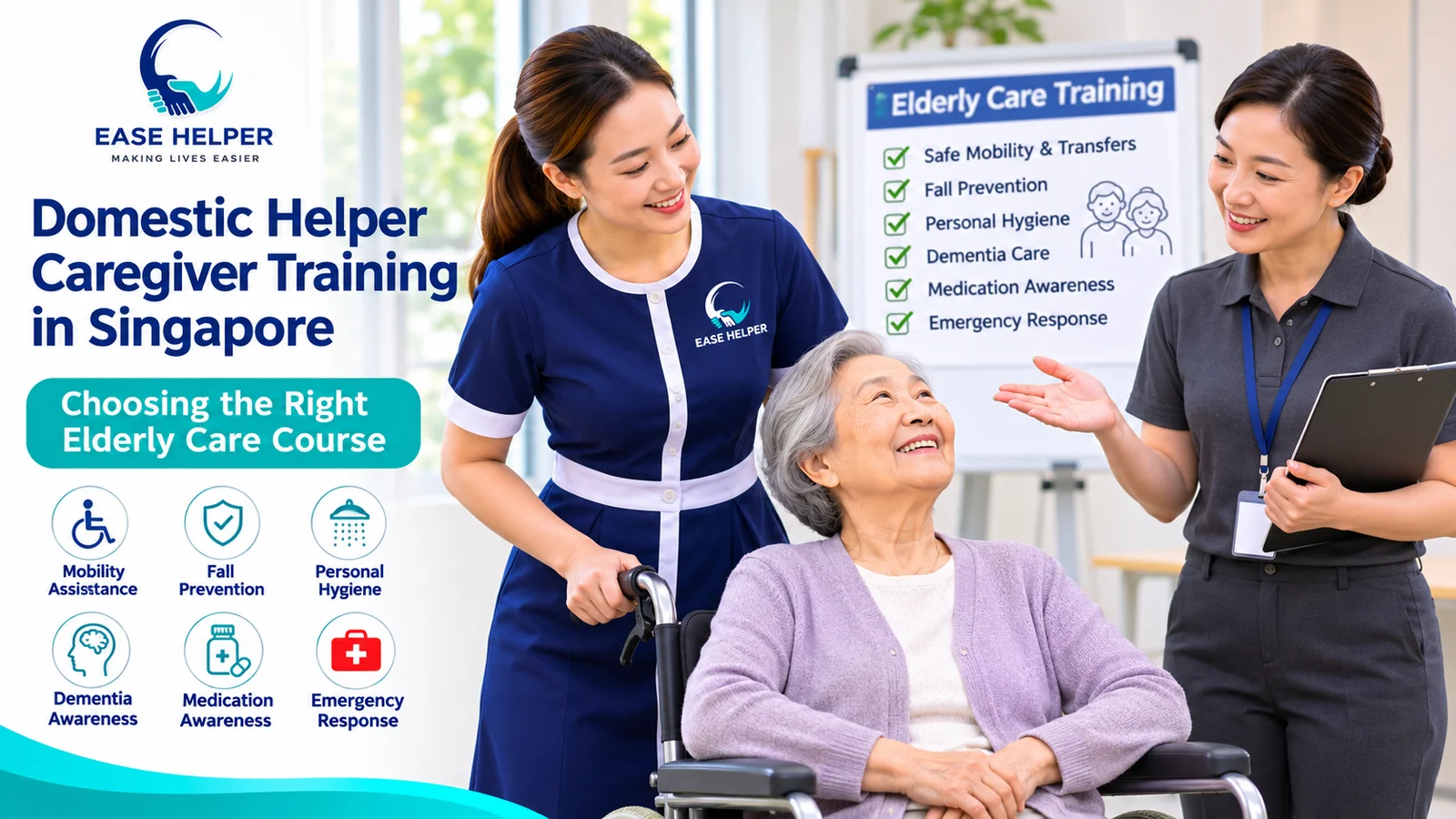
Domestic helper caregiver training in Singapore helps helpers develop practical skills for supporting elderly family members safely and respectfully. Depending on the senior’s needs, an elderly care course may cover mobility assistance, fall prevention, personal hygiene, dementia awareness, communication and emergency response. Although specialised caregiver training is not generally compulsory under MOM rules, employers should consider suitable courses before assigning unfamiliar care duties. This guide explains how to assess training needs, compare providers, understand available grants and support learning at home.
1. Why Domestic Helper Caregiver Training Matters in Singapore
Many Singapore households rely on domestic helpers to support elderly parents or grandparents. However, caring for an older person often requires more than general housekeeping skills.
For example, an elderly family member may need help walking, bathing, eating or moving between a bed and wheelchair. Others may experience memory difficulties, reduced mobility or changing medical needs.
As a result, domestic helper caregiver training can improve confidence and help families manage everyday care more safely.
Suitable training can help a helper:
- Assist with daily activities while respecting the senior’s dignity.
- Recognise common household fall hazards.
- Use mobility equipment correctly after appropriate instruction.
- Communicate with seniors who have hearing or memory difficulties.
- Support personal hygiene and daily routines.
- Recognise warning signs and seek timely assistance.
- Understand the limits of her caregiving responsibilities.
Importantly, training should match the care recipient’s condition. A helper supporting an independent senior may need different skills from someone assisting a bedbound person.
2. Is Elderly Care Training Mandatory for Domestic Helpers?
As of November 2026, the Ministry of Manpower (MOM) does not generally require all new migrant domestic workers to attend specialised elderly care training.
In its September 2026 parliamentary response, MOM explained that different households have different caregiving needs. Therefore, employers are best placed to determine which skills their helpers require.
Nevertheless, MOM encourages employers to arrange appropriate training. First-time migrant domestic workers must attend the separate mandatory Settling-in Programme, but this is not a substitute for specialist eldercare instruction.
For official guidance, see MOM’s parliamentary answer on caregiving training.
3. Assess Your Elderly Family Member’s Care Needs First
Before selecting a course, employers should identify the tasks the domestic helper will perform. This helps prevent unnecessary training and highlights skills that require professional instruction.
Start by considering the senior’s mobility, memory, personal care needs and existing healthcare arrangements.
| Care Situation | Possible Support Needed | Training Priority |
|---|---|---|
| Independent senior | Companionship, meals and household routines | Communication, nutrition awareness and fall prevention |
| Senior with limited mobility | Walking assistance and use of mobility aids | Safe movement and equipment handling |
| Wheelchair user | Transfers and wheelchair positioning | Supervised transfer techniques and pressure care awareness |
| Person with dementia | Daily routines, reassurance and supervision | Dementia communication and behaviour support |
| Bedbound senior | Personal hygiene and repositioning assistance | Specialist handling, skin care awareness and professional care planning |
| Senior recovering from hospitalisation | Support with a prescribed recovery routine | Condition-specific training guided by healthcare professionals |
For complex conditions, employers should consult the senior’s healthcare team before deciding which duties a helper can safely perform.
4. Essential Skills an Elderly Care Course Should Cover
A suitable elderly care course should combine practical demonstrations with clear explanations. Moreover, learners should have opportunities to ask questions and receive feedback.
| Training Area | Skills to Look For | Why It Matters |
|---|---|---|
| Mobility assistance | Safe walking support and correct use of aids | Helps reduce falls and handling injuries |
| Transfer techniques | Bed-to-chair and wheelchair transfers | Protects both the senior and caregiver |
| Personal hygiene | Bathing, grooming and toileting support | Maintains comfort and dignity |
| Dementia awareness | Communication, reassurance and daily routines | Supports people with memory difficulties |
| Nutrition and hydration | Meal assistance and recognising concerns | Supports everyday well-being |
| Medication awareness | Following written instructions and reporting problems | Reduces preventable medication errors |
| Emergency awareness | Recognising warning signs and contacting help | Supports timely medical attention |
| Caregiver well-being | Safe workload management and seeking support | Helps reduce stress and burnout |
However, not every course covers all these areas. Employers should compare the syllabus against their household’s actual needs.
5. Mobility Assistance and Safe Transfer Training
Helping an elderly person move safely can be physically demanding. Therefore, mobility training is especially important when the senior uses a wheelchair, walking frame or other mobility aid.
Training may cover:
- Checking the surrounding area for obstacles.
- Encouraging the senior to move at a comfortable pace.
- Using walking aids according to professional instructions.
- Positioning a wheelchair safely before a transfer.
- Recognising when a transfer requires additional assistance.
- Protecting the caregiver’s posture and avoiding unsafe lifting.
For example, a helper should not attempt to lift a heavy or unstable person alone without suitable equipment, training and a safe care plan.
Safety reminder: Transfer techniques must match the person’s mobility and medical condition. A physiotherapist, occupational therapist or appropriately qualified trainer should assess complex transfer needs. Do not rely on generic lifting instructions for every senior.
6. Fall Prevention and Home Safety
Falls can have serious consequences for older adults. Fortunately, families can reduce many household hazards through practical planning.
An elderly care course should help helpers identify common risks, including slippery bathroom floors, poor lighting, loose rugs and cluttered walkways.
Useful preventive measures include:
- Keeping walkways clear and well lit.
- Ensuring appropriate footwear and mobility aids are available.
- Checking that grab bars and other safety equipment remain secure.
- Keeping frequently used items within easy reach.
- Encouraging the senior to move slowly when changing position.
- Reporting dizziness, weakness or repeated near-falls promptly.
Additionally, employers should seek professional advice about home modifications when a senior has significant mobility difficulties.
7. Personal Hygiene, Toileting and Bathing Assistance
Personal care can be sensitive for elderly family members. Consequently, training should emphasise privacy, respectful communication and consent.
Practical lessons may include:
- Preparing towels, clothing and supplies before bathing.
- Checking water temperature and bathroom safety.
- Assisting with grooming and oral hygiene.
- Supporting toileting routines respectfully.
- Changing adult diapers hygienically where required.
- Recognising skin irritation or discomfort that needs attention.
Furthermore, a helper should never leave a senior who requires close supervision alone in an unsafe bathing situation.
For bedbound seniors, employers should arrange specialised instruction on personal hygiene, repositioning and skin care. The appropriate care plan may require professional nursing input.
8. Dementia Care Training for Domestic Helpers
Dementia can affect memory, communication, judgment and behaviour. Therefore, helpers who support someone living with dementia may benefit from specialised training.
For example, a senior may repeat questions, become confused about the time or struggle to explain discomfort.
Suitable training can teach helpers to:
- Speak slowly and use short, clear sentences.
- Maintain a calm and respectful tone.
- Follow familiar daily routines.
- Offer simple choices instead of complicated instructions.
- Recognise possible causes of distress.
- Report sudden changes in behaviour or awareness.
- Seek assistance rather than arguing or forcing compliance.
Importantly, sudden confusion may signal an urgent medical problem rather than an expected change in dementia. Employers should seek medical assessment when appropriate.
Families can explore Agency for Integrated Care (AIC) resources for dementia-related caregiving support.
9. Medication Awareness and Medical Boundaries
Some elderly people take several medicines each day. As a result, medication routines require careful organisation and clear instructions.
However, a domestic helper should not independently diagnose conditions, change medicine doses or decide whether prescribed treatment is necessary.
Employers should provide a written medication plan from the appropriate healthcare professional and clarify the helper’s permitted role.
Training may help the helper:
- Recognise medicine names and scheduled times.
- Follow approved instructions without changing doses.
- Use a medication record when instructed.
- Report missed doses or unexpected reactions promptly.
- Know when to contact the family or healthcare team.
In addition, tasks such as injections, wound treatment, tube feeding or other clinical procedures may require specialist instruction and professional oversight. Employers should not assume a general eldercare certificate qualifies a helper to perform them.
10. Nutrition, Hydration and Mealtime Assistance
Nutrition and hydration are important parts of elderly care. Nevertheless, older adults may have difficulty chewing, swallowing or maintaining their appetite.
A suitable course can teach helpers to follow the senior’s prescribed meal plan, prepare an appropriate eating environment and report changes in food or fluid intake.
Useful skills include:
- Following dietary instructions from the family and healthcare team.
- Preparing meals with suitable textures where professionally recommended.
- Helping the senior sit in a safe position for meals.
- Observing coughing or difficulty swallowing during eating.
- Recording food or fluid intake when required.
- Reporting persistent poor appetite or signs of dehydration.
For example, a senior with swallowing difficulties may need assessment by a speech therapist. Helpers should not independently modify food textures or use unapproved feeding techniques.
11. Recognising Emergencies and Warning Signs
Caregivers need to recognise when a senior requires urgent help. However, training should focus on early recognition and appropriate escalation rather than medical diagnosis.
Potential emergency warning signs include:
- Sudden facial drooping, arm weakness or speech difficulty.
- Chest pain or severe difficulty breathing.
- Loss of consciousness or unresponsiveness.
- Seizures or sudden severe confusion.
- Serious injuries following a fall.
- Heavy bleeding or other immediately dangerous symptoms.
In Singapore, call 995 for an ambulance in a medical emergency.
Additionally, employers should provide the household address, emergency contacts and clear instructions on how to reach family members.
For a suspected stroke, severe chest pain or another medical emergency, seek immediate emergency assistance rather than waiting for symptoms to improve.
First aid and CPR should be learned through suitable practical training with qualified instructors.
12. Types of Elderly Care Courses in Singapore
Different training formats suit different households. Therefore, employers should choose a course based on the senior’s needs and the helper’s existing experience.
| Course Type | Typical Focus | Suitable For |
|---|---|---|
| Basic elderly care | Daily routines, hygiene and communication | Helpers new to eldercare |
| Mobility and transfer training | Walking support, wheelchairs and safe transfers | Families supporting seniors with reduced mobility |
| Dementia care training | Communication, behaviour and routines | Caregivers supporting people with dementia |
| Home-based training | Practical instruction using household equipment | Families with specific care arrangements |
| First aid and CPR | Emergency response and practical assessment | Caregivers who need emergency skills |
| Refresher course | Updating skills and addressing knowledge gaps | Experienced helpers taking on new responsibilities |
Course names and content vary by provider. As a result, employers should review the full syllabus before enrolling.
13. Where to Find Elderly Care Training Providers
Singapore has several organisations that provide caregiving information and access to training opportunities.
Employers can begin with:
- Agency for Integrated Care (AIC) for caregiver training, care services and funding information.
- SG Enable for disability-related caregiver resources.
- MOM’s caregiver training guidance for domestic helper employers.
- Established training organisations that offer practical elderly care, dementia care and first aid courses.
Moreover, MOM has highlighted caregiver training programmes that include classroom instruction and home-based options.
Before registering, confirm the provider’s current course dates, language, fees, assessment methods and eligibility requirements.
14. Caregivers Training Grant: Can Employers Receive Support?
The Caregivers Training Grant (CTG) helps eligible caregivers pay for approved training courses.
According to MOM’s September 2026 parliamentary response, the grant was enhanced from 1 April 2024 to provide $400 per year per eligible care recipient.
Domestic helpers who provide care for eligible recipients may attend approved courses using the grant, subject to the applicable scheme conditions.
However, the grant is not automatically available for every household or every training course.
Therefore, employers should confirm:
- Whether the care recipient meets the eligibility criteria.
- Whether the selected course is approved under CTG.
- How much funding remains available for the care recipient.
- Whether the provider handles the application.
- The amount the household must pay after any subsidy.
For current grant rules and approved courses, check AIC’s official website before enrolling.
15. How Much Does Domestic Helper Elderly Care Training Cost?
Training fees depend on the provider, course duration, teaching format and level of practical instruction.
For example, a short group workshop may cost less than personalised home-based training. Meanwhile, specialised courses covering complex mobility needs may require additional sessions.
When comparing prices, consider:
- Course duration and number of lessons.
- Trainer qualifications and experience.
- Availability of practical exercises.
- Whether the trainer visits the household.
- Assessment and certificate arrangements.
- Travel costs, course materials and other charges.
- Available grants or subsidies.
Finally, ask for a complete fee breakdown and cancellation policy before making payment.
16. How to Choose the Right Elderly Care Course
A suitable course should match the helper’s duties and the senior’s condition. Therefore, employers should compare more than course titles and prices.
| Selection Factor | What to Check |
|---|---|
| Care needs | Does the course address the senior’s mobility, memory and personal care requirements? |
| Practical training | Can the helper practise techniques under supervision? |
| Trainer qualifications | Does the trainer have relevant caregiving or healthcare expertise? |
| Language | Can the helper understand the lessons and ask questions? |
| Assessment | Does the provider evaluate practical skills or only record attendance? |
| Home application | Can the skills be adapted safely to the household’s equipment and routines? |
| Funding | Does the course qualify for available financial support? |
| Schedule | Can the helper attend without compromising necessary rest? |
Above all, employers should not assume that a certificate alone guarantees competence. Instead, they should observe how the helper applies her training in a safe and supervised setting.
17. Questions to Ask the Training Provider
Before booking an elderly care course, ask the provider these practical questions:
- Does the course suit a beginner or an experienced caregiver?
- Which mobility and personal care skills will the trainer teach?
- Will the helper practise with appropriate equipment?
- Does the course cover dementia or condition-specific care?
- What qualifications and experience do the instructors have?
- Can the provider offer instruction in a language the helper understands?
- Does the course include a practical assessment?
- Is home-based instruction available?
- Can the household use the Caregivers Training Grant?
- What are the total fees, course dates and refund conditions?
In addition, ask whether the provider can recommend further training if the helper needs to manage more complex tasks.
18. Preparing Your Home for Elderly Care
Training works best when employers also provide a safe home environment. Therefore, families should review household arrangements before assigning new caregiving duties.
Consider the following:
- Keep pathways clear of clutter and loose cables.
- Ensure bathrooms have suitable safety features.
- Check that wheelchairs and mobility aids are in good condition.
- Keep emergency contacts readily available.
- Prepare written care instructions.
- Clarify which tasks require family or professional assistance.
- Provide suitable equipment for approved care procedures.
For example, a helper who has learned safe transfer techniques may still need guidance when using a particular wheelchair or bed at home.
Consequently, a home assessment by an occupational therapist or other qualified professional may be useful for seniors with significant mobility needs.
19. Evaluating Your Helper After Training
Course completion marks the beginning of practical learning. Afterwards, employers should observe whether the helper understands and applies the relevant skills.
A supervised assessment may include:
- Explaining how to reduce common fall risks.
- Demonstrating correct use of a walking aid.
- Describing the senior’s daily care routine.
- Communicating respectfully with the senior.
- Explaining when to seek assistance during transfers.
- Identifying important emergency warning signs.
- Following written care instructions accurately.
However, employers should not test unsafe lifting or clinical procedures without suitable professional supervision.
If the helper remains uncertain about a task, arrange additional instruction before assigning it independently.
20. Supporting the Well-Being of Domestic Helper Caregivers
Elderly care can involve physical effort, emotional stress and disrupted household routines. Therefore, employers should consider the domestic helper’s well-being alongside the senior’s needs.
MOM advises employers to provide reasonable workloads, adequate daily rest and weekly rest-day arrangements in line with applicable requirements.
Furthermore, employers should:
- Discuss caregiving expectations before employment begins.
- Explain new responsibilities clearly.
- Encourage the helper to report difficulties early.
- Provide suitable breaks and rest arrangements.
- Arrange additional family or professional support for demanding care needs.
- Consider respite care when continuous supervision is necessary.
For example, a helper should not be expected to provide uninterrupted overnight care while also completing a full day of household work without adequate rest.
Families can explore respite and community care services through AIC.
21. Common Mistakes Employers Should Avoid
Even well-intentioned employers can overlook important training needs. Fortunately, careful planning can prevent many common problems.
| Common Mistake | Why It Matters | Better Approach |
|---|---|---|
| Assuming housekeeping experience equals caregiving experience | Elderly care requires additional skills | Assess relevant caregiving experience |
| Choosing the cheapest course only | Practical instruction may be limited | Compare syllabus and training quality |
| Ignoring the senior’s condition | Generic training may not address actual needs | Select condition-appropriate instruction |
| Skipping mobility training | Unsafe transfers may injure both people | Arrange professional practical training |
| Expecting the helper to perform clinical tasks | Specialised procedures may require professional care | Clarify medical boundaries |
| Ignoring communication barriers | Instructions may be misunderstood | Use understandable language and demonstrations |
| Overlooking caregiver fatigue | Exhaustion can affect safety and well-being | Provide rest and additional support |
| Assuming a certificate guarantees competence | Assessment standards vary | Review practical skills after training |
22. Create a Written Elderly Care Plan
A written care plan helps employers and helpers follow consistent routines. Moreover, it reduces confusion when different family members provide instructions.
The plan may include:
- Daily meals and hydration instructions.
- Mobility assistance and equipment guidance.
- Bathing, toileting and hygiene routines.
- Medication instructions from healthcare professionals.
- Medical appointments and transport arrangements.
- Known allergies and important health information.
- Emergency contacts and escalation procedures.
- Tasks that the helper must not perform without supervision.
Update the plan when the senior’s condition changes. Additionally, ensure that the helper understands the instructions and knows whom to contact when questions arise.
Ultimately, domestic helper caregiver training works best when families combine suitable courses, practical supervision, clear communication and ongoing support.
Frequently Asked Questions
1. Is elderly care training compulsory for domestic helpers in Singapore?
No. As of November 2026, MOM does not generally require every new domestic helper to complete specialised elderly care training. However, employers should arrange suitable instruction when their household requires caregiving skills.
2. Can a domestic helper without elderly care experience attend a caregiver course?
Yes. Introductory courses can help beginners learn daily care skills. Nevertheless, employers should confirm that the programme includes appropriate practical training and matches the senior’s needs.
3. How much funding is available under the Caregivers Training Grant?
MOM states that the grant was enhanced to $400 per year per eligible care recipient from 1 April 2024. However, funding depends on the scheme’s eligibility rules, approved courses and available balance. Employers should confirm current details with AIC.
4. Can a trained domestic helper perform nursing procedures?
Not automatically. General caregiver training does not qualify a helper to perform every clinical procedure. Therefore, employers should seek guidance from qualified healthcare professionals before assigning specialised medical tasks.
5. What is the best elderly care course for a domestic helper?
The best course depends on the senior’s condition and the helper’s responsibilities. For example, a helper assisting a wheelchair user may need transfer training, while someone supporting a person with dementia may benefit from specialised communication and behaviour support lessons.
Looking for a Domestic Helper to Support Elderly Family Members?
Every household has different caregiving needs. EaseHelper helps Singapore employers consider domestic helpers’ experience, communication abilities and suitability for elderly care responsibilities.
Discuss your family’s requirements with EaseHelper and explore suitable domestic helper options.
Explore EaseHelper ServicesDisclaimer: This article provides general educational information for employers and domestic helpers in Singapore. Caregiving courses, grants, eligibility requirements and MOM policies may change. Training does not replace professional medical advice, nursing services, rehabilitation assessment or emergency treatment. Families should consult qualified healthcare professionals about complex caregiving needs. In a medical emergency in Singapore, call 995.