
Blog
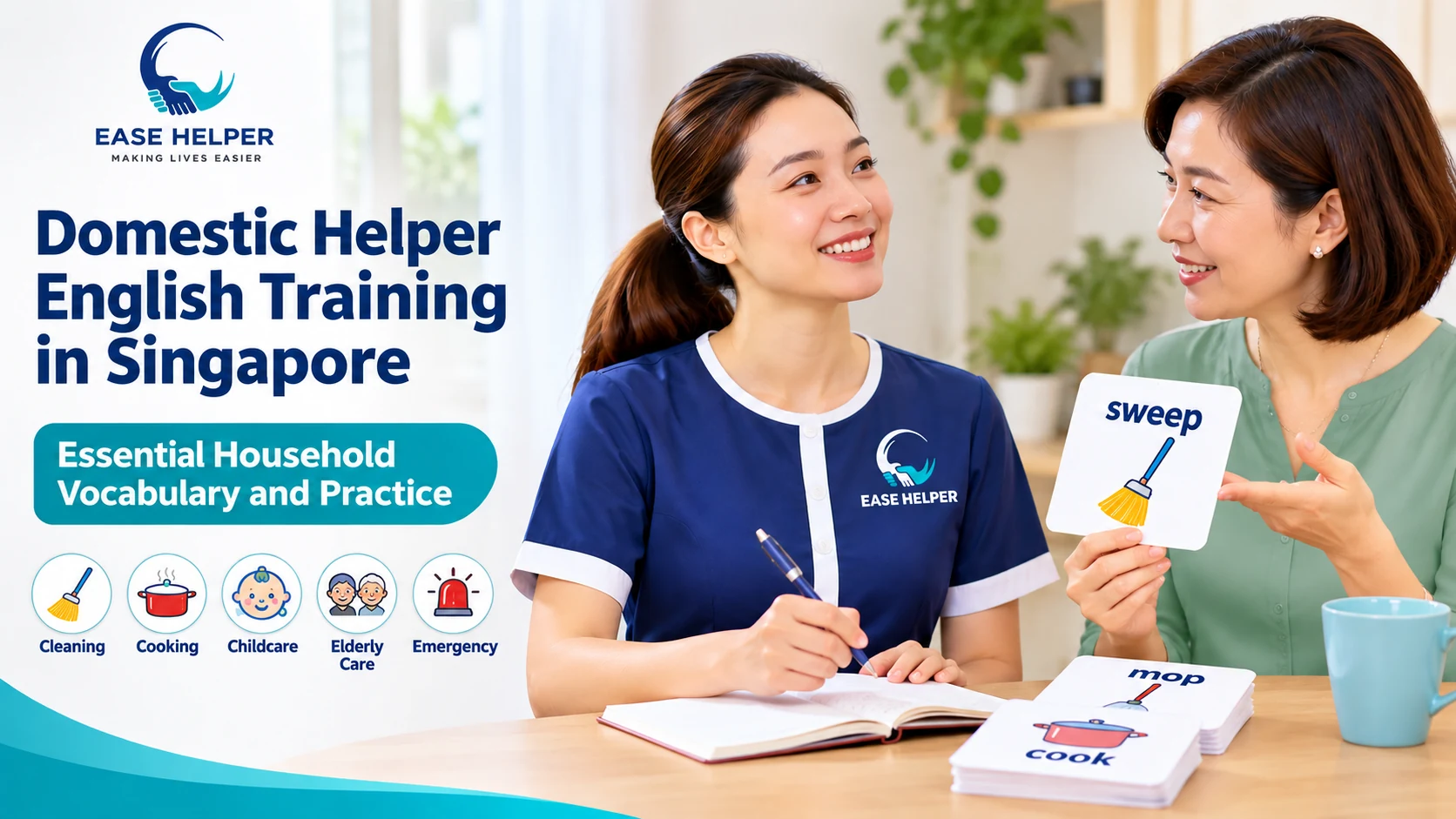
Domestic Helper English Training in Singapore: Essential Household Vocabulary and Practice

Executive Summary
Domestic helper English training in Singapore helps domestic helpers understand household instructions, communicate confidently and perform daily responsibilities safely. Employers can start with essential vocabulary for cleaning, cooking, childcare, elderly care and emergencies. Short lessons, visual demonstrations and regular speaking practice can help helpers from Myanmar, Indonesia and other approved source countries improve their English gradually. The goal is effective everyday communication, not perfect grammar.
1. Why Domestic Helper English Training Matters in Singapore
Singapore households often communicate in English, Mandarin or a mixture of languages. Some employers also use Singlish expressions that may be unfamiliar to newly arrived domestic helpers.
As a result, a helper may misunderstand an instruction even when she has previous domestic work experience. This does not necessarily indicate poor working ability. She may simply need time to become familiar with the family’s language and routines.
Practical English training can help domestic helpers:
- Understand daily cleaning and cooking instructions.
- Recognise important household safety warnings.
- Communicate clearly with children and elderly family members.
- Ask questions when instructions are unclear.
- Report household problems and emergencies promptly.
- Build confidence when shopping or using public transport.
Employers can consult the Ministry of Manpower (MOM) for official guidance on employing migrant domestic workers in Singapore.
2. Start with Essential Household English Vocabulary
The most effective domestic helper English training begins with words that the helper encounters every day. Therefore, employers should introduce vocabulary according to the helper’s actual responsibilities.
Cleaning and Housekeeping Vocabulary
| English Word | Meaning or Use | Example Instruction |
|---|---|---|
| Sweep | Remove dust using a broom | Please sweep the kitchen floor. |
| Mop | Clean the floor using a mop | Please mop the living room. |
| Wipe | Clean a surface using a cloth | Wipe the dining table. |
| Rinse | Wash briefly with clean water | Rinse the vegetables thoroughly. |
| Scrub | Clean by rubbing firmly | Scrub the sink gently. |
| Fold | Arrange clothing neatly | Fold the clean towels. |
| Separate | Keep different items apart | Separate white and coloured clothes. |
| Disinfect | Use a suitable product to reduce germs | Disinfect the approved surface as instructed. |
Employers can demonstrate each task while saying the corresponding English sentence. Repetition in real situations often makes vocabulary easier to remember.
Kitchen and Cooking Vocabulary
| English Word | Meaning or Use | Example Instruction |
|---|---|---|
| Chop | Cut food into smaller pieces | Chop the carrots into small pieces. |
| Slice | Cut food into thin pieces | Slice the cucumber. |
| Boil | Cook in boiling liquid | Boil the water. |
| Steam | Cook using steam | Steam the vegetables. |
| Stir | Mix food with a spoon or utensil | Stir the soup gently. |
| Refrigerate | Place food in the refrigerator | Refrigerate the leftovers promptly. |
| Expiry date | Date printed on a product | Check the expiry date before using it. |
In addition, teach the names of frequently used kitchen equipment, including the rice cooker, refrigerator, chopping board, frying pan and measuring cup.
3. Teach Useful English Sentences for Daily Household Tasks
Knowing individual words is helpful, but helpers also need to understand complete instructions. Start with short sentences before introducing longer explanations.
Common Employer Instructions
- “Please clean the bathroom after breakfast.”
- “Put the clean clothes in the wardrobe.”
- “Please wash your hands before preparing food.”
- “Use a separate chopping board for raw meat.”
- “Let me know when the groceries are running low.”
- “Please check with me before using a new cleaning product.”
Useful Responses for Domestic Helpers
- “Yes, I understand.”
- “Could you please repeat that?”
- “Can you show me how to do it?”
- “Should I do this now or later?”
- “I have finished the cleaning.”
- “I am not sure. May I check with you?”
Encourage helpers to ask for clarification instead of guessing. This is particularly important when instructions involve children, elderly people, food preparation or potentially dangerous equipment.
4. Domestic Helper English Training for Childcare
When a helper assists with childcare, she should understand basic vocabulary related to feeding, hygiene, routines and safety.
| Vocabulary | Practical Example |
|---|---|
| Nap time | “The child usually takes a nap after lunch.” |
| Diaper | “Please tell me when the diaper needs changing.” |
| High chair | “Make sure the child is safely secured in the high chair.” |
| Allergy | “The child has a food allergy. Please follow the written instructions.” |
| Fever | “Tell me immediately if the child develops a fever.” |
| Choking | “Call for help immediately if the child is choking.” |
However, vocabulary lessons alone do not qualify a helper to handle childcare emergencies. Employers should provide practical safety training and ensure that the helper knows when to seek immediate assistance.
For important childcare information, keep written instructions and emergency contacts readily accessible.
5. Essential English for Elderly Care
Helpers who support elderly family members may need additional vocabulary relating to mobility, personal care and daily routines.
Useful expressions include:
- “Are you feeling comfortable?”
- “Would you like some water?”
- “Please hold the handrail.”
- “Do you feel dizzy?”
- “Do you need help standing up?”
- “I will inform your family member.”
Employers should also explain words such as wheelchair, walking frame, handrail, appointment, pain and dizziness.
Safety reminder: A helper should not independently change medication doses, perform unfamiliar medical procedures or attempt unsafe lifting. Employers should provide appropriate instructions, supervision and practical caregiver training for the tasks involved.
Where an elderly family member primarily speaks Mandarin, Hokkien, Cantonese or another language, learning a few essential phrases in that language may be more useful than relying on English alone.
6. Teach Emergency English Before Advanced Vocabulary
Emergency communication deserves priority because a helper may need to explain a problem quickly and accurately.
Important Emergency Phrases
- “There is a fire.”
- “I smell gas.”
- “Someone has fallen.”
- “The child is having difficulty breathing.”
- “I need help immediately.”
- “Please call an ambulance.”
- “The person is unconscious.”
Teach the helper how to state the household address clearly and contact emergency services. In Singapore, the emergency numbers are 995 for ambulance and fire emergencies and 999 for police emergencies.
Practise short emergency conversations using hypothetical situations. Explain that she should prioritise immediate safety and seek appropriate emergency assistance rather than spending time searching for the correct English words.
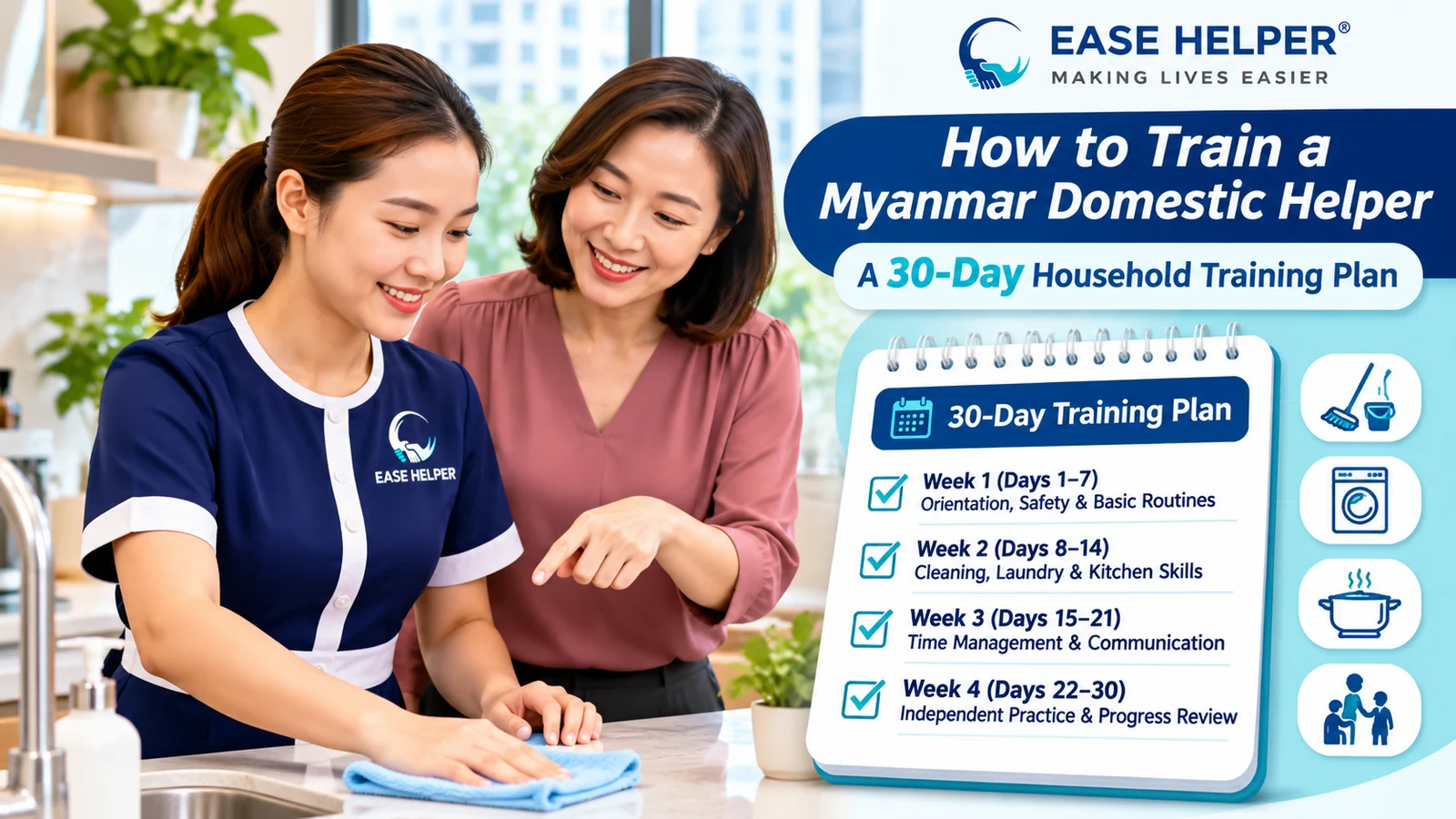
7. A Practical Four-Week Domestic Helper English Training Plan
Employers can use the following plan as a flexible starting point. Adjust the lessons according to the helper’s existing English ability and daily responsibilities.
| Week | Learning Focus | Suggested Practice | Expected Progress |
|---|---|---|---|
| Week 1 | Basic household words and greetings | Name objects, identify rooms and practise simple instructions | Recognise common household vocabulary |
| Week 2 | Cleaning, laundry and cooking | Practise task instructions during supervised demonstrations | Understand short work-related sentences |
| Week 3 | Childcare, elderly care and shopping | Use role-play conversations and shopping lists | Ask questions and report simple problems |
| Week 4 | Safety, emergencies and revision | Review emergency phrases and practise complete conversations | Communicate more confidently in familiar situations |
Short sessions of approximately 10–15 minutes can work well when they fit comfortably into the helper’s schedule. These are suggested practice durations, not formal training requirements.
8. Five Effective Methods for Teaching English at Home
Method 1: Use Real Household Objects
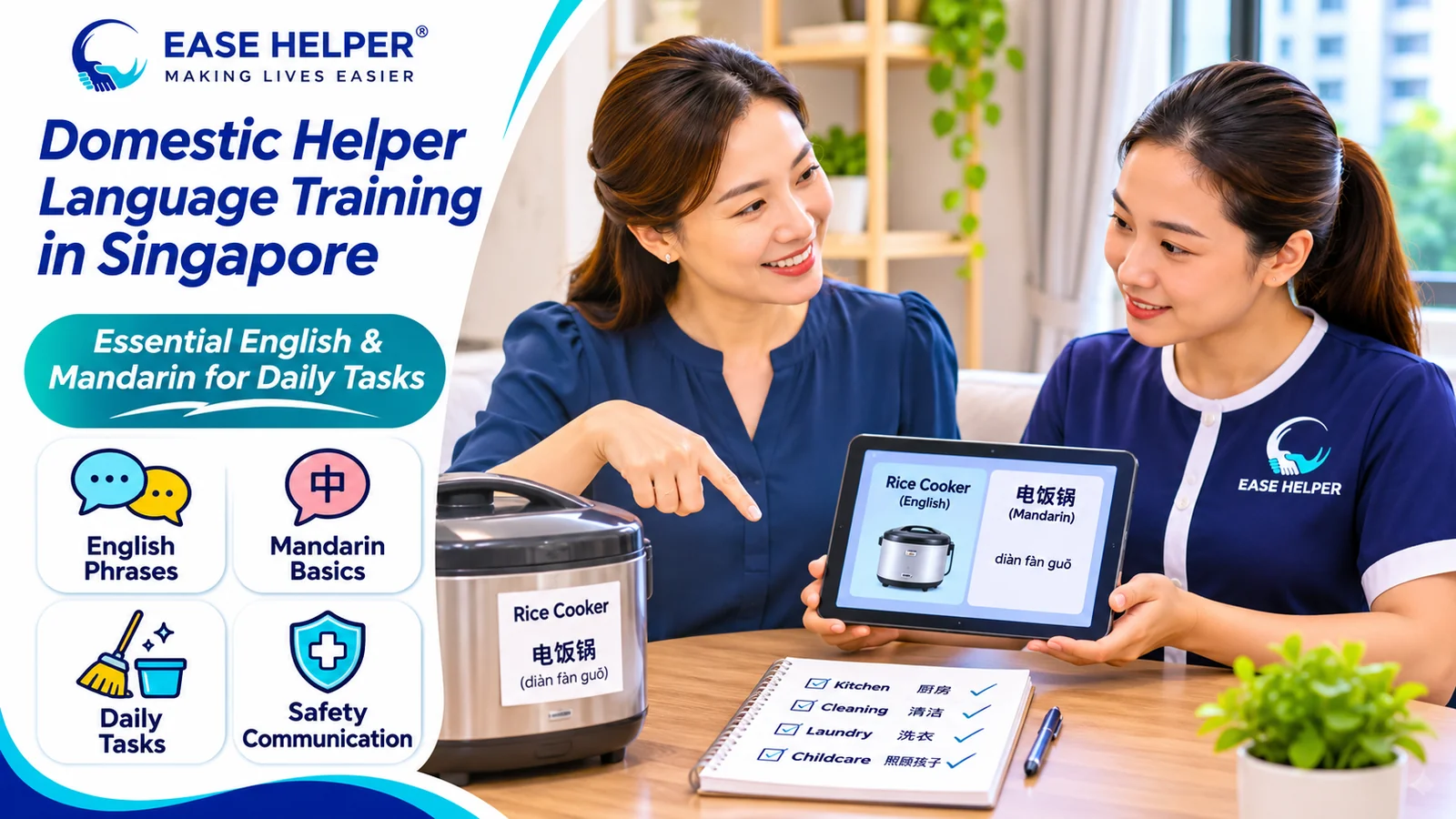
Point to familiar items such as a broom, towel, kettle or chopping board. Say the English word clearly and invite the helper to repeat it. Then demonstrate how the object is used.
Method 2: Create a Picture Vocabulary List
Prepare a small illustrated vocabulary guide showing important household items. Include English words and, where useful, translations into the helper’s preferred language.
Method 3: Practise Short Conversations
Use everyday scenarios such as receiving grocery instructions, answering the door or reporting a broken appliance. Role-play allows the helper to practise speaking without the pressure of an actual problem.
Method 4: Repeat and Review
Review previously learned words before introducing new vocabulary. For example, ask the helper to identify five familiar kitchen objects before beginning the next lesson.
Method 5: Give Encouraging Feedback
Correct mistakes politely and demonstrate the intended meaning. Avoid embarrassment or criticism. The objective is clear communication rather than perfect pronunciation or grammar.
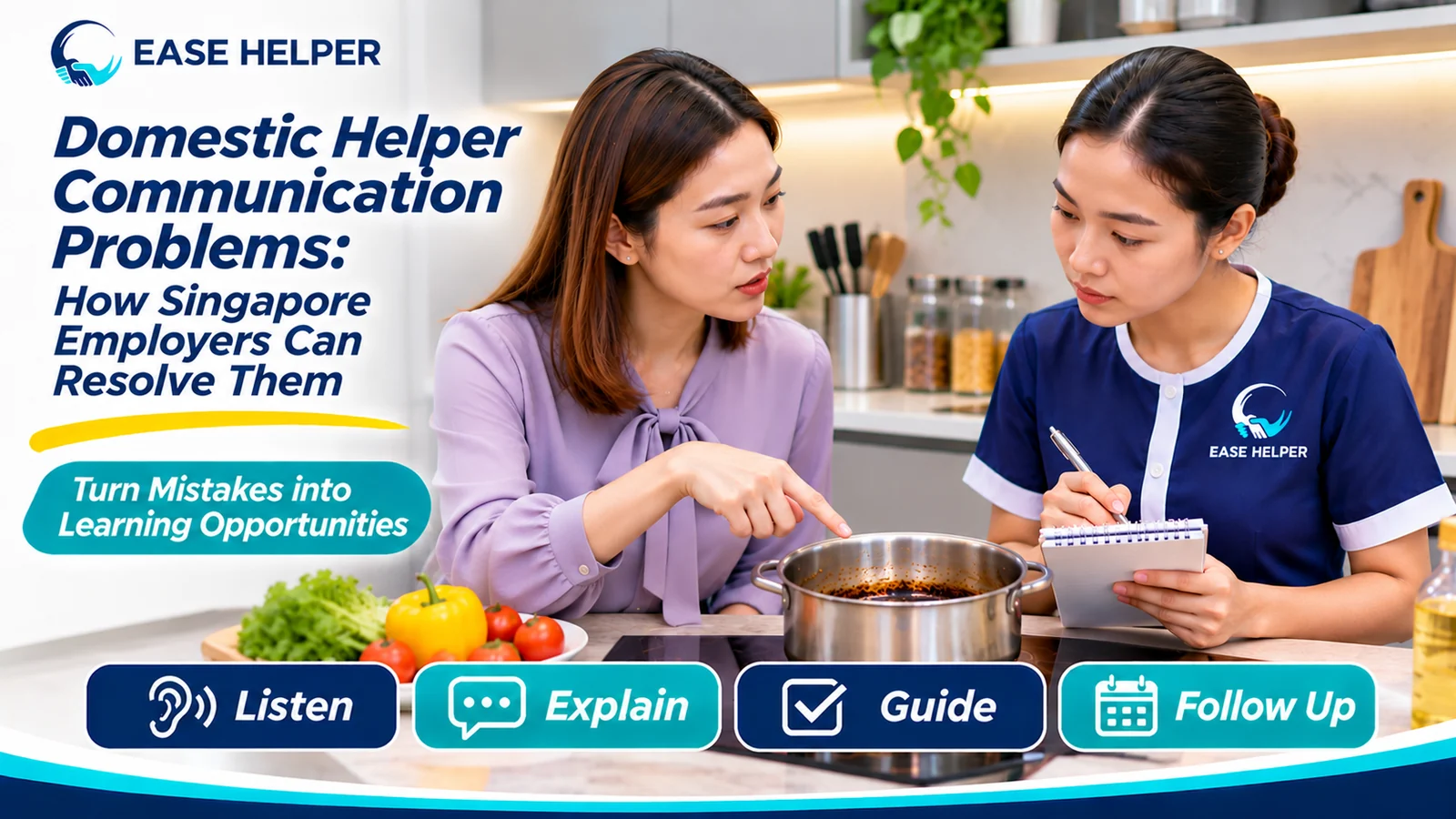
9. Common Mistakes Employers Should Avoid
| Common Mistake | Why It Causes Problems | Better Approach |
|---|---|---|
| Speaking too quickly | Important words may be missed | Speak clearly and pause between instructions |
| Using unfamiliar Singlish expressions | The helper may misunderstand local phrases | Use simple standard English first |
| Teaching too many words at once | New information becomes difficult to remember | Introduce small groups of useful words |
| Correcting every minor grammar error | The helper may become hesitant to speak | Focus first on understanding and safety |
| Assuming silence means understanding | Unclear instructions may remain unresolved | Invite questions and ask for a practical demonstration |
| Using English alone for safety-critical instructions | Important details may be misunderstood | Use translation, demonstrations and written guidance when necessary |
10. Should You Enrol Your Domestic Helper in an English Course?
Some helpers benefit from structured lessons outside the household, particularly when they want to improve conversational confidence, listening skills or everyday vocabulary.
When evaluating a course, consider:
- Language level: Does the course welcome beginners or require basic English knowledge?
- Learning objectives: Does it focus on everyday conversation or more advanced academic English?
- Practical content: Are speaking, listening and common real-life situations included?
- Schedule: Can the helper attend without compromising her rest arrangements or well-being?
- Accessibility: Is the location convenient, and are online lessons available?
- Cost: Are course fees, materials and other charges clearly explained?
Employers can check MOM’s official website and relevant training providers for current learning opportunities.
Course availability, fees, eligibility and schedules can change. Therefore, check directly with the provider before enrolling.
11. How to Measure Your Helper’s English Progress
Rather than testing grammar alone, evaluate whether the helper can communicate effectively during familiar household tasks.
For example, employers can review whether she can:
- Identify ten commonly used household objects.
- Follow simple two-step instructions.
- Ask for clarification when necessary.
- Explain when a task has been completed.
- Report a problem using a short sentence.
- Recognise important safety and emergency vocabulary.
Progress may vary depending on previous education, confidence, language exposure and learning opportunities. Celebrate gradual improvements and continue providing support.
12. Build English Practice Into Everyday Household Routines
The best learning opportunities often happen during ordinary activities. For example, employers can explain new words while preparing a shopping list, demonstrate laundry instructions or practise short conversations after reviewing the household schedule.
Nevertheless, language lessons should remain reasonable and supportive. A helper also needs adequate time for meals, rest and personal activities.
For official guidance on employment conditions, employers can refer to the MOM Work Permit information for migrant domestic workers.
Ultimately, domestic helper English training works best when both parties participate. Employers should communicate patiently, while helpers should feel comfortable asking questions and explaining difficulties.
Frequently Asked Questions
1. Is English training compulsory for domestic helpers in Singapore?
There is no general requirement for every domestic helper to complete a separate English language course. However, employers should ensure that their helpers understand the instructions needed to perform their duties safely. First-time migrant domestic workers must attend MOM’s mandatory Settling-in Programme, which is different from an optional English course.
2. How long does it take a domestic helper to improve her English?
Improvement depends on her starting level, previous experience and opportunities to practise. Some helpers become more comfortable with familiar household instructions within several weeks, while broader conversational ability may take longer.
3. What English vocabulary should a new domestic helper learn first?
Start with everyday household objects, cleaning instructions, cooking vocabulary, simple questions and emergency phrases. Choose words based on the family’s actual needs rather than memorising long vocabulary lists.
4. Can employers teach their domestic helpers English at home?
Yes. Employers can use short conversations, demonstrations, pictures and simple role-play activities. However, professional language classes may provide additional structure for helpers who want more comprehensive learning.
5. What should employers do when a helper does not understand English instructions?
Repeat the instruction slowly, use simpler words and demonstrate the task. Translation tools and written instructions may also help. For safety-critical responsibilities, confirm understanding through an appropriate demonstration rather than relying only on verbal agreement.
Find a Domestic Helper Who Suits Your Household
Every Singapore household has different language preferences, daily routines and caregiving needs. EaseHelper helps employers consider domestic helpers’ experience, communication abilities and suitability for their family requirements.
Explore suitable domestic helper options and discuss your household’s priorities with our team.
Explore EaseHelper ServicesDisclaimer: This article provides general educational information for Singapore employers and domestic helpers. Vocabulary lists, training schedules and learning activities are suggestions rather than official MOM requirements. Employers should refer to current MOM guidance for employment, safety and rest-day obligations. Language training does not replace practical safety instruction, professional caregiver training or emergency response procedures where these are needed.