Blog
Transfer Domestic Helper in Singapore: Process, Fees and Timeline

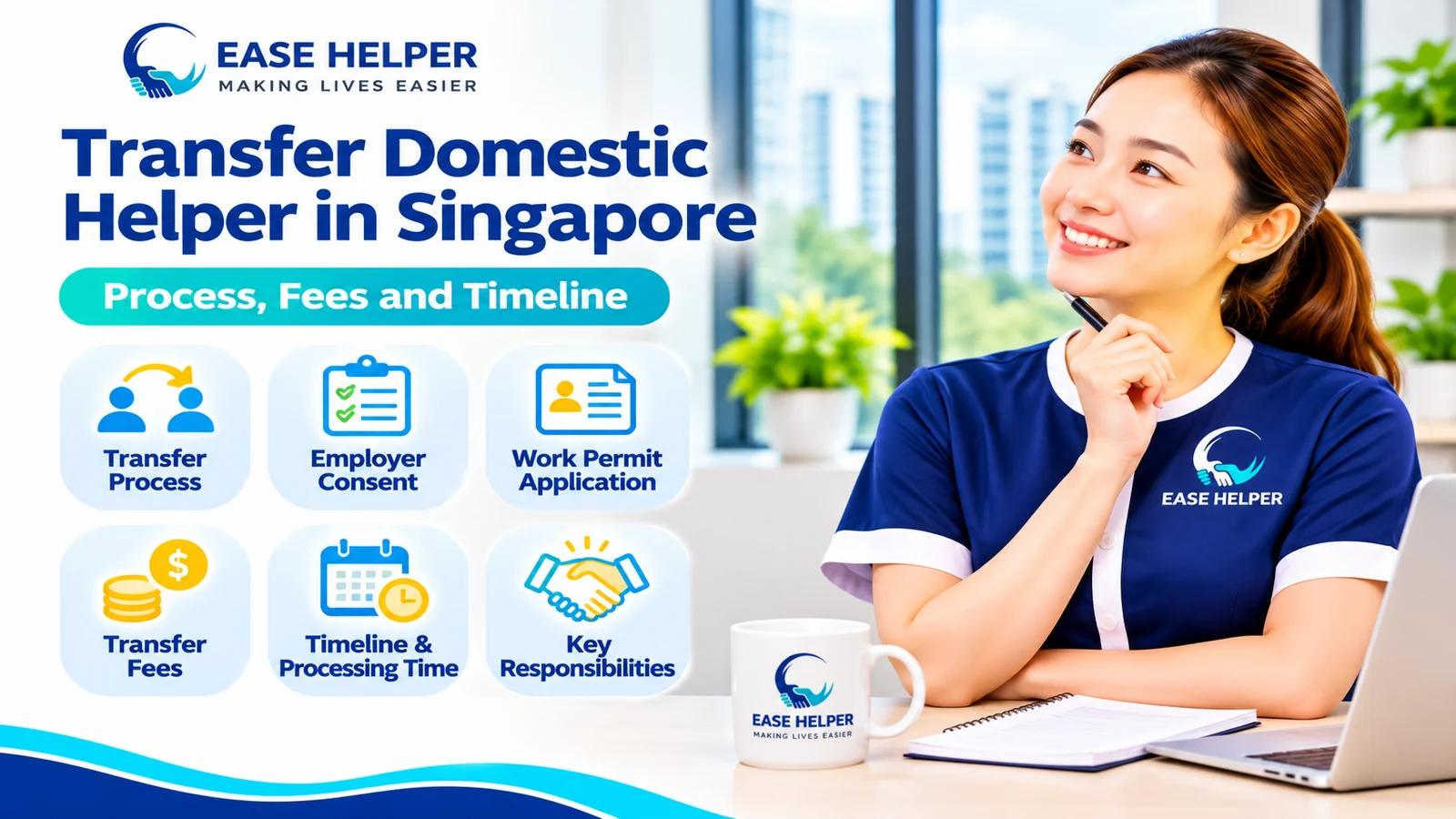
Hiring a transfer helper in Singapore is an option for families seeking a domestic helper who is already working in the country. Unlike recruiting someone from overseas, a transfer involves moving a helper from her current employer to a new employer through the appropriate Work Permit process.
However, the transfer is not simply a private agreement between two households. The current employer, prospective employer and helper must understand their responsibilities. In addition, the new employer must obtain the necessary approval and arrange a new Work Permit before employment begins.
This guide explains the transfer domestic helper process in Singapore, including consent, application steps, fees, timelines and practical considerations.
Executive Summary
A domestic helper transfer allows a helper who is already employed in Singapore to move to another employer, subject to the applicable requirements.
- Consent: The current employer must approve a direct transfer through MOM’s prescribed process.
- Application: The prospective employer applies for a new Work Permit.
- Processing: MOM generally provides an outcome within one week for the direct-transfer application.
- Timing: The initial steps must be completed at least 30 days before the existing Work Permit expires.
- Costs: Budget for Work Permit charges, insurance, security bond arrangements where applicable, agency services and ongoing employment expenses.
- Employment: The helper can begin working for the new employer only after the new Work Permit has been issued.
Early planning and clear communication help reduce delays, misunderstandings and unnecessary expenses.
1. What Is a Transfer Domestic Helper in Singapore?
A transfer domestic helper is a migrant domestic worker who is already in Singapore and is changing from one employer to another.
For example, a household may no longer require domestic support because its circumstances have changed. If the helper wishes to continue working in Singapore, a transfer to another eligible employer may be considered.
Likewise, a family seeking household support may prefer to interview a helper who has previous experience working in Singapore.
Nevertheless, a transfer requires the appropriate employer consent, Work Permit application and compliance with employment conditions.
2. Why Do Employers Consider Hiring a Transfer Helper?
Transfer helpers may offer several practical advantages, depending on their experience and the household’s requirements.
Previous experience in Singapore
A helper who has worked locally may already be familiar with Singapore household routines, public transport and common domestic responsibilities.
Opportunity for an in-person interview
Because the helper is already in Singapore, an in-person interview may be possible when properly arranged and agreed upon.
Potentially shorter deployment period
Some transfers may be completed without overseas travel arrangements. However, the actual timeline still depends on consent, approval and Work Permit issuance.
Opportunity to assess specific skills
Employers can discuss the helper’s experience in cleaning, cooking, childcare, elderly care or other relevant duties.
Experience alone does not guarantee suitability. Employers should still assess communication, expectations and compatibility.
3. Who Is Involved in a Domestic Helper Transfer?
Three parties are central to a direct transfer.
| Party | Main responsibilities |
|---|---|
| Current employer | Provide the required transfer consent, complete outstanding obligations and maintain responsibility until the transfer takes effect. |
| New employer | Apply for the new Work Permit, arrange required insurance and security bond, agree on the transfer date and complete issuance. |
| Domestic helper | Agree to the new employment arrangement, understand the proposed duties and terms, and sign the required declaration. |
An employment agency may also assist with interviews, documentation, coordination and the applicable administrative process.
4. Step-by-Step Process to Transfer a Domestic Helper
The following steps describe the direct-transfer procedure between two employers.
- Discuss the proposed transfer. Confirm that the helper wishes to transfer and that the current employer is prepared to provide the required consent.
- Check the existing Work Permit. Confirm its expiry date and ensure the helper has completed her required six-monthly medical examination.
- Request current employer consent. The new employer uses MOM’s FDW eService to initiate the consent request. The current employer receives an email requesting approval.
- Submit the Work Permit application. After consent is provided, the new employer proceeds with the application.
- Receive the application outcome. If approved, MOM issues the In-Principle Approval (IPA) and relevant declaration documentation.
- Prepare the required arrangements. Complete the IPA instructions, purchase qualifying insurance and arrange a security bond where applicable.
- Agree on the transfer date. Both employers coordinate the date on which the new Work Permit will be issued.
- Issue the new Work Permit. On the agreed date, the new employer completes issuance through the FDW eService, uploads the declaration and prints the Temporary Work Permit.
Once the new Work Permit is issued, the previous Work Permit is automatically cancelled.
Official reference: MOM — Transfer a migrant domestic worker directly to a new employer.
5. How Long Does a Transfer Helper Application Take?
MOM states that a direct-transfer Work Permit application generally receives an outcome within one week.
However, the overall transfer timeline can be longer because employers must first arrange consent, verify permit validity, complete insurance and bond requirements, and agree on a transfer date.
| Stage | Expected timing |
|---|---|
| Interview and agreement | Varies by household and helper availability |
| Current employer consent | Depends on the current employer’s response |
| Direct-transfer Work Permit application | Generally within one week |
| Insurance and bond arrangements | Depends on completion of required documentation |
| Work Permit issuance | On the agreed transfer date, within MOM’s deadline |
Important deadline: For a direct transfer, the new Work Permit must be issued by the earlier of 21 days after approval or the expiry of the current Work Permit. Employers should not wait until the final day to make arrangements.
6. What Happens if the Current Work Permit Is Expiring?
Work Permit expiry is one of the most important considerations when arranging a transfer.
MOM requires the initial checks and application steps for a direct transfer to be completed at least 30 days before the current Work Permit expires.
If the existing permit is approaching expiry, the current employer may need to request an extension where permitted.
The prospective employer should confirm the remaining validity before making commitments about the helper’s starting date.
Late applications or missed issuance deadlines can create immigration and employment complications.
7. Does the Current Employer Need to Agree to the Transfer?
Yes. A direct transfer requires the current employer’s consent through the prescribed MOM process.
The new employer initiates the request, and the current employer confirms consent using the FDW eService.
Employers should not assume that a verbal discussion alone completes the official transfer requirement.
The helper’s own willingness to enter the new employment arrangement is also essential. A prospective employer should discuss the proposed salary, duties, rest days and household expectations before proceeding.
8. What if the Current Employer Does Not Agree?
A direct transfer cannot simply proceed without the required consent.
Where there is disagreement, the parties should discuss their concerns and consider the available lawful options.
These may include continuing the existing employment, reaching an agreement on a transfer or making other arrangements consistent with MOM requirements.
An employment agency may help explain the process and coordinate communication. However, it cannot bypass the applicable consent and Work Permit requirements.
9. How Much Does It Cost to Hire a Transfer Helper?
The total cost depends on the recruitment arrangement, the helper’s agreed salary and the services required.
| Expense | Budget consideration |
|---|---|
| Work Permit application | S$35 government fee |
| Work Permit issuance | S$35 government fee |
| Agency service fee | Varies according to services and written quotation |
| Medical insurance | Premium depends on policy and required coverage |
| Personal accident insurance | Premium depends on policy and required coverage |
| Security bond arrangement | Applicable guarantee and arrangement costs |
| Monthly salary | Based on agreed employment terms |
| Monthly levy | Based on applicable MOM levy category |
| Food, accommodation and upkeep | Additional household expenses |
Agency quotations should clearly identify which charges are included and which must be paid separately.
Employers should also distinguish between an insurance coverage amount and the actual premium payable.
10. Who Pays the Levy During the Transfer?
For a direct transfer, the current employer remains responsible for the levy until the new employer issues the Work Permit.
After issuance, the existing Work Permit is automatically cancelled and the current employer’s levy billing stops.
The new employer then assumes the relevant obligations associated with the newly issued Work Permit.
Consequently, the agreed transfer date is important for both employers’ financial planning.
11. What Happens to the Security Bond?
The security bond is another important part of the transfer process.
For the current employer, MOM states that the security bond will be discharged one week after the helper starts working for the new employer, subject to the applicable conditions.
The new employer must arrange the required security bond before issuing the new Work Permit, where applicable.
Employers should not confuse the S$5,000 bond guarantee with an ordinary agency service fee.
12. Can a Domestic Helper Start Working Before the Transfer Is Approved?
No. A helper must not begin working for the prospective employer before the new Work Permit has been issued under that employer’s name.
Even if both households have agreed to the transfer, the helper remains under the existing employment arrangement until the official transfer takes effect.
Employers should avoid informal trial work or asking the helper to perform household duties before the new permit is issued.
13. Direct Transfer Versus Agency-Assisted Transfer
Domestic helper transfers may be arranged directly between employers or with assistance from an employment agency.
| Consideration | Direct transfer | Agency-assisted arrangement |
|---|---|---|
| Coordination | Employers arrange the required steps | Agency may coordinate the process |
| Candidate assessment | Prospective employer conducts assessment | Agency may assist with interviews and suitability assessment |
| Administration | Employers complete the required transactions | Agency may handle authorised transactions |
| Service fees | No agency fee if no agency is engaged | Agency service charges may apply |
| Responsibility during transition | Current employer remains responsible until transfer takes effect | May change if an agency formally takes over responsibility under MOM’s procedure |
Where an employment agency formally takes over responsibility for a helper pending placement, separate MOM conditions apply. The agency must provide appropriate upkeep, accommodation, food and medical care during the relevant period.
Official reference: MOM — Transfer through an employment agency.
14. How to Interview a Transfer Domestic Helper
A thorough interview helps determine whether the helper’s experience matches the household’s needs.
Useful questions include:
- What household duties have you performed in Singapore?
- Do you have experience caring for infants, children or elderly people?
- What meals are you comfortable preparing?
- Which household tasks require additional training?
- How do you prefer to receive daily instructions?
- What are your expectations regarding salary and rest days?
- What type of household arrangement are you looking for?
Employers should discuss duties respectfully and avoid making assumptions based solely on the helper’s previous employment history.
15. What Should Employers Check Before Confirming a Transfer?
Before proceeding, the prospective employer should review the following checklist.
- Confirm the helper’s willingness to transfer.
- Verify the current Work Permit expiry date.
- Check whether the required medical examination has been completed.
- Confirm current employer consent.
- Discuss salary, duties, accommodation and rest-day arrangements.
- Understand agency fees and refund terms, where applicable.
- Arrange qualifying insurance and the required security bond.
- Agree on a realistic transfer date.
- Ensure the new Work Permit is issued before employment begins.
These checks can help prevent avoidable delays and disagreements.
16. Common Mistakes During a Helper Transfer
Applying too close to Work Permit expiry
Late planning may leave insufficient time for consent, approval and issuance.
Assuming consent has already been recorded
The official consent process must be completed even when the parties have discussed the transfer privately.
Starting work before permit issuance
The helper cannot begin employment with the new household until the appropriate Work Permit is issued.
Overlooking the full cost
Employers should account for insurance, levy, bond arrangements and any agency charges, rather than focusing only on salary.
Failing to agree on expectations
Clear discussions about household duties, rest days and communication help both parties begin the new employment arrangement with realistic expectations.
17. How EaseHelper Can Assist with a Domestic Helper Transfer
EaseHelper assists Singapore households with domestic helper recruitment and placement arrangements.
For employers considering a transfer helper, our team can help clarify household requirements, coordinate suitable interviews and explain the relevant administrative steps.
We can also discuss the services included in the placement arrangement and the importance of complying with Work Permit requirements.
Our objective is to help employers make informed decisions while respecting the helper’s employment rights and the responsibilities of everyone involved.
Frequently Asked Questions
1. How long does it take to transfer a domestic helper in Singapore?
MOM generally provides an outcome within one week for a direct-transfer Work Permit application. However, the complete process may take longer because consent, documentation, insurance and the agreed transfer date must also be arranged.
2. Can I hire a transfer helper without the current employer’s consent?
A direct transfer requires the current employer’s consent through MOM’s prescribed process. Employers should not assume that an informal agreement or the helper’s preference alone is sufficient.
3. How much are the government Work Permit fees for a transfer helper?
The standard Work Permit application fee is S$35, and the issuance fee is S$35. Other expenses, including insurance, bond arrangements and agency services, may apply.
4. Can a transfer helper start work immediately after the interview?
No. The helper can start working for the new employer only after the new Work Permit has been issued under that employer’s name.
5. Is hiring a transfer helper cheaper than hiring a fresh helper?
Not necessarily. A transfer may avoid certain overseas recruitment or travel arrangements, but total costs depend on agency fees, insurance, employment terms and the specific placement circumstances.
Looking to Hire a Transfer Domestic Helper in Singapore?
EaseHelper can help you understand the transfer process, assess your household requirements and explore suitable placement arrangements.
Contact our team to discuss your family’s needs and the next steps.
Explore EaseHelperDisclaimer: This article provides general information and does not constitute legal or immigration advice. Transfer requirements, government fees, processing times and employment regulations may change. Always verify current rules with Singapore’s Ministry of Manpower and confirm the applicable arrangements before proceeding with a transfer.