Blog
Domestic Helper Public Holidays in Singapore: Are Employers Required to Give Time Off?

Executive Summary
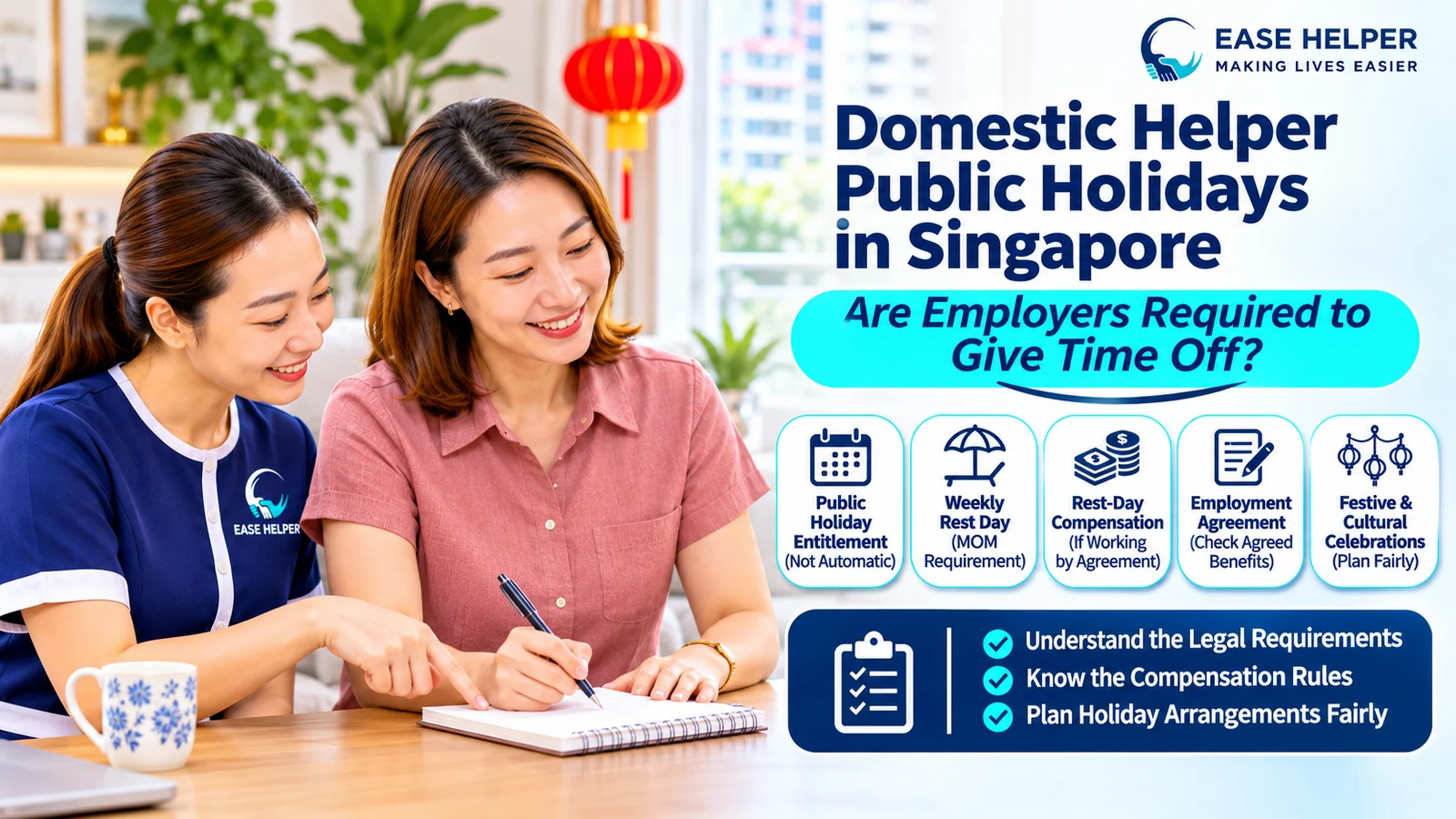
Domestic helper public holidays in Singapore follow different rules from public holidays for employees covered by the Employment Act. Employers do not automatically have to provide all 11 gazetted public holidays as paid days off. However, they must comply with MOM’s weekly rest-day requirements and honour agreed employment terms. This guide explains the differences, holiday pay, rest-day compensation and practical ways to plan household arrangements fairly.
Are Domestic Helpers Entitled to Public Holidays in Singapore?
Singapore celebrates 11 gazetted public holidays each year. However, domestic helpers do not automatically receive these holidays as statutory paid days off under the Employment Act.
The Ministry of Manpower (MOM) explains that migrant domestic workers are not covered by the Employment Act. Instead, their employment is regulated through the Employment of Foreign Manpower framework and applicable Work Permit conditions.
Therefore, employers should distinguish between statutory requirements and additional benefits agreed with their helpers.
For example, an employer may voluntarily offer Chinese New Year or Christmas as an extra day off. Alternatively, an employment agreement may already provide specific public holiday benefits.
In either case, employers should discuss the arrangements clearly and honour their commitments.
For official guidance, refer to MOM’s employment contract guidance for domestic workers.
Domestic Helper Public Holidays vs Weekly Rest Days
Public holidays and weekly rest days are not the same. In fact, they have different legal and practical implications.
Although domestic helpers do not automatically receive Employment Act public holiday benefits, MOM requires employers to provide weekly rest days.
| Arrangement | Requirement | Employer Consideration |
|---|---|---|
| Gazetted public holiday | No automatic Employment Act paid holiday entitlement for domestic helpers | Check agreed benefits and household arrangements |
| Weekly rest day | One rest day per week, subject to MOM rules | Agree on the day and document arrangements |
| Mandatory monthly rest day | At least one rest day each month cannot be compensated away | Ensure the helper actually takes the required rest |
| Working on an eligible rest day | Requires mutual agreement and at least one additional day’s salary | Calculate and record compensation correctly |
| Additional contractual holiday | Depends on the agreed employment terms | Honour paid or unpaid leave commitments |
Consequently, employers should never use public holiday arrangements to bypass mandatory rest-day requirements.
What Does MOM Require for Domestic Helper Rest Days?
MOM requires employers to provide their domestic helpers with one rest day each week. Furthermore, both parties must mutually agree on the rest-day arrangements.
If a helper agrees to work on a rest day that may legally be compensated, the employer must pay at least one additional day’s salary.
However, at least one rest day every month must be taken. Employers cannot replace that mandatory rest day with additional salary.
Important Rest-Day Rules
- Provide one rest day each week.
- Agree on the arrangements with the helper.
- Ensure at least one rest day each month is actually taken.
- Pay the required compensation for other rest days worked by mutual agreement.
- Keep clear records of rest days and payments.
- Update the agreed rest-day arrangements in the relevant MOM service when required.
Additionally, MOM allows flexible arrangements, such as taking one full day or two half days, subject to its conditions.
Read MOM’s official rest-day and well-being requirements for further information.
What Happens When a Public Holiday Falls on a Rest Day?
Sometimes, a gazetted public holiday falls on the helper’s agreed weekly rest day.
In this situation, the public holiday does not automatically create an additional statutory day off under the Employment Act.
However, the helper must still receive her rest day in accordance with MOM’s requirements.
For example, suppose a helper normally rests on Sunday and a public holiday also falls on Sunday. The employer should preserve the agreed rest-day arrangement unless both parties agree on a lawful alternative.
Furthermore, if the employment contract promises an additional public holiday benefit, the employer should follow that agreement.
Important: Do not automatically apply the Employment Act’s substitute public holiday rules to migrant domestic workers. Instead, check MOM’s domestic worker requirements and the employment agreement.
Must Employers Pay Extra for Work on Public Holidays?
Domestic helpers do not automatically qualify for the Employment Act’s public holiday pay provisions.
Therefore, working on a gazetted public holiday does not, by itself, create a statutory entitlement to double pay or another day’s salary under that Act.
However, additional compensation may be required under an agreed employment contract.
Moreover, if the public holiday is also an agreed weekly rest day and the helper works by mutual agreement, MOM’s rest-day compensation requirements apply. The mandatory monthly rest day cannot be compensated away.
Example: Public Holiday on a Normal Working Day
A family celebrates National Day at home. The helper’s normal working schedule continues, and the day is not her weekly rest day.
In this example, no automatic Employment Act public holiday premium applies. Nevertheless, the employer should honour any additional holiday benefits promised in the contract.
Example: Public Holiday on an Agreed Rest Day
A helper normally takes Sunday as her weekly rest day. A public holiday falls on that Sunday.
If the helper agrees to work and the day is not her mandatory monthly rest day, the employer must provide the required rest-day compensation.
Therefore, the payment arises from the rest-day arrangement rather than the public holiday itself.
How to Calculate Domestic Helper Rest-Day Compensation
MOM provides a standard method for calculating compensation when a helper agrees to work on an eligible weekly rest day.
First, divide the monthly salary by 26 working days. Then, multiply the result by the number of rest days worked that require compensation.
One day’s rest-day compensation = Monthly salary ÷ 26
Example Using a Monthly Salary of S$650
| Calculation | Amount |
|---|---|
| Monthly salary | S$650 |
| One day’s compensation | S$650 ÷ 26 = S$25 |
| Two eligible rest days worked | S$25 × 2 = S$50 |
| Total salary including compensation | S$700 |
This example assumes that the helper takes the required mandatory monthly rest day and that both parties agree on the other rest-day arrangements.
For the official formula, refer to MOM’s rest-day compensation calculation.
Can Employers Offer Additional Public Holiday Benefits?
Yes. Employers may provide additional public holiday benefits beyond the statutory requirements that apply to migrant domestic workers.
For example, some households choose to offer selected holidays as paid days off. Others provide extra rest time during important celebrations.
These arrangements can support a positive working relationship. However, employers should explain whether the additional time off is paid, unpaid or part of an agreed leave benefit.
Possible Voluntary Arrangements
- Offering selected public holidays as additional paid leave.
- Providing extra time off during major celebrations.
- Allowing the helper to attend religious or cultural activities.
- Adjusting non-essential household duties during festive periods.
- Agreeing on an alternative day off when appropriate.
Above all, employers should avoid creating uncertainty about whether an additional holiday replaces a weekly rest day or supplements it.
How Should Employers Handle Cultural and Religious Holidays?
Singapore households often employ helpers from Myanmar, Indonesia and other countries. Consequently, employers and helpers may celebrate different cultural or religious occasions.
For example, a helper may value time for Thingyan, Hari Raya or another important celebration.
Although these occasions do not automatically create an additional statutory leave entitlement, employers can discuss reasonable arrangements in advance.
Moreover, respecting personal traditions can improve communication and mutual understanding.
Practical Ways to Show Consideration
- Ask about important celebrations early.
- Discuss requests without making assumptions.
- Consider household caregiving needs.
- Explain whether additional leave is paid or unpaid.
- Document any changes to agreed schedules.
As a result, both parties can plan their commitments more confidently.
Planning Household Duties During Singapore Public Holidays
Public holidays often change a family’s normal routine. For instance, children may stay home from school, relatives may visit and household meals may require extra preparation.
Therefore, employers should discuss the expected workload before the holiday.
1. Review the Family Schedule
Identify planned outings, family meals and caregiving needs. Then, decide which tasks are genuinely necessary.
2. Confirm Rest-Day Arrangements
Check whether the holiday overlaps with the helper’s agreed rest day. If it does, preserve her legal entitlements.
3. Prioritise Essential Duties
Focus on necessary childcare, elderly care and household tasks. Meanwhile, consider postponing non-essential cleaning.
4. Share Instructions Clearly
Explain the day’s schedule in advance. Additionally, allow reasonable time for meals and rest.
5. Arrange Alternative Support
If the helper takes a rest day, arrange suitable family support or lawful external services where necessary.
These steps can reduce misunderstandings while supporting a more organised household.
Domestic Helper Public Holidays: Common Employer Mistakes
| Common Mistake | Why It Matters | Better Approach |
|---|---|---|
| Assuming all 11 public holidays are mandatory paid leave | The Employment Act rules do not automatically apply | Check the correct MOM framework |
| Assuming no rest-day obligations apply | Mandatory weekly and monthly rest-day rules still apply | Follow MOM’s rest-day requirements |
| Replacing the mandatory monthly rest day with money | This is not permitted | Ensure the helper actually takes the rest day |
| Ignoring agreed holiday benefits | Disputes may arise over employment terms | Honour written agreements |
| Changing holiday schedules without discussion | Creates confusion and frustration | Agree on arrangements in advance |
| Failing to record compensation | May lead to salary disputes | Maintain clear payment records |
Frequently Asked Questions About Domestic Helper Public Holidays
1. Do domestic helpers receive all 11 public holidays in Singapore?
No. Domestic helpers do not automatically receive the Employment Act’s 11 paid public holiday entitlements. However, employers must honour any additional holiday benefits agreed in the employment contract.
2. Can a domestic helper work on National Day or Chinese New Year?
Yes, if the day is part of her normal working schedule and the arrangement complies with applicable employment conditions. However, if it is her agreed rest day, MOM’s rest-day rules apply.
3. Must employers pay double salary on public holidays?
No automatic Employment Act public holiday premium applies to migrant domestic workers. Nevertheless, employers must honour contractual benefits and provide applicable rest-day compensation.
4. Can a public holiday replace a domestic helper’s weekly rest day?
A public holiday does not automatically replace or cancel a weekly rest day. Employers must continue to comply with MOM’s rest-day requirements and mutually agreed arrangements.
5. Can employers offer extra leave for religious celebrations?
Yes. Employers may voluntarily provide additional leave or rest time. Therefore, both parties should agree on the dates, payment arrangements and relationship to existing rest-day entitlements.
How EaseHelper Supports Employers in Singapore
Understanding domestic helper public holidays in Singapore helps employers distinguish legal requirements from voluntary employment benefits.
At EaseHelper, we support families with domestic helper recruitment and practical employment guidance. Furthermore, we encourage employers to establish clear expectations, communicate respectfully and refer to MOM for current regulatory requirements.
Whether your household needs childcare, elderly care or general household support, planning ahead can help create a more stable working relationship.
Looking for a Domestic Helper in Singapore?
EaseHelper helps Singapore families explore domestic helper recruitment options and understand important employment considerations.
Explore EaseHelper ServicesDisclaimer: This article provides general information and does not constitute legal advice. Domestic helper employment is subject to applicable Singapore laws, Work Permit conditions and mutually agreed employment terms. MOM requirements may change. Employers should consult the latest official MOM guidance for their circumstances.