Blog
Domestic Helper Communication Barriers in Singapore: How Employers Can Improve Understanding


Domestic helper communication barriers in Singapore can create misunderstandings even when employers and helpers have good intentions. Different languages, unfamiliar household routines and indirect instructions may make everyday tasks harder than necessary.
Fortunately, communication can improve through simple words, practical demonstrations and regular conversations. Employers do not need to speak their helper’s first language fluently. Instead, both parties can develop a shared approach that supports clarity, safety and mutual respect.
This guide explains common communication difficulties and offers practical ways to improve understanding in Singapore households.
Executive Summary
Clear communication helps employers and domestic helpers work together more effectively. Common barriers include language differences, unfamiliar vocabulary, indirect instructions and hesitation to ask questions.
Employers can improve understanding by speaking clearly, giving one instruction at a time, demonstrating unfamiliar tasks and using visual reminders. In addition, regular feedback allows both parties to clarify expectations before small misunderstandings become bigger problems.
For safety-related duties, employers should confirm understanding through practical demonstrations rather than relying only on verbal agreement.
1. Why Communication Matters in Singapore Households
Domestic helpers often work in homes where family members speak English, Mandarin, Malay, dialects or a combination of languages. Meanwhile, helpers may have different levels of familiarity with these languages.
As a result, a simple household instruction may be interpreted differently from what the employer intended.
For example, an employer might say, “Please settle the kitchen before lunch.” However, a newly arrived helper may not know whether this means washing dishes, wiping surfaces, preparing ingredients or completing every kitchen task.
Clear communication helps households:
- Reduce avoidable misunderstandings.
- Explain household expectations more consistently.
- Improve safety when using appliances and cleaning products.
- Support childcare and elderly care routines.
- Encourage helpers to ask questions when uncertain.
- Build a more respectful working relationship.
Therefore, communication should be treated as an ongoing part of household management rather than a one-time orientation.
2. Common Domestic Helper Communication Barriers
Communication difficulties do not always arise from limited English proficiency. Sometimes, the problem involves unfamiliar expressions, different expectations or insufficient explanations.
| Communication Barrier | Example | Practical Solution |
|---|---|---|
| Language differences | The helper does not understand an unfamiliar English word. | Use simpler vocabulary and demonstrate the task. |
| Singlish and local expressions | Instructions contain expressions the helper has never heard. | Use standard, straightforward English. |
| Multiple instructions | Several unrelated tasks are explained at once. | Break instructions into smaller steps. |
| Unclear expectations | “Clean properly” means different things to each person. | Show the expected result. |
| Hesitation to ask questions | The helper agrees despite feeling uncertain. | Invite questions and confirm understanding gently. |
| Different household habits | The helper follows a method used by a previous employer. | Explain the current household’s preferred method. |
Importantly, employers should avoid assuming that a misunderstanding reflects a poor attitude or unwillingness to learn.
3. Use Simple and Direct English
Clear instructions usually work better than long explanations filled with unfamiliar words.
For example, instead of saying, “When you have a chance, sort out the laundry and make sure everything is properly arranged,” an employer could say, “Please fold the clean clothes and put them in the bedroom cupboard.”
Five Ways to Make Instructions Clearer
- Use short sentences with familiar words.
- Explain one task before introducing another.
- Identify the location, item and expected result.
- Avoid slang or expressions that may cause confusion.
- Allow time for the helper to ask questions.
Furthermore, speak at a natural, measured pace. Speaking much louder does not necessarily make an instruction easier to understand.
4. Demonstrate Tasks Instead of Only Explaining Them
Visual demonstrations can bridge language gaps quickly. They also help employers show their preferred household standards.
For example, an employer can demonstrate how to separate laundry, operate a washing machine or arrange cleaning equipment.
A Simple Demonstration Method
- Show: Demonstrate the task at a comfortable pace.
- Explain: Describe the most important steps in simple language.
- Practise: Invite the helper to try while you provide guidance.
- Confirm: Check whether the helper understands the key safety points.
However, do not expect a helper to remember every detail after one demonstration. Repetition and written reminders may help when tasks are unfamiliar.
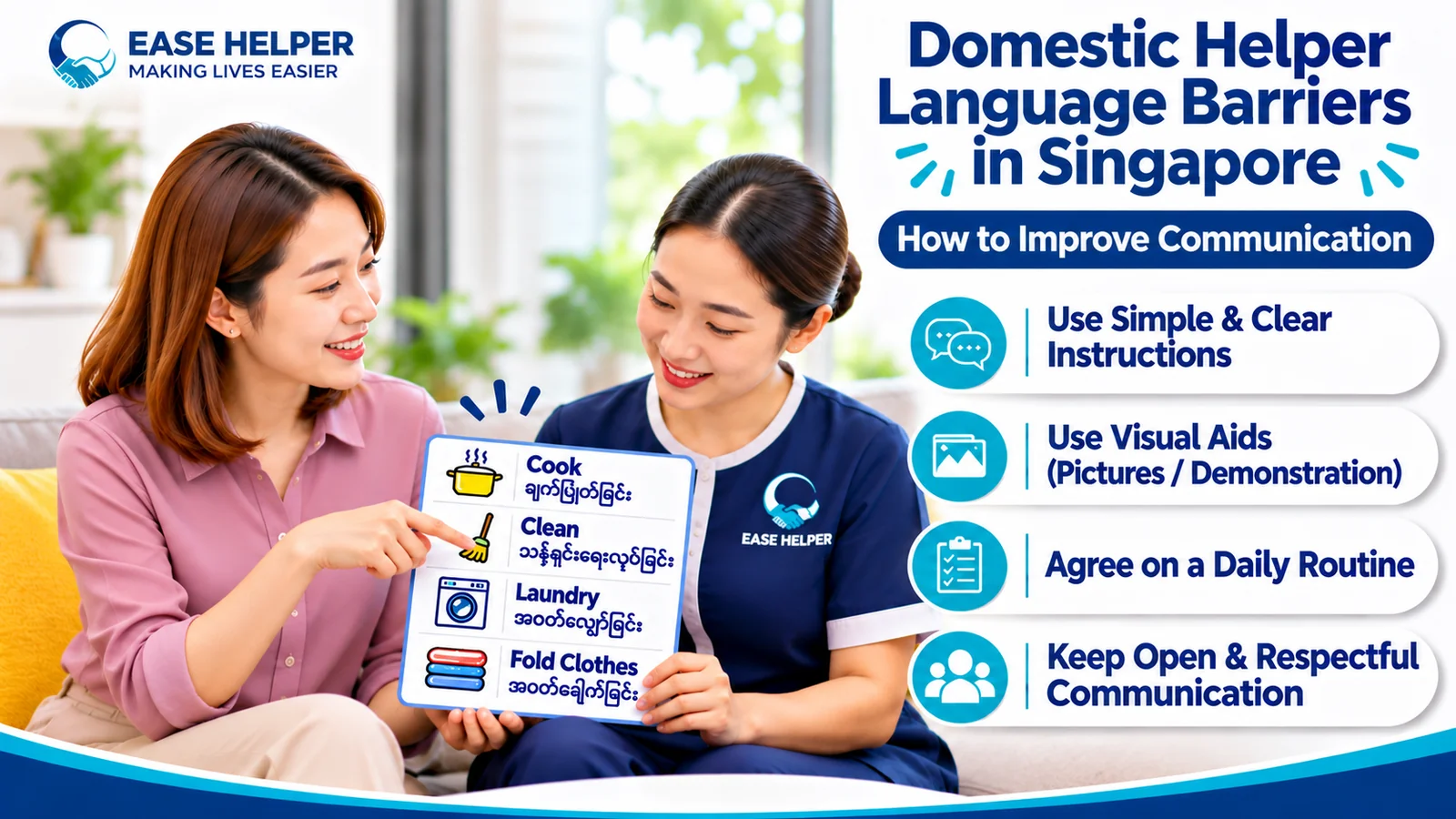
5. Use Pictures, Labels and Household Checklists
Visual tools can make household communication easier, particularly during the first few weeks of employment.
For example, a picture of the correct cleaning product beside a bathroom checklist may be clearer than a long written instruction.
Useful Visual Communication Tools
- Pictures showing where household items belong.
- Simple labels for cupboards and storage areas.
- Illustrated appliance instructions.
- Short cleaning checklists.
- Meal preparation notes with ingredient photographs.
- Emergency contact information in an accessible location.
Nevertheless, labels should not replace proper training for hazardous cleaning chemicals, electrical appliances or other safety-sensitive tasks.
6. Explain Household Vocabulary and Singapore Expressions
Newly arrived domestic helpers may encounter words that are common in Singapore but unfamiliar elsewhere.
Consequently, employers should explain local terms when they first arise.
| Expression | Possible Meaning | Clearer Instruction |
|---|---|---|
| “Later” | An unspecified future time | “Please do this after lunch.” |
| “Settle the kitchen” | Complete several kitchen duties | “Wash the dishes and wipe the kitchen counter.” |
| “Keep properly” | Put an item in its expected place | “Put the towels on the second shelf.” |
| “Can or not?” | Asking whether something is possible | “Do you know how to do this task?” |
| “Bring down” | Take an item to a lower floor | “Please take the rubbish to the designated bin area downstairs.” |
These examples illustrate possible meanings. Since expressions vary between households, employers should explain what they specifically intend.
7. Confirm Understanding Without Embarrassing the Helper
A helper may answer “yes” because she believes she understands, wishes to be polite or feels uncomfortable admitting uncertainty.
Therefore, asking “Do you understand?” may not always reveal whether the instruction was clear.
Instead, try questions such as:
- “Which cleaning product will you use?”
- “What will you do first?”
- “Where should these items go?”
- “Can you show me how to switch off the appliance?”
These questions check practical understanding without turning the conversation into a test.
Most importantly, thank the helper for asking questions and correct mistakes calmly.
8. Communicate Clearly About Childcare and Elderly Care
Communication becomes especially important when a domestic helper supports children or elderly family members.
In these situations, unclear instructions may affect safety, comfort or timely assistance.
For Childcare
Explain the child’s routine, supervision needs, approved activities and emergency contacts. In addition, clarify when the helper must contact a parent immediately.
For instance, an employer should provide clear instructions about what to do if a child becomes unwell, suffers an injury or requires urgent assistance.
For Elderly Care
Discuss mobility needs, meal routines, communication preferences and situations that require family support.
Furthermore, employers should clearly distinguish ordinary assistance from medical procedures that require professional guidance or suitable training.
Safety reminder: Do not rely solely on translation apps for medication instructions, emergency procedures or other high-risk care duties. Confirm critical information with an appropriate healthcare professional when necessary.
9. Use Translation Apps Carefully
Translation apps can help when employers and helpers do not share enough vocabulary to explain a task.
However, automatic translations are not always accurate. A short phrase may lose its meaning, particularly when it contains local expressions or technical terms.
For better results:
- Translate short, complete sentences.
- Avoid slang and complicated wording.
- Check important instructions through demonstrations.
- Use photographs when they clarify the task.
- Avoid sharing unnecessary personal or confidential information through translation tools.
In addition, employers should confirm that the helper understands the translated message before expecting her to act on it.
10. Give Feedback Calmly and Specifically
Feedback works best when it identifies what needs to change and explains the preferred approach.
For example, saying “You always clean badly” may leave the helper confused or discouraged.
Instead, an employer could say, “Please wipe the dining table after each meal and check that no food remains.”
A Practical Feedback Approach
- Describe the specific task or situation.
- Explain the expected result.
- Demonstrate the correct method when necessary.
- Allow the helper to ask questions.
- Review progress after she has had time to practise.
Likewise, acknowledge improvements. Positive feedback helps clarify which methods meet the household’s expectations.
11. Encourage Two-Way Communication
Communication should not flow only from employer to helper.
Domestic helpers also need opportunities to explain difficulties, ask for clarification and raise concerns about household routines.
For example, a helper may discover that two assigned tasks cannot be completed safely at the same time. Rather than remaining silent, she should feel comfortable explaining the conflict.
Employers can encourage this by asking:
- “Is there any instruction you would like me to explain again?”
- “Which task is difficult to complete?”
- “Do you need another demonstration?”
- “Is there anything important about today’s routine that we should discuss?”
As a result, both parties can address problems before they become recurring misunderstandings.
12. Establish a Short Weekly Communication Review
A brief weekly discussion can help employers and helpers improve their working relationship.
It does not need to be formal or lengthy. Instead, choose a convenient time to review household instructions and any recent difficulties.
Suggested Weekly Review Checklist
- Identify instructions that caused confusion.
- Clarify any changes to household routines.
- Review important safety reminders.
- Discuss tasks requiring additional training.
- Recognise progress and improvements.
- Invite feedback from the helper.
Furthermore, keep the discussion respectful and focused on practical solutions.
13. When Should Employers Seek Additional Support?
Some communication difficulties improve with patience and practice. However, persistent misunderstandings may require more structured support.
For example, employers may consider additional training when the helper repeatedly struggles with unfamiliar household equipment or essential routines.
Where appropriate, a licensed employment agency may also help explain expectations or facilitate communication between employer and helper.
For broader guidance on employing a migrant domestic worker, consult the Ministry of Manpower.
Frequently Asked Questions
1. How can I communicate better with a domestic helper who speaks limited English?
Use short sentences, demonstrate unfamiliar tasks and provide visual reminders. Additionally, ask practical questions to confirm understanding instead of relying only on a verbal “yes”.
2. Should I use translation apps to communicate with my domestic helper?
Translation apps can support everyday communication. However, check important instructions carefully, particularly when they involve safety, healthcare or unfamiliar equipment.
3. What should I do if my helper keeps misunderstanding instructions?
Review whether the instructions are clear, specific and realistic. Then demonstrate the preferred method, allow practice and discuss any remaining difficulties calmly.
4. How can I encourage my domestic helper to ask questions?
Respond patiently when she seeks clarification. Also, invite questions during demonstrations and regular household discussions so that uncertainty can be addressed early.
5. Can a domestic helper agency help with communication problems?
A licensed employment agency may be able to provide practical guidance or facilitate discussions, depending on its services. Employers should explain the specific difficulties and ask what support is available.
How EaseHelper Can Support Better Household Communication
Every Singapore household has different expectations, languages and daily routines. Therefore, employers should consider communication needs when selecting a domestic helper.
EaseHelper helps employers explore domestic helper options and discuss relevant experience, household responsibilities and training expectations. Clear communication from the beginning can support a smoother adjustment for everyone.
Looking for a Domestic Helper in Singapore?
Explore EaseHelper’s domestic helper services and learn more about finding suitable household support.
Explore EaseHelper ServicesDisclaimer: This article provides general communication and household management guidance. It does not replace employment regulations, professional healthcare advice or individual employment arrangements. For current Singapore requirements relating to migrant domestic workers, consult the Ministry of Manpower.