
Blog
Domestic Helper Time Management in Singapore: How to Organise Daily Household Tasks


Domestic helper time management in Singapore can make everyday household routines more organised and less stressful. A clear schedule helps employers explain their priorities while giving domestic helpers a practical way to manage daily responsibilities.
However, a good schedule does not mean filling every available minute with work. Instead, it should reflect the household’s actual needs, allow time for meals and rest, and recognise that unexpected situations may change the day’s priorities.
Whether your helper manages cleaning, cooking, childcare or elderly care, this guide explains how to organise tasks fairly and effectively.
Executive Summary
Effective domestic helper time management begins with clear priorities, realistic workloads and regular communication. Employers should distinguish essential daily duties from tasks that can wait.
In addition, household schedules should account for childcare, elderly care, meals, adequate rest and unexpected changes. A simple checklist can help both parties understand what needs to be completed without creating unnecessary pressure.
Above all, employers should review the routine together with their helper and adjust it when family needs change.
1. Why Time Management Matters for Domestic Helpers
Many Singapore households rely on domestic helpers to support several areas of daily life. For example, a helper may prepare breakfast, clean the kitchen, wash clothes and supervise a child before lunchtime.
Without a clear plan, these responsibilities can overlap. As a result, the helper may feel uncertain about which task matters most.
Good time management provides several benefits:
- Clarifies daily household priorities.
- Reduces repeated instructions and misunderstandings.
- Helps employers plan meals and family routines.
- Allows more realistic time for cleaning and laundry.
- Supports safer childcare and elderly care.
- Creates opportunities for regular breaks and adequate rest.
- Encourages better communication between employers and helpers.
Importantly, the purpose of a schedule is to improve coordination, not to monitor every minute of the helper’s day.
2. Start by Identifying Your Household’s Priorities
Before preparing a daily timetable, employers should list the household’s main needs.
For instance, a family with a newborn may prioritise infant care and hygiene. Meanwhile, a household with elderly parents may focus on meal preparation, mobility assistance and safe supervision.
Divide Household Duties into Three Categories
| Priority | Examples | Recommended Approach |
|---|---|---|
| High Priority | Child supervision, essential elderly care, urgent safety matters and time-sensitive meals | Complete or attend to these first |
| Medium Priority | Routine cooking, laundry, kitchen cleaning and basic household tidying | Plan around essential care duties |
| Flexible Priority | Organising cupboards, cleaning windows and other non-urgent deep-cleaning tasks | Schedule when sufficient time is available |
However, priorities can change. A medical concern or childcare need should take precedence over routine housework.
3. Create a Realistic Daily Household Schedule
A daily schedule gives the helper a general structure. Nevertheless, employers should avoid treating it as a rigid timetable that cannot change.
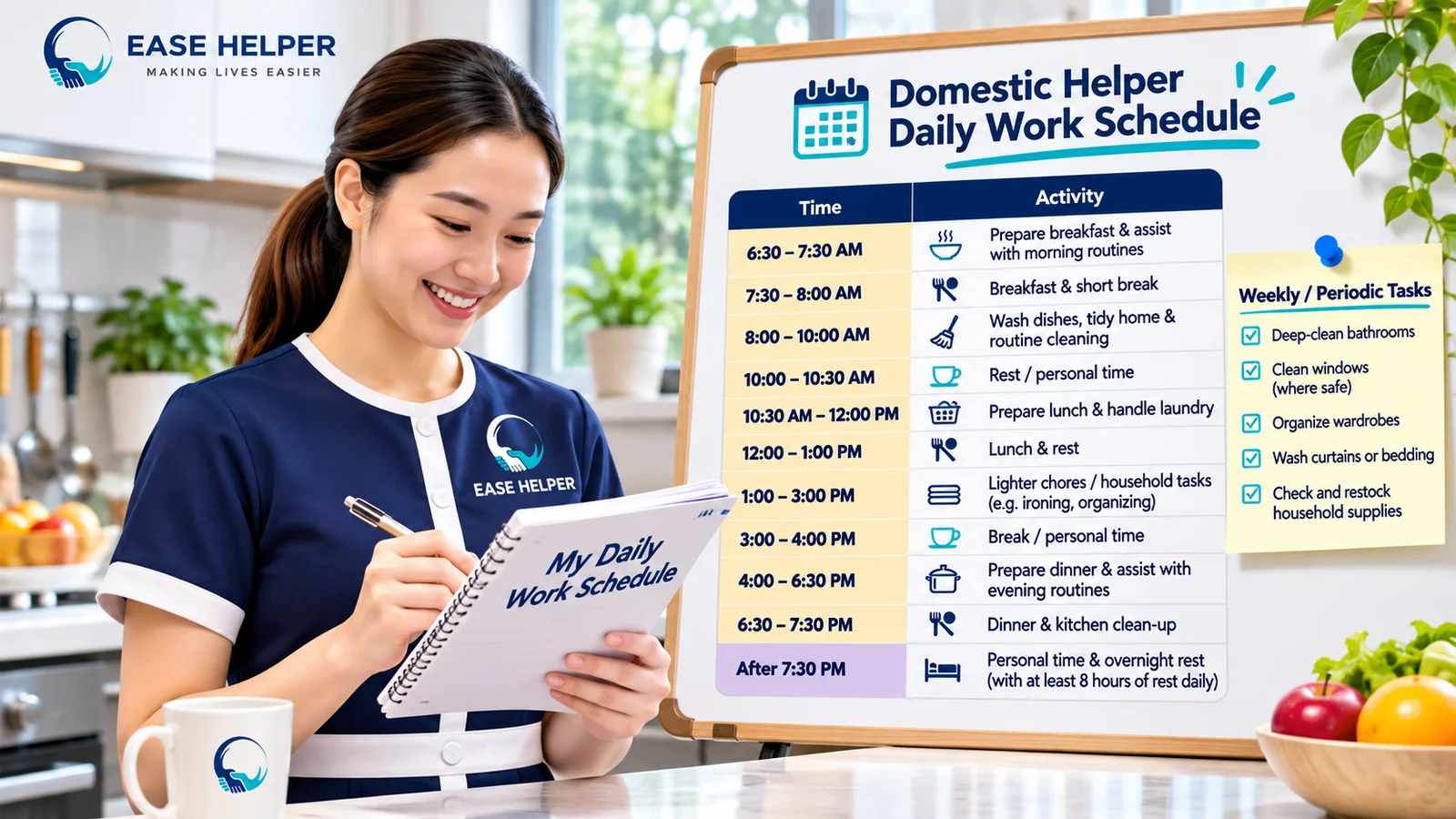
The following example illustrates how a household might organise routine duties while allowing breaks and flexibility.
Sample Daily Schedule for a Singapore Household
| Time | Suggested Activity | Important Consideration |
|---|---|---|
| 7:00–8:00 am | Prepare breakfast and assist with morning household routines | Adjust to the family’s actual waking time |
| 8:00–9:00 am | Breakfast, personal needs and kitchen tidying | Allow sufficient time to eat |
| 9:00–10:30 am | Laundry and routine cleaning | Focus on agreed priority areas |
| 10:30–11:00 am | Break and personal time | Avoid unnecessary interruptions |
| 11:00 am–12:30 pm | Lunch preparation and essential household duties | Allow flexibility for care responsibilities |
| 12:30–1:30 pm | Lunch and rest | Provide a meaningful break |
| 1:30–3:30 pm | Light housework, laundry folding or agreed family support | Do not overload the afternoon |
| 3:30–4:00 pm | Break or personal time | Adjust based on the day’s workload |
| 4:00–6:30 pm | Dinner preparation and kitchen duties | Coordinate with family meal times |
| After dinner | Essential clean-up followed by personal time and rest | Protect sufficient uninterrupted sleep |
This is an illustrative schedule, not a mandatory working-hours arrangement. Employers should adapt it to the helper’s actual responsibilities and ensure appropriate rest.
Employer reminder: Singapore’s Ministry of Manpower advises employers to provide migrant domestic workers with sufficient rest, including at least eight hours of uninterrupted sleep daily. Employers must also comply with applicable rest-day requirements.
4. Organise Daily, Weekly and Monthly Tasks Separately
One common time management mistake is expecting every household task to be completed every day.
Instead, employers can divide responsibilities by frequency. This approach makes workloads easier to manage and reduces unnecessary repetition.
Daily Tasks
- Prepare agreed meals.
- Wash dishes and clean food preparation surfaces.
- Tidy frequently used rooms.
- Complete essential childcare or elderly care duties.
- Handle laundry when necessary.
- Remove household rubbish as needed.
Weekly Tasks
- Change bedsheets according to household needs.
- Clean bathrooms more thoroughly.
- Organise frequently used storage areas.
- Check cleaning supplies.
- Complete selected deep-cleaning tasks.
Monthly or Occasional Tasks
- Organise cupboards and storage spaces.
- Clean less frequently used household areas.
- Review household supplies.
- Check the condition of cleaning tools.
- Discuss improvements to existing routines.
For example, an employer could schedule cupboard organisation on a quieter weekday instead of adding it to a busy childcare day.
5. Prioritise Childcare and Elderly Care Over Non-Urgent Housework
When a domestic helper provides care for children or elderly family members, safety and supervision must remain central to the schedule.
Therefore, employers should avoid assigning tasks that require the helper to leave a vulnerable person unattended.
For Households with Young Children
Plan cleaning and meal preparation around the child’s needs. In addition, explain which duties can be postponed when supervision becomes necessary.
For instance, if a toddler needs immediate attention, folding laundry can wait.
For Households with Elderly Family Members
Allow enough time for meals, mobility assistance and other agreed care routines. Furthermore, employers should explain when the helper must request additional support.
A helper should not be expected to perform unsafe lifting or medical procedures without suitable training.
6. Teach Domestic Helpers How to Prioritise Tasks
Some helpers may have previous household experience but remain unfamiliar with their new employer’s preferences.
Consequently, employers should demonstrate how to decide which tasks need immediate attention.
Use a Simple Three-Step Method
- Check safety: Does a child, elderly person or another family member need immediate assistance?
- Check urgency: Is there a time-sensitive task such as preparing a scheduled meal?
- Check flexibility: Can the remaining task wait until later?
For example, if the washing machine finishes while the helper is supervising a young child, the child’s safety should take priority.
Similarly, a minor household cleaning task can wait when an elderly family member requires assistance.
7. Use a Simple Daily Checklist
A checklist can help domestic helpers remember agreed responsibilities without requiring employers to repeat instructions throughout the day.
However, keep the checklist short and practical.
Example Household Checklist
| Task | Priority | Status |
|---|---|---|
| Prepare breakfast | High | To do / Completed |
| Clean kitchen surfaces | Medium | To do / Completed |
| Complete necessary laundry | Medium | To do / Completed |
| Prepare lunch or dinner | High | To do / Completed |
| Tidy living room | Flexible | To do / Completed |
| Organise one storage shelf | Flexible | To do / Deferred |
Importantly, an unfinished low-priority task does not necessarily mean poor performance. Instead, discuss whether the day’s workload was realistic.
8. Allow Time for Meals, Breaks and Adequate Sleep
Effective time management should include proper rest. A helper who is consistently tired may struggle to concentrate on household responsibilities.
Therefore, employers should plan routines that allow sufficient meals, personal time and uninterrupted sleep.
In addition, domestic helpers in Singapore are entitled to mandatory rest-day arrangements under MOM rules. Employers should understand these requirements and avoid using a daily checklist to undermine the helper’s rest time.
For current employment requirements, refer to the Ministry of Manpower’s domestic worker guidance.
9. Communicate Instructions Clearly
A detailed schedule is only useful when the helper understands it.
For this reason, employers should explain tasks in simple language and demonstrate unfamiliar procedures.
Practical Communication Tips
- Give clear instructions instead of vague expectations.
- Explain which tasks have the highest priority.
- Demonstrate unfamiliar household routines.
- Use pictures or translated notes when helpful.
- Allow the helper to ask questions.
- Review instructions when household needs change.
For example, rather than saying “clean everything before lunch”, specify the kitchen and dining area as the immediate priorities.
As a result, the helper can organise her time more confidently.
10. Avoid Common Time Management Mistakes
Some scheduling problems come from unclear expectations rather than a lack of effort.
Mistake 1: Assigning Too Many Tasks
A long checklist may appear organised, but it can become unrealistic when care duties or unexpected needs arise. Instead, identify essential tasks and postpone non-urgent work.
Mistake 2: Changing Instructions Repeatedly
Frequent changes can disrupt the helper’s routine. Therefore, explain which new tasks take priority and which existing tasks may be delayed.
Mistake 3: Ignoring Task Duration
Cooking, cleaning and laundry require different amounts of time depending on the household. Consequently, employers should observe how long tasks reasonably take before setting expectations.
Mistake 4: Comparing Helpers Unfairly
Every helper has different experience and familiarity with household routines. Instead of comparing people, provide clear training and assess progress fairly.
Mistake 5: Overlooking Rest
A schedule should not eliminate meals, breaks or adequate sleep. Proper rest supports both wellbeing and safe household operations.
11. Review the Schedule Together
Household routines naturally change. For example, a child may begin attending school, an elderly family member may require additional care, or an employer’s work schedule may change.
Therefore, employers should review the daily plan regularly.
During a review, ask practical questions:
- Which tasks are taking longer than expected?
- Are the most important duties receiving enough attention?
- Are there unnecessary or repeated tasks?
- Does the helper have sufficient time for meals and rest?
- Would additional training or equipment make the work easier?
Most importantly, listen to the helper’s feedback and make reasonable adjustments.
12. Build a Sustainable Household Routine
Successful domestic helper time management is not about completing the greatest number of tasks in the shortest possible time.
Instead, it involves balancing household priorities, safety, communication and rest.
When employers provide clear instructions and realistic schedules, helpers can understand expectations more easily. Consequently, the household may experience fewer misunderstandings and smoother daily routines.
Over time, a consistent but flexible approach can support a more respectful and productive working relationship.
Frequently Asked Questions
1. How should employers organise a domestic helper’s daily tasks?
Start by identifying essential care duties, meal preparation and routine housework. Then group tasks by priority and frequency. Allow flexibility for unexpected situations and sufficient rest.
2. Should domestic helpers follow a strict daily timetable?
A timetable can provide useful structure, but it should remain flexible. Childcare, elderly care and urgent household needs may require changes throughout the day.
3. What should a helper do when several tasks need attention at once?
Prioritise immediate safety and essential care responsibilities. Next, complete time-sensitive duties. Finally, handle routine tasks that can reasonably wait.
4. How can employers improve a helper’s time management skills?
Provide simple checklists, demonstrate unfamiliar tasks, explain priorities and review the schedule together. Additional training can help when a helper is learning new household routines.
5. How can employers prevent a domestic helper from becoming overloaded?
Set realistic expectations, distribute tasks across the week, allow sufficient rest and encourage open communication. Review unfinished tasks to determine whether the workload needs adjustment.
How EaseHelper Can Support Your Household
Different families have different household routines. Some require more childcare support, while others prioritise cooking, cleaning or elderly care.
EaseHelper helps Singapore employers explore domestic helper options based on their household needs and preferences. During the selection process, employers can discuss relevant experience, responsibilities and training expectations.
Looking for a Domestic Helper in Singapore?
Explore EaseHelper’s domestic helper services and find out how to choose a helper whose experience suits your household responsibilities.
Explore EaseHelper ServicesDisclaimer: This article provides general household management guidance and does not replace Singapore employment regulations or individual employment arrangements. Sample schedules are illustrative and should be adapted to actual duties, reasonable workloads and rest requirements. For current rules governing migrant domestic workers, refer to the Ministry of Manpower.