
Blog
How to Train Your Domestic Helper in Grocery Shopping and Household Budgeting in Singapore

Executive Summary
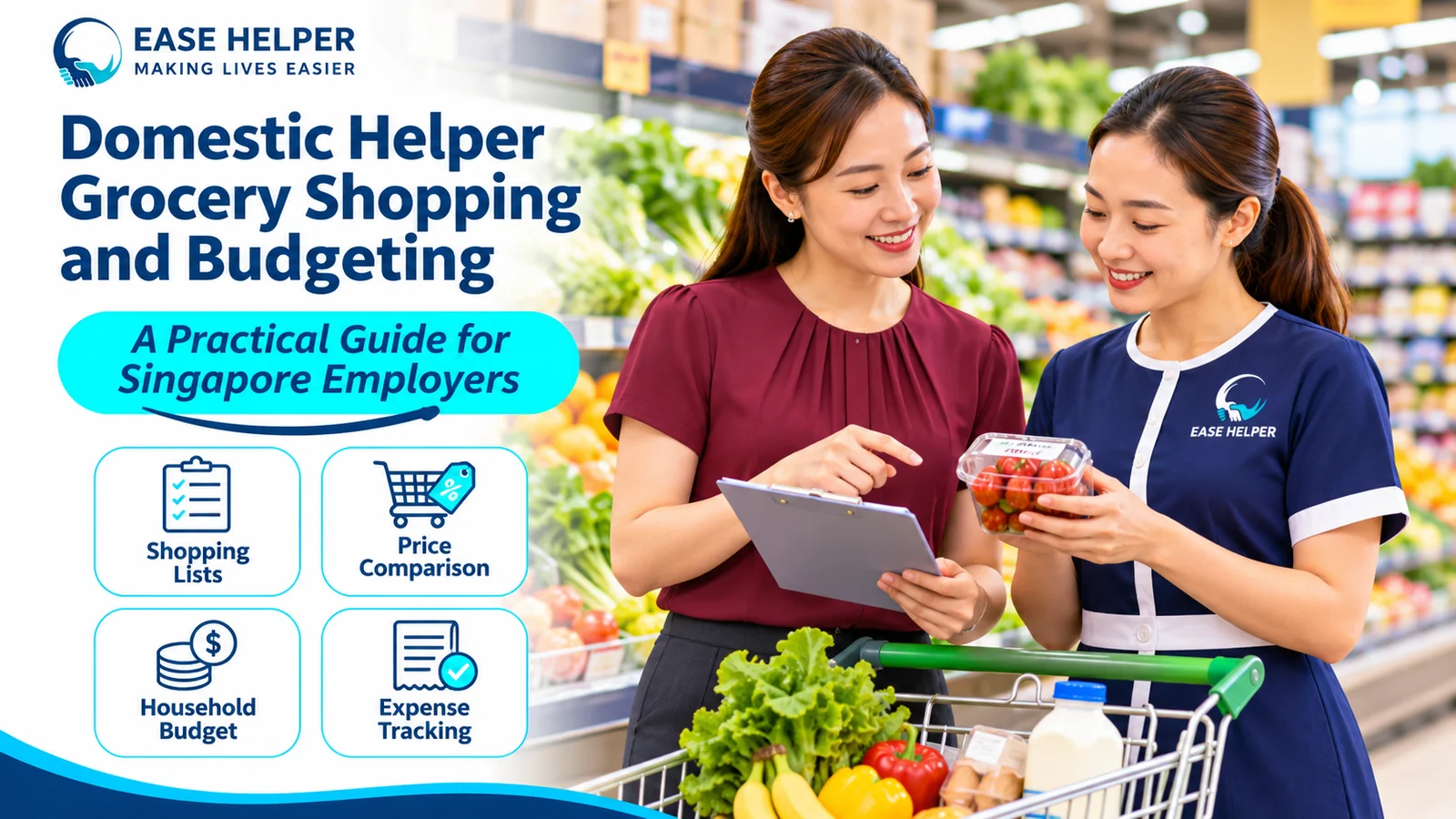
Domestic helper grocery shopping and budgeting training helps Singapore employers manage household purchases more efficiently. Start with a clear shopping list, explain your family’s food preferences and demonstrate how to compare prices. Next, teach your helper to select fresh ingredients, follow an agreed budget and record spending. This guide includes practical shopping instructions, budgeting examples, receipt management and safety tips for Singapore households.
Why Domestic Helper Grocery Shopping and Budgeting Training Matters
Domestic helper grocery shopping and budgeting training helps families establish clear expectations before assigning shopping responsibilities. Although some helpers have experience buying groceries, they may be unfamiliar with Singapore supermarkets, local ingredients or household preferences.
For example, a helper might select an unsuitable ingredient because the packaging looks similar. Alternatively, she may purchase more food than the family needs.
Fortunately, employers can reduce these mistakes through clear instructions and practical demonstrations. Moreover, a simple household shopping system helps both parties track spending and avoid misunderstandings.
1. Explain Your Family’s Grocery Shopping Requirements
Before asking your helper to shop independently, explain what your family usually buys. Start with common ingredients, preferred brands and dietary requirements.
Information Employers Should Provide
- Number of household members and typical meal portions.
- Preferred vegetables, fruits, meat and seafood.
- Any food allergies or dietary restrictions.
- Preferred brands and acceptable alternatives.
- Usual shopping locations.
- Expected shopping frequency.
- Budget limits and approval requirements.
For instance, some families prefer specific rice varieties or cooking oils. Therefore, show your helper the actual packaging rather than relying only on verbal descriptions.
Additionally, explain which products she should never substitute without permission.
2. Teach Your Domestic Helper to Prepare a Shopping List
A shopping list helps your helper buy the correct items and quantities. It also reduces unnecessary purchases.
How to Create a Practical Grocery List
- Check the refrigerator, freezer and pantry.
- Identify ingredients needed for upcoming meals.
- Write the product name and required quantity.
- Add preferred brands when necessary.
- Separate essential items from optional purchases.
- Confirm the list with the employer.
For example, instead of writing “chicken”, specify the cut, approximate quantity and whether fresh or frozen chicken is acceptable.
Likewise, include photographs of unfamiliar products when helpful. This can make shopping easier for helpers who are still learning English.
Sample Household Grocery List
| Category | Example Item | Instruction |
|---|---|---|
| Vegetables | Broccoli | Choose fresh, firm heads |
| Fruit | Apples | Buy the agreed quantity |
| Protein | Chicken breast | Check the label and required weight |
| Staples | Rice | Follow the family’s preferred variety |
| Dairy | Milk | Confirm the correct type and expiry date |
| Household | Dishwashing liquid | Check the preferred product and size |
3. Introduce Common Singapore Grocery Shopping Locations
Singapore offers several grocery shopping options. Therefore, introduce your helper to the stores that suit your family’s budget and needs.
Supermarkets
Supermarkets provide packaged groceries, fresh produce and household supplies. Examples include FairPrice, Sheng Siong, Giant and Cold Storage. However, product availability and prices vary between outlets.
Wet Markets
Wet markets can offer fresh vegetables, seafood, meat and other ingredients. Nevertheless, helpers may need guidance on selecting products, understanding prices and communicating with stallholders.
Neighbourhood Shops
Local provision shops may be convenient for small purchases. For example, a helper might buy a missing ingredient without travelling to a larger supermarket.
Initially, accompany your helper to the preferred shopping location. Then, demonstrate how to locate products, compare prices and complete payment.
4. Teach Your Domestic Helper to Compare Grocery Prices
Price comparison is an important household budgeting skill. However, the cheapest-looking package does not always offer the best value.
Compare Unit Prices
Teach your helper to compare products using the same unit, such as price per kilogram, litre or 100 grams.
For example, a 500-gram product priced at S$4 costs S$8 per kilogram. Meanwhile, a 1-kilogram package priced at S$7 costs S$7 per kilogram. Therefore, the larger package has a lower unit price.
However, the larger package may not be suitable if the family cannot finish it before it spoils. Consequently, shopping decisions should consider both value and actual household needs.
Check Promotions Carefully
- Compare the promotional price with the usual price.
- Check whether the offer requires multiple purchases.
- Review expiry dates before buying discounted food.
- Consider whether the family will use the entire quantity.
- Ask for approval before making substantial changes to the shopping list.
5. Explain How to Choose Fresh Ingredients
Freshness matters when buying vegetables, fruit, meat and seafood. Therefore, teach your helper to inspect products carefully.
Vegetables and Fruits
- Look for produce in suitable condition for the intended use.
- Avoid items with obvious mould or significant spoilage.
- Check packaging for trapped moisture or damage.
- Select ripeness according to when the family plans to eat the item.
Meat and Seafood
- Buy from suitable, reputable retailers.
- Check packaging, storage conditions and use-by dates.
- Keep chilled and frozen items cold during transport.
- Avoid damaged or leaking packages.
- Return perishable groceries home promptly.
Furthermore, explain that appearance alone cannot confirm food safety. When in doubt, the helper should ask before purchasing or using questionable food.
For additional food safety guidance, consult the Singapore Food Agency.
6. Establish a Household Grocery Budget
Domestic helper grocery shopping and budgeting training should include a clear spending limit. Nevertheless, the employer should set a realistic amount based on family size, dietary needs and current prices.
Sample Grocery Budget Worksheet
| Category | Illustrative Weekly Allocation | Notes |
|---|---|---|
| Vegetables and fruit | S$35 | Adjust to family preferences |
| Meat, fish and eggs | S$55 | Depends on planned meals |
| Rice, noodles and staples | S$20 | Some purchases last several weeks |
| Dairy and other groceries | S$25 | Depends on household needs |
| Contingency | S$15 | For approved additional items |
| Total | S$150 | Illustrative example only |
These figures are examples, not recommended spending levels or current market prices. Each employer should establish a suitable budget.
Important: Household grocery funds should remain separate from the helper’s personal money and salary. Employers should explain payment arrangements clearly and avoid requiring the helper to finance household purchases from her own wages.
7. Teach Receipt Management and Expense Recording
Keeping receipts creates a clear record of household purchases. In addition, it helps employers understand spending patterns.
Simple Grocery Expense Record
| Date | Store | Amount | Receipt | Notes |
|---|---|---|---|---|
| Monday | Supermarket | S$42.50 | Saved | Weekly vegetables and fruit |
| Wednesday | Wet market | S$28.00 | Recorded | Fresh ingredients |
| Friday | Neighbourhood shop | S$12.80 | Saved | Additional household items |
The example above uses fictional transactions for illustration.
Employers can use a notebook, spreadsheet or shared shopping application. However, the method should be easy for the helper to understand.
8. Explain Payment Methods and Money Handling
Some households provide cash for groceries, while others use an employer-authorised payment method. Regardless of the arrangement, employers should establish clear rules.
Good Payment Practices
- Agree on the amount available for shopping.
- Explain which payment methods are authorised.
- Keep receipts or transaction records.
- Return any unused cash and account for spending.
- Never share banking passwords or one-time passwords.
- Report payment problems immediately.
Moreover, employers should avoid giving helpers unnecessary access to personal banking accounts or sensitive financial information.
9. Teach Safe Grocery Shopping in Singapore
Shopping often involves walking, crossing roads and using public transport. Therefore, employers should explain basic travel and personal safety precautions.
- Use safe pedestrian crossings.
- Follow public transport rules.
- Carry shopping bags without excessive strain.
- Keep phones and valuables secure.
- Know how to contact the employer if assistance is needed.
- Avoid carrying more groceries than can be managed safely.
- Use suitable transport for heavy or bulky purchases.
For example, if the shopping list includes heavy bottled drinks or large bags of rice, the employer can arrange delivery instead of expecting the helper to carry everything.
10. Teach Food Storage After Shopping
Shopping responsibilities do not end at the checkout counter. After returning home, your helper should store groceries promptly and appropriately.
Basic Grocery Storage Checklist
- Place chilled and frozen food into suitable storage promptly.
- Follow product labels and storage instructions.
- Separate raw meat and seafood from ready-to-eat food.
- Check packaging before placing items into storage.
- Rotate stock according to appropriate dates and condition.
- Inform the employer about damaged or questionable items.
Furthermore, avoid leaving perishable groceries at room temperature unnecessarily, especially in Singapore’s warm climate.
11. Common Grocery Shopping Mistakes and Solutions
| Common Mistake | Possible Problem | Better Practice |
|---|---|---|
| Buying the wrong brand | Product may not meet household preferences | Use photographs or specific product names |
| Buying too much food | Waste and unnecessary spending | Check existing supplies before shopping |
| Ignoring unit prices | Higher cost for similar quantities | Compare prices using consistent units |
| Forgetting receipts | Difficulty tracking expenses | Save receipts after each purchase |
| Buying unsuitable substitutes | Meal preparation problems | Ask for approval before substitutions |
| Delaying cold food storage | Food safety concerns | Transport and store perishables promptly |
If a mistake occurs, discuss the issue calmly and explain how to prevent it. In particular, encourage your helper to ask questions whenever shopping instructions are unclear.
12. Create a Practical Grocery Shopping Routine
A consistent routine makes shopping more predictable. Additionally, it helps your helper balance grocery duties with other household tasks.
Suggested Weekly Routine
- Before shopping: Check supplies and prepare the list.
- Employer review: Confirm quantities, alternatives and budget.
- During shopping: Compare suitable products and check freshness.
- At checkout: Confirm purchases and keep the receipt.
- After returning: Store groceries promptly.
- Expense review: Record spending and return unused funds.
As your helper becomes familiar with the routine, you can gradually reduce supervision. Nevertheless, continue discussing unusual purchases or changes in household needs.
13. Use Technology to Make Grocery Shopping Easier
Simple digital tools can help domestic helpers follow shopping instructions. For example, employers can share a shopping list through an agreed messaging application.
Photographs are particularly useful when product names are unfamiliar. Likewise, a shared checklist can reduce forgotten items.
However, employers should explain appropriate phone use, privacy expectations and how to protect personal information. Technology should support the helper’s work without creating unnecessary confusion.
Frequently Asked Questions About Domestic Helper Grocery Shopping
1. Can a domestic helper buy groceries for the employer in Singapore?
Grocery shopping for the employer’s household is generally a domestic household duty. Employers should provide clear instructions, suitable funds and safe working arrangements while complying with applicable Ministry of Manpower requirements.
2. How should I teach my domestic helper to manage grocery spending?
Start with an agreed shopping list and realistic budget. Then, demonstrate price comparisons, receipt management and expense recording. Review the first few shopping trips together.
3. Should I give my domestic helper cash or a payment card?
Choose an arrangement that suits your household and provides appropriate safeguards. Explain spending limits, authorised purchases and how to report transactions. Never disclose sensitive banking credentials.
4. What should my domestic helper do if an item is unavailable?
Explain which substitutes are acceptable. For unfamiliar or important products, ask the helper to contact the employer before making a replacement.
5. How can I prevent misunderstandings about grocery expenses?
Use clear written instructions, an agreed budget and a simple receipt system. Review purchases regularly and discuss discrepancies respectfully.
How EaseHelper Can Support Your Household
Good grocery shopping and budgeting habits help domestic helpers manage everyday household responsibilities. However, each family has different preferences, budgets and routines.
EaseHelper assists Singapore employers with domestic helper recruitment and household matching. During the selection process, families can discuss cooking experience, grocery shopping familiarity and other relevant housekeeping skills.
Looking for a Domestic Helper in Singapore?
Explore EaseHelper’s recruitment services and find out how we can assist your family with its household needs.
Explore EaseHelper ServicesDisclaimer: This article provides general household shopping, budgeting and food safety guidance. Illustrative budgets and transactions are not current market quotations. Employers should follow applicable Ministry of Manpower requirements and consult the Singapore Food Agency for current food safety guidance. Household arrangements should remain reasonable, safe and consistent with the helper’s employment conditions.