Blog
Infant Care Course for Domestic Helpers in Singapore: Skills, Training and Course Selection

Executive Summary
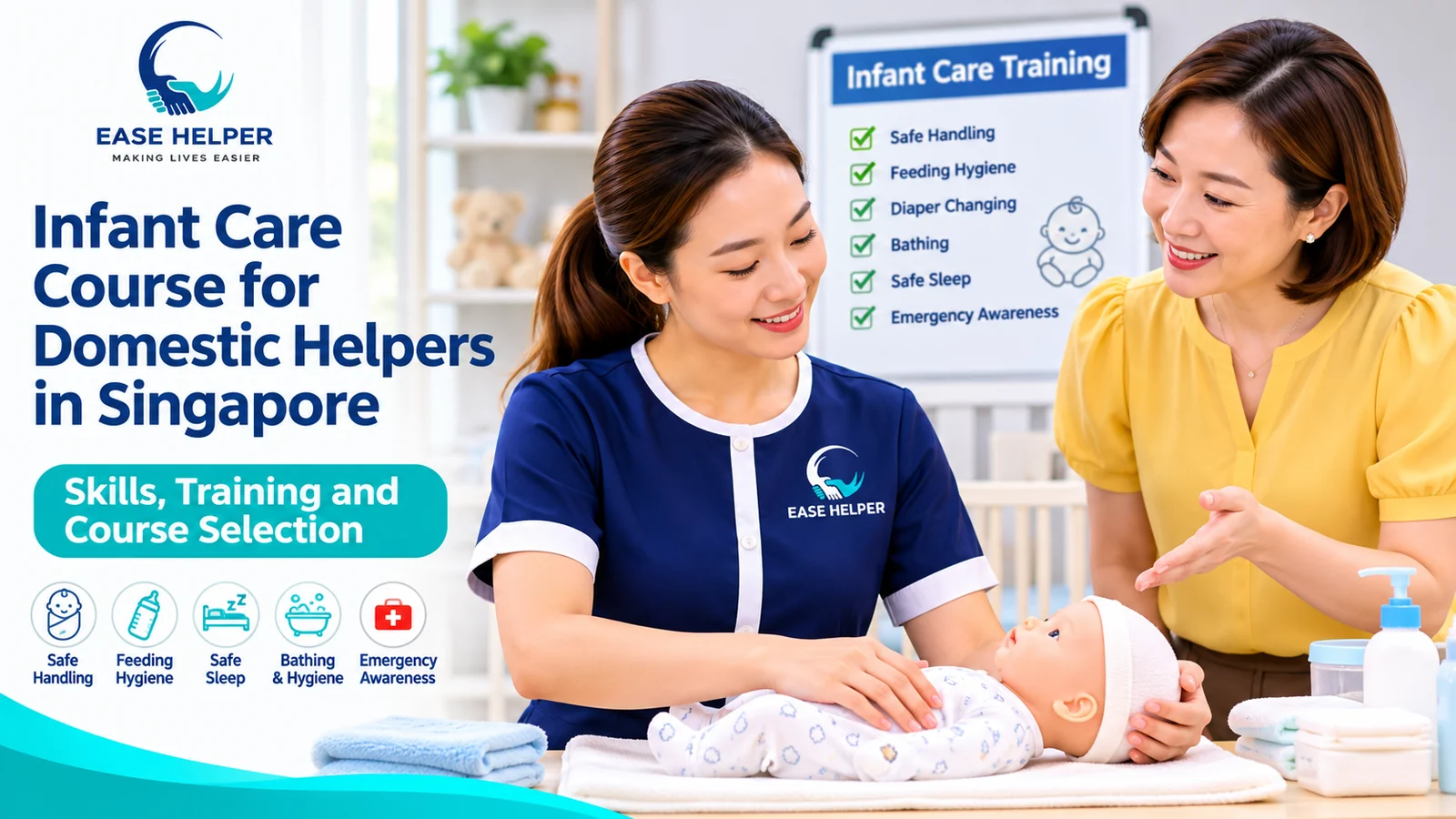
An infant care course for domestic helpers in Singapore can help caregivers develop practical skills in safe handling, feeding hygiene, diaper changing, bathing, sleep safety and emergency awareness. In addition, suitable training helps domestic helpers understand the special needs of newborns and young infants. Employers should therefore choose courses based on their baby’s age, the helper’s experience and the quality of hands-on practice. Although MOM does not generally require specialised infant care training, appropriate instruction and supervision remain important. This guide explains essential skills, course selection and ways to reinforce learning at home.
1. Why Infant Care Training Matters for Domestic Helpers
Welcoming a newborn brings major changes to family routines. Parents must manage feeding schedules, interrupted sleep, medical appointments and everyday responsibilities. As a result, many households consider additional support from a domestic helper.
However, experience in general housekeeping does not automatically prepare someone to care for a newborn. Infant care requires careful attention to hygiene, feeding, safe handling and early warning signs.
Therefore, a suitable infant care course can help a domestic helper:
- Understand the needs of newborns and young infants.
- Practise safe holding, carrying and positioning techniques.
- Follow parents’ instructions for feeding and milk preparation.
- Learn safe sleep principles.
- Perform routine hygiene tasks confidently.
- Recognise situations requiring urgent assistance.
- Communicate clearly about the baby’s routine and well-being.
Nevertheless, training should complement parental supervision and professional healthcare advice. It should never replace them.
2. Is an Infant Care Course Mandatory in Singapore?
As of November 2026, the Ministry of Manpower (MOM) does not generally require all new migrant domestic workers to attend a separate infant care course.
In a September 2026 parliamentary response, MOM explained that households have different caregiving needs. Consequently, employers are best placed to decide which skills their domestic helpers require.
Even so, MOM encourages employers to arrange suitable caregiving training when necessary. First-time migrant domestic workers must also attend the mandatory Settling-in Programme. However, that programme differs from specialised infant care training.
For official policy information, read MOM’s parliamentary answer on caregiving training.
3. Essential Skills an Infant Care Course Should Cover
Course content varies between training providers. Therefore, employers should compare the actual syllabus rather than relying only on the course title.
For example, a practical infant care course should cover the following areas:
| Training Area | Skills to Look For | Why It Matters |
|---|---|---|
| Safe handling | Supporting the head and neck, lifting and carrying safely | Helps prevent handling injuries |
| Feeding hygiene | Handwashing, bottle cleaning and following feeding instructions | Reduces contamination risks |
| Milk storage | Labelling, refrigeration and safe handling of expressed milk | Supports safe feeding practices |
| Diaper changing | Preparation, cleaning, hand hygiene and safe positioning | Promotes hygiene and prevents falls |
| Bathing | Preparing supplies, supporting the baby and checking water temperature | Reduces slipping and scalding risks |
| Safe sleep | Back sleeping, firm sleep surface and clear cot | Helps reduce sleep-related hazards |
| Communication | Reporting feeding, diaper changes and unusual symptoms | Keeps parents informed |
| Emergency awareness | Recognising danger signs and seeking immediate help | Supports timely emergency response |
4. Safe Holding and Handling of Newborns
Newborns need careful handling because their neck muscles are still developing. Therefore, training should teach helpers to support the baby’s head and neck whenever they lift or carry the infant.
Practical lessons should also cover the following steps:
- Wash hands before handling the baby.
- Support the head, neck and body securely.
- Move the baby gently between safe surfaces.
- Keep one hand on the baby during diaper changes on an elevated surface.
- Never shake a baby, even when crying is difficult to settle.
- Ask parents for help when unsure.
Ideally, learners should practise these techniques with a suitable training doll first. Afterwards, they can learn household routines through supervised demonstrations.
Training tip: Ask the provider whether the course includes practical handling exercises. For example, a programme consisting entirely of slides or videos may offer too little opportunity to assess physical techniques.
5. Feeding, Bottle Preparation and Milk Hygiene
Feeding routines should always follow the parents’ instructions and relevant healthcare advice. Moreover, helpers must understand that expressed breast milk and infant formula require different preparation and storage methods.
Expressed Breast Milk
A helper may assist with retrieving, labelling, thawing or preparing expressed breast milk. Therefore, training should cover clean hands, suitable storage containers, correct refrigeration and safe thawing.
Importantly, caregivers should never heat breast milk in a microwave. Instead, they should follow current safe warming guidance.
For additional information, consult Singapore HealthHub for breastfeeding and milk storage advice.
Infant Formula
When a baby receives infant formula, the helper should follow the manufacturer’s instructions and the parents’ feeding plan.
For example, training should explain how to:
- Wash hands and prepare a clean workspace.
- Use suitable equipment and safe water preparation methods.
- Measure formula accurately without changing the recommended ratio.
- Follow current preparation, cooling and storage guidance.
- Discard feeds when necessary rather than keeping unsafe leftovers.
In addition, parents should demonstrate their household’s exact feeding procedure. Instructions for breast milk and formula are not interchangeable.
6. Safe Sleep Training for Domestic Helpers
Safe sleep is one of the most important topics in infant care training. According to Singapore HealthHub, babies should sleep on their backs on a firm, flat surface with a properly fitted sheet.
Furthermore, the sleeping area should remain free from loose blankets, pillows, cot bumpers and soft toys.
Domestic helpers should therefore understand these principles:
- Place babies on their backs for sleep.
- Use a firm and appropriately fitted cot mattress.
- Keep soft objects and loose bedding out of the cot.
- Avoid sofas, armchairs and pillow-like loungers as infant sleep surfaces.
- Inform parents about sleep difficulties or unusual breathing.
- Follow current safe sleep guidance when establishing routines.
For more information, visit HealthHub’s official website.
Before enrolling a helper, employers should confirm that the course teaches current safe sleep recommendations rather than outdated practices.
7. Diaper Changing, Bathing and Daily Hygiene
Diaper changing and bathing are common infant care tasks. Nevertheless, both require careful preparation and constant attention.
Diaper Changing
First, prepare all supplies before placing the baby on the changing surface. Next, clean the baby appropriately and dispose of the used diaper hygienically. Finally, wash hands thoroughly.
Most importantly, never leave a baby unattended on a changing table or another elevated surface.
Bathing
Before bathing, the helper should prepare towels, clothing and other necessary items. She should also check the water temperature and learn how to support the baby’s head and body.
In addition, a caregiver must never leave a baby alone in bathwater, even briefly.
Cleaning Infant Equipment
Helpers should also learn how to clean feeding equipment, changing areas and frequently used baby items. Whenever possible, they should follow the manufacturer’s instructions and the family’s hygiene routine.
8. Recognising Infant Warning Signs and Emergencies
Infant care training should help helpers recognise when a baby needs urgent attention. However, a short caregiving course does not qualify a helper to diagnose medical conditions.
For example, important warning signs may include:
- Difficulty breathing or unusual breathing patterns.
- Blue or grey lips or skin.
- Unresponsiveness or unusual difficulty waking.
- Seizure-like movements.
- Signs of choking or inability to breathe normally.
- Fever in a young infant, particularly a baby under three months old.
- Unusual weakness, poor feeding or signs of dehydration.
In Singapore, call 995 for a medical emergency requiring an ambulance.
In particular, an infant under three months with a temperature of 38°C or higher needs urgent medical assessment. Other concerning symptoms may also require immediate medical attention.
Therefore, employers should ensure that the helper knows the household address, emergency contact numbers and the procedure for notifying parents.
Additionally, helpers should learn infant CPR and choking-response techniques through suitable hands-on training with qualified instructors. Reading instructions alone cannot replace practical emergency training.
9. Different Types of Infant Care Courses in Singapore
Employers may encounter several training formats. Consequently, the most suitable choice depends on the helper’s experience, language ability and the baby’s needs.
| Course Type | Typical Focus | Suitable For |
|---|---|---|
| Basic infant care | Handling, feeding, diaper changing and hygiene | Helpers with limited infant care experience |
| Newborn care workshop | Early infant routines and practical demonstrations | Families preparing for a newborn |
| Infant first aid | Emergency recognition and response | Caregivers needing emergency skills |
| Home-based training | Training adapted to household equipment and routines | Families wanting personalised instruction |
| Refresher training | Reviewing current practices and correcting skill gaps | Experienced helpers returning to infant care duties |
However, course names are not standardised. Always check the actual syllabus before making a decision.
10. How to Choose the Right Infant Care Training Provider
Choosing a suitable provider requires more than comparing prices. Instead, employers should review the course content, teaching methods and practical assessment.
Check the Course Content
First, ask whether the syllabus covers safe sleep, infant handling, feeding hygiene, bathing, diaper changing and emergency awareness.
Look for Hands-On Practice
Next, confirm that learners can practise with suitable training dolls and receive feedback. Practical demonstrations help helpers apply new skills.
Review Trainer Qualifications
In addition, check whether instructors have relevant experience or professional qualifications in infant care, nursing, early childhood care or first aid, depending on the course.
Confirm the Language of Instruction
Importantly, the helper must understand the lessons. Therefore, ask whether the provider offers translated materials or instruction in a familiar language.
Understand Assessment and Certification
Furthermore, check whether the provider assesses learners through practical demonstrations, written questions or attendance alone.
A certificate of attendance does not necessarily prove that the helper has demonstrated every practical skill.
Compare Costs and Schedules
Finally, compare fees, course duration, location, cancellation policies and the helper’s rest arrangements before enrolling.
11. Questions to Ask Before Booking an Infant Care Course
Before paying for a course, employers should ask several practical questions. The answers can help identify whether the programme matches the family’s needs.
| Question | Why It Matters |
|---|---|
| Does the course cover newborn care? | Not every childcare course focuses on young infants |
| Is hands-on practice included? | Physical skills require supervised demonstration |
| Are training dolls provided? | Allows safer initial practice |
| Who conducts the training? | Helps assess instructor suitability |
| What language is used? | Supports understanding and participation |
| Is there a practical assessment? | Helps identify skills requiring improvement |
| Is first aid included? | Clarifies whether separate emergency training is needed |
| What are the total fees? | Prevents unexpected costs |
| Is a certificate issued? | Clarifies the evidence of completion |
12. Where Can Employers Find Infant Care Courses?
In Singapore, several training organisations and community programmes offer caregiving education. However, not every programme specifically covers newborn or infant care.
Therefore, employers can begin by checking:
- Agency for Integrated Care (AIC) for caregiving information and training resources.
- SG Enable for relevant caregiver support and training information.
- Ministry of Manpower for domestic helper employment guidance.
- Established providers offering infant care, newborn care or infant first aid programmes.
In addition, course availability, eligibility, fees and schedules can change. As a result, employers should verify the latest details directly with the provider.
Some caregiving courses may also qualify for financial support under specific schemes. Nevertheless, not every infant care course or household will meet the eligibility requirements.
13. How Much Does an Infant Care Course Cost?
There is no single standard price for all infant care courses in Singapore. Instead, fees depend on the provider and training format.
For example, costs may vary according to:
- Course duration and number of sessions.
- Group classes versus individual instruction.
- Trainer qualifications and assessment methods.
- Training centre lessons versus home-based instruction.
- Included learning materials and certificates.
- Available subsidies or funding arrangements.
Therefore, employers should request a complete fee breakdown before payment. They should also confirm refund and rescheduling policies.
For employer-requested training, both parties should clarify payment and scheduling arrangements in advance.
14. How to Evaluate Your Helper After Training
Completing a course is an important milestone. However, employers should also check whether the helper can apply her new knowledge.
For example, a practical assessment can include:
- Demonstrating how to lift and hold a training doll safely.
- Explaining safe sleep arrangements.
- Preparing a clean feeding area.
- Describing the family’s milk storage instructions.
- Demonstrating diaper changing with a training doll.
- Explaining what to do when a baby shows unusual symptoms.
- Identifying when to ask parents for assistance.
Afterwards, parents should supervise initial caregiving tasks and provide patient feedback. If necessary, they can arrange refresher lessons or professional guidance.
15. Preparing a Household Infant Care Instruction Sheet
Even a trained domestic helper needs clear instructions about the family’s routines. Therefore, employers should prepare a simple written guide for important infant care tasks.
For example, the instruction sheet may include:
- Feeding instructions approved by the parents.
- Milk preparation and storage procedures.
- Diaper changing and hygiene routines.
- Safe sleep arrangements.
- Allergy or medical information provided by the parents.
- Emergency contact numbers.
- Paediatrician or clinic contact details.
- Tasks that require parental approval.
Furthermore, employers should update the instructions as the baby grows. Explain the information in a language the helper understands and keep the guide accessible.
16. Common Mistakes When Selecting Infant Care Training
Several common mistakes can reduce the value of a training course. Fortunately, employers can avoid many of them by reviewing the syllabus and assessment methods carefully.
| Common Mistake | Why It Matters | Better Approach |
|---|---|---|
| Choosing solely by price | Important practical lessons may be missing | Compare the syllabus and training quality |
| Assuming childcare experience equals newborn experience | Infants have different needs from older children | Assess newborn-specific skills |
| Relying only on online videos | Physical techniques may not receive proper assessment | Include supervised hands-on practice |
| Ignoring language barriers | Safety instructions may be misunderstood | Choose understandable instruction |
| Assuming certification guarantees competence | Certificates vary in assessment standards | Observe practical skills at home |
| Skipping emergency training | The helper may not recognise urgent situations | Consider suitable infant first aid training |
| Leaving a helper unsupervised immediately after training | Household routines may still be unfamiliar | Introduce duties gradually with supervision |
17. Infant Care Training Should Support Both Parents and Helpers
Successful infant care depends on cooperation between parents and the domestic helper. Therefore, employers should provide clear instructions, suitable equipment and opportunities to ask questions.
Likewise, domestic helpers should feel comfortable reporting uncertainty, feeding difficulties or unusual symptoms promptly.
Importantly, completing a short course does not qualify a helper to perform unfamiliar medical procedures or manage every aspect of newborn care independently.
Ultimately, parents remain responsible for healthcare decisions and appropriate care arrangements. Meanwhile, ongoing communication and supervision help everyone work together safely.
Frequently Asked Questions
1. Is an infant care course compulsory for domestic helpers in Singapore?
No. As of November 2026, MOM does not generally require all domestic helpers to complete specialised infant care training. However, employers should consider suitable courses when their household requires infant caregiving support.
2. Can a domestic helper without newborn experience attend an infant care course?
Yes. Many introductory courses teach basic infant care skills. Therefore, employers should confirm that the programme welcomes beginners and includes supervised practical exercises.
3. Does an infant care certificate mean a helper can care for a newborn independently?
Not necessarily. Certificates may show attendance or completion of specific assessments. Consequently, parents should still review practical abilities and supervise the helper appropriately.
4. Should domestic helpers attend infant first aid training?
Infant first aid training can be valuable for helpers who assist with newborns or young children. In particular, hands-on training with qualified instructors can help caregivers understand emergency response procedures.
5. How should employers choose between infant care courses?
Compare course content, trainer qualifications, practical exercises, language accessibility, assessment methods, schedules and costs. Above all, choose a course that matches the helper’s responsibilities and the family’s needs.
Looking for a Domestic Helper to Support Your Family?
Families with newborns and young children have different caregiving priorities. Therefore, EaseHelper helps employers consider domestic helpers’ experience, communication abilities and suitability for their household needs.
Discuss your family’s requirements with EaseHelper and explore suitable domestic helper options.
Explore EaseHelper ServicesDisclaimer: This article provides general educational information for Singapore employers and domestic helpers. Infant care courses, subsidies, eligibility requirements and MOM policies may change. Furthermore, training does not replace parental supervision, professional healthcare advice, infant first aid certification or medical treatment. For health concerns involving a newborn or infant, consult a qualified healthcare professional. In an emergency in Singapore, call 995.