
Blog
Domestic Helper Kitchen Appliance Training: Safe Use of Common Household Equipment

Executive Summary
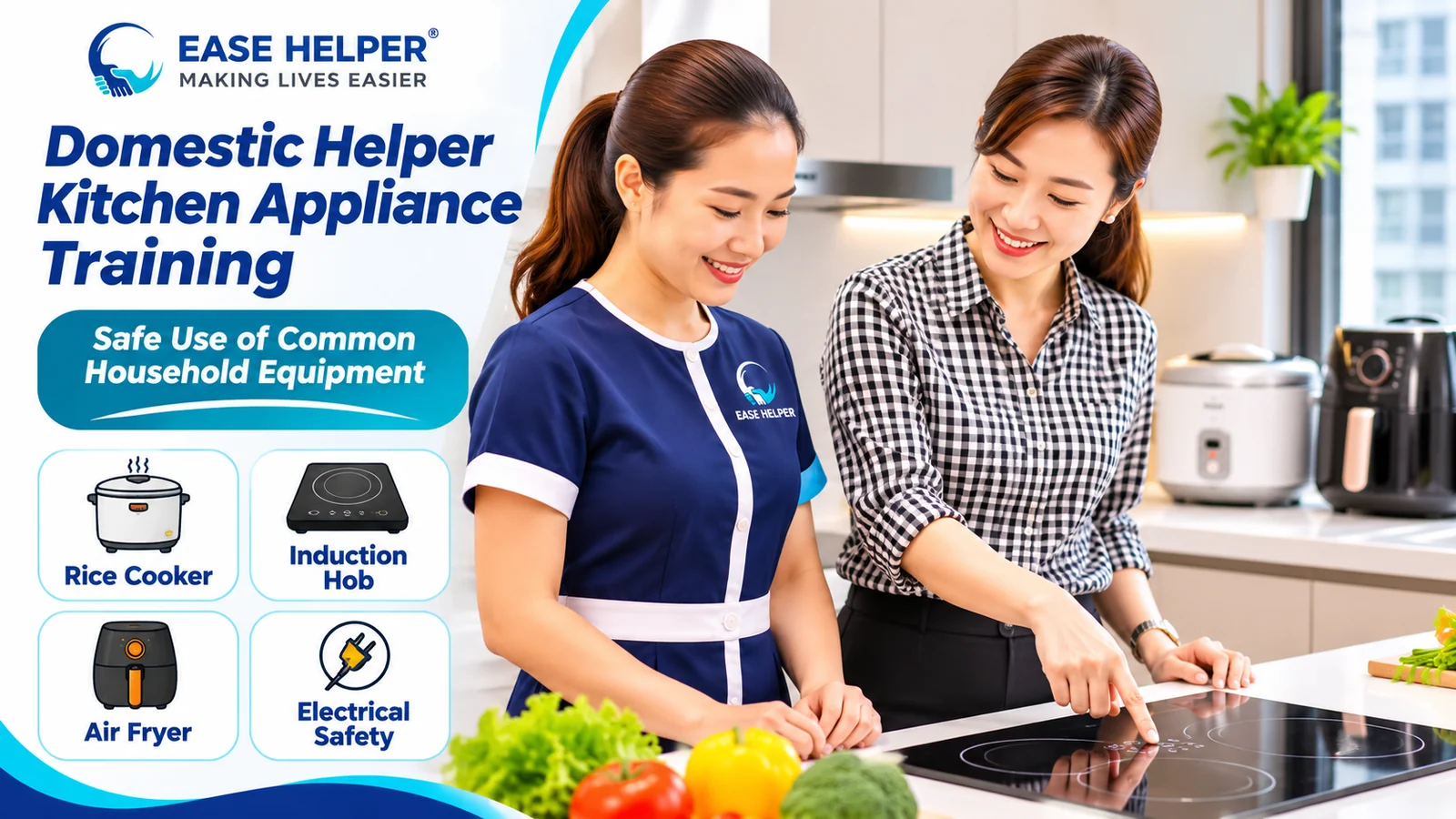
Domestic helper kitchen appliance training helps Singapore families reduce accidents and build confidence in daily meal preparation. Modern kitchens often contain rice cookers, induction hobs, microwaves, ovens, air fryers, blenders and electric kettles. However, each appliance has different operating instructions and safety risks.
This guide explains how employers can teach domestic helpers to use common kitchen equipment safely. It includes appliance-specific precautions, electrical safety rules, cleaning procedures, emergency responses and a practical training checklist.
Why Kitchen Appliance Training Matters in Singapore Homes
Many domestic helpers arrive with cooking experience. However, they may not have used the same appliances or models found in Singapore households.
For example, a helper who regularly cooks on a gas stove may be unfamiliar with an induction hob. Likewise, someone who has used a basic rice cooker may need guidance on a multifunction pressure cooker.
Therefore, employers should demonstrate their appliances before expecting independent use. Clear instructions can reduce the risk of burns, electrical accidents, equipment damage and food preparation mistakes.
Importantly, previous cooking experience does not automatically mean someone knows how to operate every appliance safely.
1. Start With a Kitchen Appliance Safety Orientation
Before your helper prepares meals independently, introduce the main appliances in your kitchen. Explain which equipment she may use and which items require additional supervision or training.
What Should Employers Demonstrate?
- Where to find each appliance’s operating instructions.
- How to switch the equipment on and off correctly.
- Which surfaces become hot during operation.
- How to select suitable cookware or accessories.
- How to recognise warning lights, alarms and error messages.
- How to clean the appliance after it has cooled.
- What to do when the appliance behaves unexpectedly.
In addition, show your helper the location of the main electrical switches and relevant kitchen safety equipment.
Employer tip: Keep appliance manuals accessible. If the helper finds the instructions difficult to understand, demonstrate the steps and prepare a short, appliance-specific checklist.
2. Teach Safe Rice Cooker Operation
Rice cookers are common in Singapore households. Although they are convenient, improper use may cause steam burns, spills or equipment damage.
Rice Cooker Training Checklist
- Show the helper how to measure rice and water according to the appliance instructions.
- Check that the inner pot is correctly positioned before switching on the cooker.
- Keep the exterior of the inner pot and electrical contact areas dry.
- Explain the cooking and keep-warm functions.
- Warn against placing hands or the face near escaping steam.
- Allow hot components to cool before cleaning.
Furthermore, explain that the keep-warm function does not replace proper food safety practices. Follow the manufacturer’s instructions and avoid leaving cooked rice at unsafe temperatures.
3. Use Induction Hobs and Electric Cooktops Safely
Induction hobs and electric cooktops can look different from traditional gas stoves. Consequently, helpers should learn how the controls, cookware requirements and residual heat indicators work.
Important Induction Hob Safety Rules
- Use cookware that the manufacturer identifies as suitable.
- Keep the cooking surface dry and free from unnecessary objects.
- Turn pot handles away from the edge of the counter.
- Do not leave active cooking unattended.
- Check the residual heat indicator before touching the surface.
- Switch off the cooking zone after use.
Although induction technology heats compatible cookware directly, the hob surface can still become hot from contact with the pan. Therefore, never assume it is safe to touch immediately after cooking.
If the glass surface cracks, stop using the appliance and follow the manufacturer’s safety instructions. Do not attempt a repair.
4. Explain Microwave Oven Safety
Microwave ovens are useful for reheating food and preparing certain dishes. However, incorrect containers or heating methods can create serious risks.
Microwave Safety Checklist
- Use containers clearly identified as microwave-safe.
- Do not place ordinary metal utensils or unsuitable foil inside.
- Never heat sealed containers that may build up pressure.
- Stir food or rotate it when appropriate to improve even heating.
- Allow standing time when the instructions require it.
- Use care when opening hot containers because steam may escape.
- Follow the manufacturer’s instructions for cleaning.
For example, reheated soup may appear calm while remaining extremely hot. Therefore, your helper should handle the container carefully and check that the food has heated evenly.
Additionally, avoid operating a microwave with a damaged door or seal. Arrange professional inspection if a safety problem appears.
5. Train Helpers to Use Air Fryers Safely
Air fryers have become popular in Singapore kitchens. Nevertheless, their heating elements, hot baskets and restricted airflow create specific safety considerations.
Air Fryer Safety Guidelines
- Place the appliance on a stable, heat-resistant surface.
- Allow the ventilation space specified by the manufacturer.
- Do not overfill the cooking basket.
- Use only accessories approved for the appliance.
- Handle hot baskets and trays with suitable protection.
- Keep hands away from hot exhaust air.
- Allow the appliance to cool before cleaning.
Moreover, explain how to select the correct cooking programme and check that food has cooked thoroughly.
Employers should also demonstrate how to remove the basket without spilling hot oil or food.
6. Explain Oven and Toaster Oven Safety
Conventional ovens and toaster ovens can cause burns when helpers touch hot trays, racks or doors. Therefore, practical demonstrations should include safe loading and unloading.
Safe Oven Practices
- Preheat only when the recipe or appliance instructions require it.
- Use oven-safe trays and cookware.
- Keep flammable materials away from heating elements.
- Use suitable oven gloves when handling hot items.
- Open the door carefully to avoid escaping heat and steam.
- Switch off the oven after cooking.
- Clean spills according to the manufacturer’s instructions.
Also, avoid storing kitchen towels, plastic containers or other items inside the oven. Someone may accidentally switch it on without noticing them.
7. Use Blenders and Food Processors Carefully
Blenders and food processors contain fast-moving blades. Consequently, helpers should never place their fingers or utensils near moving components.
Blender Safety Checklist
- Place the appliance on a stable surface.
- Check that the jug, lid and blade assembly are correctly fitted.
- Keep hands away from the blades.
- Use the appropriate speed and quantity settings.
- Never remove the lid or insert utensils while the blades are moving.
- Switch off and unplug the appliance before disassembly or cleaning, as directed by the manual.
In addition, follow the manufacturer’s instructions before blending hot liquids. Some appliances are not designed for hot ingredients, and trapped steam can cause dangerous pressure or splashing.
8. Handle Electric Kettles and Hot Water Safely
Electric kettles are straightforward to operate, but boiling water can cause severe scalds. Therefore, helpers should learn safe filling, pouring and cleaning procedures.
- Fill the kettle only within the marked minimum and maximum levels.
- Keep the kettle and power base stable.
- Ensure the exterior electrical contacts remain dry.
- Keep the lid securely closed when required.
- Pour slowly and avoid directing steam toward the body.
- Keep hot water away from children and vulnerable household members.
- Allow the kettle to cool before descaling or cleaning.
Furthermore, never immerse the electrical base or other non-waterproof electrical components in water.
9. Take Extra Care With Electric Pressure Cookers
Electric pressure cookers require more detailed training because they operate under pressure. Unlike an ordinary rice cooker, incorrect opening or venting may cause serious scalds.
Therefore, employers should provide model-specific instruction before allowing independent use.
Essential Pressure Cooker Rules
- Read the manufacturer’s operating instructions.
- Check that the sealing ring and pressure-release components are correctly fitted.
- Follow the minimum and maximum filling limits.
- Never force the lid open while the cooker remains pressurised.
- Keep hands and the face away from escaping steam.
- Follow the prescribed pressure-release method.
- Stop using the appliance if its safety mechanisms appear damaged.
Important: Never improvise pressure-release procedures or bypass a safety lock. If the helper is uncertain, she should stop and ask the employer to check the manual.
10. Follow Basic Electrical Safety Rules
Every electrical kitchen appliance presents some risk when used incorrectly. Therefore, domestic helper kitchen appliance training should include general electrical safety.
Electrical Safety Checklist
- Keep hands dry when handling electrical plugs and switches.
- Inspect visible cords and plugs for damage before use.
- Avoid overloading sockets or extension leads.
- Keep electrical appliances away from standing water.
- Do not pull a plug out by its cable.
- Never insert objects into electrical openings.
- Stop using equipment that sparks, smokes, smells of burning or behaves abnormally.
- Do not attempt electrical repairs without appropriate qualifications.
Employers can consult the Consumer Product Safety Office for information about consumer product safety in Singapore.
11. Know What to Do During a Kitchen Appliance Emergency
Even careful households can experience appliance problems. Therefore, employers should explain how to respond without putting anyone at additional risk.
| Situation | Safer Response |
|---|---|
| Smoke or burning smell from an appliance | Stop using it. Disconnect power only if safe. Move away and alert the employer. |
| Electrical sparks or exposed wires | Do not touch damaged equipment. Keep others away and arrange qualified assistance. |
| Small cooking fire | Raise the alarm and follow the household fire emergency plan. Never use water on an oil or electrical fire. |
| Serious fire or immediate danger | Evacuate to safety and call Singapore Civil Defence Force at 995. |
| Hot water or steam burn | Cool the affected area under cool running water for 20 minutes. Seek medical help when appropriate. |
| Appliance malfunction | Stop operation and inform the employer. Do not attempt an unauthorised repair. |
For fire prevention and emergency guidance, refer to the Singapore Civil Defence Force (SCDF).
Most importantly, a helper should never risk personal safety to save an appliance or household item.
12. Clean and Maintain Kitchen Appliances Properly
Regular cleaning helps keep appliances hygienic and functional. However, improper cleaning may damage electrical components or create hazards.
Safe Cleaning Principles
- Switch off the appliance and disconnect it when required.
- Allow hot surfaces and components to cool.
- Remove detachable parts according to the manual.
- Use suitable cleaning products and tools.
- Keep electrical components dry.
- Dry and reassemble parts correctly before the next use.
For instance, the removable basket of an air fryer may be washable, while the main electrical housing must not be immersed in water.
Additionally, never assume that every removable part is dishwasher-safe. Check the manufacturer’s instructions first.
13. Create a Kitchen Appliance Training Checklist
A simple training record helps employers identify which appliances the helper can use independently and which require further practice.
| Appliance | Training Focus | Practical Assessment |
|---|---|---|
| Rice cooker | Water measurement, steam safety and cleaning | Prepare rice safely with guidance |
| Induction hob | Suitable cookware, heat settings and switching off | Cook a simple dish |
| Microwave | Suitable containers and safe reheating | Reheat food correctly |
| Air fryer | Basket handling, airflow and cooking settings | Prepare a basic meal |
| Oven | Temperature controls and hot tray handling | Use an oven tray safely |
| Blender | Blade safety and secure assembly | Blend ingredients safely |
| Electric kettle | Filling limits and scald prevention | Boil and pour water safely |
| Pressure cooker | Pressure controls and safe lid opening | Demonstrate model-specific safety steps under supervision |
Employers can mark each appliance as Not Trained, Practising or Confident. Then, review progress during the helper’s first few weeks.
14. Use a Simple Four-Step Training Method
Domestic helper kitchen appliance training works best when employers combine explanations with practical demonstrations.
- Explain: Describe the appliance, its purpose and its main hazards.
- Demonstrate: Show the correct operating procedure.
- Practise: Allow the helper to repeat the steps under suitable supervision.
- Review: Check understanding and correct mistakes respectfully.
Furthermore, avoid teaching too many unfamiliar appliances in one session. Instead, introduce equipment gradually according to the household’s daily cooking needs.
For a broader introduction to domestic helper employment, see our guide to hiring a domestic helper in Singapore.
15. Common Kitchen Appliance Training Mistakes
| Common Mistake | Better Approach |
|---|---|
| Assuming the helper knows every appliance | Demonstrate each unfamiliar model before independent use. |
| Explaining only how to switch equipment on | Include shutdown, cleaning and emergency procedures. |
| Giving several instructions at once | Teach one appliance at a time. |
| Ignoring manufacturer instructions | Use the manual as the primary reference for operation and maintenance. |
| Allowing damaged equipment to remain in use | Stop using it and arrange appropriate inspection or replacement. |
| Criticising mistakes without demonstrating the correct method | Provide clear, respectful feedback and additional practice. |
Frequently Asked Questions
1. Should employers train domestic helpers to use kitchen appliances?
Yes. Employers should demonstrate unfamiliar appliances and explain their safety requirements. Previous cooking experience does not guarantee familiarity with every model or control system.
2. Which kitchen appliances require extra care?
Pressure cookers, ovens, induction hobs, blenders and other appliances with heat, steam, pressure or moving blades require particular attention. However, even simple equipment such as kettles and rice cookers can cause injuries when used incorrectly.
3. Can a domestic helper use an induction hob without previous experience?
She can learn to use one through suitable training. Employers should explain compatible cookware, temperature controls, residual heat and correct shutdown procedures before independent use.
4. What should a helper do if an appliance produces sparks or smoke?
She should stop using it, avoid touching damaged equipment and alert the employer. If a fire or immediate danger develops, evacuate and call 995. Do not attempt unauthorised electrical repairs.
5. How can employers check whether appliance training is effective?
Use a short practical assessment. Ask the helper to demonstrate safe operation, shutdown and cleaning. Provide additional guidance when needed and revisit the instructions after a period of practice.
Looking for a Domestic Helper in Singapore?
EaseHelper helps Singapore families explore suitable domestic helper options based on their household needs and individual experience. Clear training and realistic expectations can help a new helper adapt to your kitchen and daily household routines.
Explore EaseHelper ServicesDisclaimer: This article provides general household kitchen appliance safety guidance. It does not replace manufacturer instructions, professional electrical advice, emergency training or official safety requirements. Appliance designs and safety procedures vary. Always follow the relevant manual and current guidance from Singapore authorities.